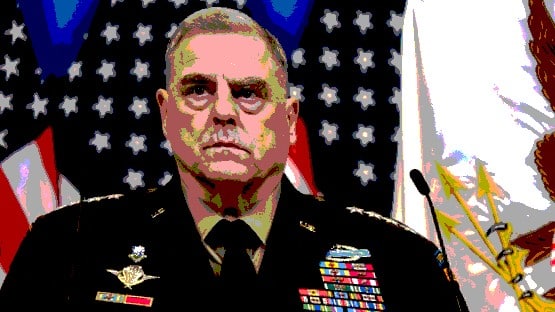
You probably couldn’t have asked for a more thoughtful Chair of the Joint Chiefs than Mark Milley, whose term ends on Sept. 30. He was one of the good guys who repeatedly restrained President Trump from veering into dubious schemes—such as a war of choice with Iran.
But there is also no mistaking that Milley is a general, a military person through and through. From a recent interview in the Princeton Alumni Weekly (Milley graduated from Princeton in 1980):
“Milley and others believe that new technologies such as precision-guided munitions, global positioning systems, artificial intelligence, quantum computing, robotics, and hypersonic weapons are already transforming how militaries are trained, supported, and operate, and that the pace will only accelerate.
‘All these technologies are coming at us very, very quickly,’ Milley argues. ‘And we, the United States, need to be on the front side of that curve. We don’t have to be perfect, but we have to be better than our enemy.’”
In a world of hypersonic missiles tipped with nuclear warheads, what exactly does it mean to be “better than our enemy”?
As Stephen Kinzer argues in an op-ed in the Boston Globe:
“In the coming years, China and its partners will work intensely to strengthen their military power—only to counter American threats, of course. So will the United States and its partners—only to counter Chinese threats. Each side insists that it seeks only to defend itself. Neither believes the other, so both prepare for war. That makes war more likely.
“Because this spiral of mistrust is so common, it has a name: the security dilemma. It tells us that steps one country takes to increase its security often provoke rivals to take countersteps. That leads to competition that makes all parties less secure.”
The security dilemma puts generals, no matter how cautious and intelligent, in an ever more impossible position. Is there any other way out except for military officials in opposing camps to openly acknowledge the issue and begin to talk with one another about how to resolve their nations’ conflicts in ways other than mutual suicide?
Ultimately, the only way to be “better than our enemy” is to think in a new way: to accept that security is interdependent: mine depends on yours and yours depends on mine. And to accept that the way to rethink global security cannot be through technological competition, which will never end except in a general conflagration.
And finally, to turn to the cooperative realization of shared goals: survival and the transformation of energy sources in order to mitigate global climate change. This new way is also an old way: the way of the Golden Rule, an ethic shared by all the world’s major religions.
Of the hundreds of scientists who worked under Dr. Robert Oppenheimer to develop the first atomic bomb, only one ceased his research and left Los Alamos on moral grounds once it became clear that Hitler had been unable to make a weapon. His name was Joseph Rotblat. He is not mentioned in the popular film about Oppenheimer.
Rotblat went on to be instrumental in developing the Pugwash Conference, where scientists meet yearly to engage in a frank exchange of ideas—exactly as the militaries of the world’s superpowers ought to be doing. Rotblat was awarded the Nobel Peace Prize in 1995, a half-century after the first nuclear bombs were dropped on Japan.
There are technologies necessary to confirm that arms control agreements have not been violated. And it remains crucial to further develop technologies that can help stop the illegal transfer of radioactive materials.
But ultimately it is not technological advance, it is only people, like Rotblat or Mikhail Gorbachev, who will enable us to move beyond the security dilemma. I wonder if Mark Milley, ideally along with equivalent military leaders in China or elsewhere, as they lie awake pondering the paradoxes of military force in the nuclear age, will see the flashing “No Exit” sign before it is too late.
There is still time, brother.
Winslow Myers, syndicated by PeaceVoice, is the author of “Living Beyond War: A Citizen’s Guide” and serves on the Advisory Board of the War Prevention Initiative.




 Share
Share