A tiny piece of news out of Florida the other day poked me, you might say, in the rear end. The nation’s prison population — we’re number one! — expanded slightly, as did the concept of crime itself.
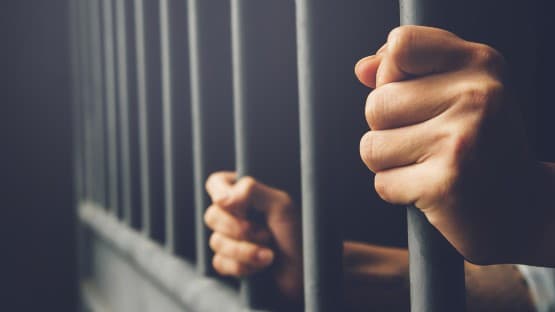
A couple in Daytona Beach, Florida — two police officers — put their 3-year-old son in jail two days in a row, handcuffing him, letting him sit in the cell wailing, because he . . .
Pooped in his pants.
This was how they were conducting potty training. I kid you not. And it worked, according to Dad, who told a social worker looking into the matter that the toddler has promised he won’t do it again — problem solved! The couple apparently faces an investigation for their actions by their department, but remained adamant, according to the Washington Post, that they had done nothing wrong. This is how you get kids to grow up properly. Spare the handcuffs, spoil the child.
Yeah, some shocking nonsense, right? But as I read about the incident, I felt a deep murmur of smug certainty resonating off in the distance somewhere. The couple’s strange attitude felt, shall we say, American — the reduction of life to the simple and linear: right vs. wrong. No psychological, social or spiritual complexity here, folks. Just punish, terrify, and purify.
The reason I’m writing about it isn’t to castigate this particular couple but, rather, to look at the larger context in which their attitude toward parenting fits. Kids in jail aren’t exactly a rare phenomenon. The legal bureaucracy that runs this country is pretty simple-minded. Consider, for instance, the militarization of the nation’s public schools, via the placement of school resource officers — cops — in the hallways, walking around, looking for trouble, keeping order.
The nation’s schools are “over-criminalized and under-resourced,” according to a report in Chicago Policy Review, which points out that U.S. schools “overwhelmingly have more police on hand than support staff to deal with students’ behavior issues.” This means, as of a few years ago, according to ACLU statistics, that some three million students attend schools that have police officers but no nurses; 1.7 million students attend schools with police but no counselors. The stats go on and on. Ten million students have no social workers at their school, but they have, you guessed it, police.
And this, of course, means that “disciplining” students often amounts to arresting them, not looking with any depth of understanding into their behavior. As far as I’m concerned, this national attitude is precisely as stupid and simplistic as that shown by the police parents who tossed their 3-year-old into jail for going in his pants rather than the toilet. The attitude that makes such an educational structure possible is totally reductionist: Children who misbehave must be punished. It’s called tit for tat. There is no other option. And it goes on their permanent record. Any questions?
If there are consequences for the arrested child in later life, that’s something for the future to worry about. And black kids are more likely to be arrested than white kids? Go ahead and complain if you want — call it racism — it’s not our concern.
And then there’s this basic fact. Police have far less basic training for what they do than teachers, counselors, psychologists — people whose work actually penetrates the complexity of human life. I say this not to disparage policing, but to note the disrespect with which the legal system itself holds police work. In point of fact, maintaining order requires more than a badge, a gun and a pair of handcuffs. It requires both a depth of human understanding and access to options other than arrest and jail cells.
When a child — when anyone — is arrested, he or she is instantly shoved into isolation, separated from the rest of the community. He’s disconnected from the rest of the world. Indeed, the American prison structure seems to be completely focused on the maintenance of criminal isolation, perhaps for the arrestee’s entire life, which guarantees our society an ongoing presence of domestic enemies.
In contrast, as Fania Davis wrote in Yes! Magazine: “a student’s sense of belonging to a high school community is a top protective factor against violence and incarceration.”
Davis, a civil rights attorney, is co-founder of an organization called Restorative Justice for Oakland (California) Youth. And her essay in Yes! told the story of a local school conflict — a 14-year-old boy, chastised for falling asleep at this desk, began cursing at his teacher, took a swing at a counselor who intervened, and could easily… oh, so easily . . . have been expelled, arrested, tossed into the social trash bin.
What happened instead, however, was the opposite of that. And no, it didn’t happen with the immediacy of a police intervention. The school had a Restorative Justice coordinator, a process I’ve been writing about for years and believe in with the fullness of my being. It’s not about punishment. It’s about healing. And it’s a long, deeply complex process, involving all concerned — those who caused harm, those who were affected by it — speaking their truth and listening to one another from the heart.
The Restorative Justice coordinator managed to calm the boy down enough so that, as they walked into the coordinator’s office, he told the story of his day, which involved a missing, drug-addicted mother and two younger siblings for whom he prepared breakfast. Eventually, those involved in the brouhaha — including the teacher, the principal and the boy’s mother (eventually tracked down by the coordinator) — sat together in a peace circle, told their stories in full detail and listened to one another.
This was, of course, a lengthy process, requiring an enormous effort by the Restorative Justice coordinator, but what flowed out of it was awe and understanding. As Davis wrote, the principal later exclaimed: “We were about to put this kid out of school, when what he really deserved was a medal.”
This is called “a feeling of belonging.” And the feeling involves all concerned.
Robert Koehler ([email protected]), syndicated by PeaceVoice, is a Chicago award-winning journalist and editor. He is the author of Courage Grows Strong at the Wound.


 Share
Share