Faculty members at the Virginia-Maryland College of Veterinary Medicine at Virginia Tech have produced the first textbook specifically about veterinary medical education.
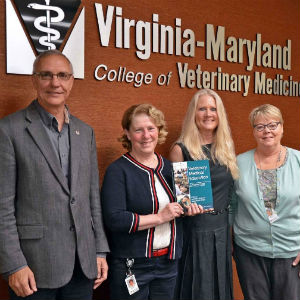
Jennifer Hodgson, associate dean for professional programs, and Jacquelyn Pelzer, director of admissions and student services, served as editors of “Veterinary Medical Education: A Practical Guide,” published by Wiley Blackwell. Other faculty members at the college also contributed to the work.
“When we decided to work on this project, there were already quite a few textbooks on medical education, but none specifically about veterinary medical education,” said Hodgson, who is also a professor in the Department of Population Health Sciences.
“While we do use medical education textbooks in our work and medical education and veterinary medical education have many similarities, we realized we needed a textbook which would highlight some of the differences and challenges faced by our profession.”
The textbook offers a comprehensive resource for veterinary medical educators across the globe and takes a practical, real-world approach for teaching veterinary skills and knowledge. It comprises 38 chapters written by 64 authors from eight countries.
“We wanted the textbook to have a global perspective,” said Pelzer, who is also an associate professor in the Department of Population Health Sciences and who completed a graduate certificate in veterinary medical education from the University of London’s Royal Veterinary College. “We have hopes that veterinary colleges in both developed and developing countries will be able to refer to it for ways to handle their curriculum and get a sense of what other colleges are doing.”
The publication of “Veterinary Medical Education” coincides with the completion of the veterinary college’s first year in a new doctor of veterinary medicine curriculum. Last August, the college began implementing a new curriculum that integrates the basic and clinical sciences into new courses based on function, incorporates team-based learning, allows early entry into the clinics, and introduces pass/fail grading. Current and former students, practitioners, veterinary medical association representatives, and other key stakeholders played a critical role in developing the new curriculum to prepare students for the opportunities and challenges of 21st-century veterinary medicine.
The 626-page textbook is organized into sections, including The Curriculum, Learning and Teaching Strategies, Learning Opportunities, Assessing the Student, Assessing the Program, Teaching and Assessing Professional Competencies, The Educational Environment, and Future Directions. Throughout the book, the authors placed boxes with corresponding icons to highlight main points, draw attention to the application of a tool or process, offer supporting evidence or details about a specific topic, reflect on a chapter, familiarize the reader with educational terminology or concepts, and describe concepts and theories.
Hodgson served as co-author of the first chapter on “Curricular Design, Review, and Reform,” while Pelzer served as co-author on a chapter on “Student Selection.” Karen Inzana, director of assessment and professor of neurology in the Department of Small Animal Clinical Sciences, penned a chapter on “Curriculum Mapping.”
Hodgson and Cyril Clarke, dean of the veterinary college, co-authored the final chapter on “Veterinary Medical Education: Envisioning the Future,” which covers the parallels between veterinary medical education and medical education, crosscutting themes like One Health and global reach, the high expectations for clinical competence, and the integration of experiential and collaborative learning in the veterinary curriculum.


 Share
Share

AFP