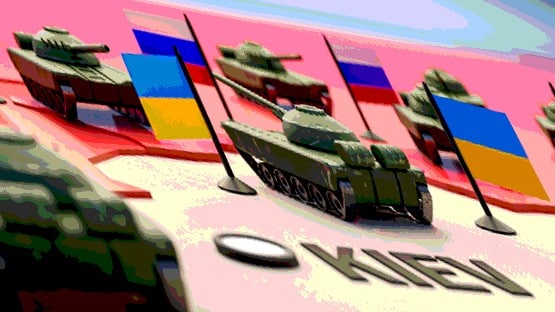
Freedom’s just another word for . . . blowing up your children? Giving them cancer?
Militarism is obsolete, for God’s sake. Its technology is out of control. The latest shred of news that has left me stunned and terror-stricken is this, as reported by Reuters: “The Biden administration will for the first time send controversial armor-piercing munitions containing depleted uranium to Ukraine. . . . It follows an earlier decision by the Biden administration to provide cluster munitions to Ukraine, despite concerns over the dangers such weapons pose to civilians.”
Russia’s war on Ukraine is a disaster at every level. Some 70,000 Ukrainians have died, according to the New York Times, and possibly another 120,000 have been wounded, with Russia’s casualty level actually far higher.
The war (like all wars) has to stop, but NATO and the U.S., just like Russia itself, are looking not for peace and conflict resolution but victory. Killing the enemy is what matters, the more the better.
War is humanity’s most horrific addiction. When it takes hold of a people’s soul, all environmental and human concerns vanish. And today – indeed, throughout the course of my lifetime – with the development of nuclear weapons, we’ve been at the brink of self-generated extinction. And we’re still playing with it, rather than trying to move beyond it.
Depleted uranium – DU – is one of the playthings of war: At 1.6 times the density of lead, DU shells are the last word in penetration power: locomotives compressed to the size of bullets. The shells ignite the instant they’re fired and explode on impact.
I first started writing about depleted uranium in 2003, when I heard Doug Rokke (who died two and a half years ago) speak in Chicago. Doug, a career soldier, was involved in the first Gulf War, leading a team of soldiers whose job was to clean up the war zones in the aftermath of our bombing raids.
As I wrote then:
Depleted uranium “isn’t really depleted of anything. It’s dirty: U-238, the low-level radioactive byproduct of the uranium enrichment process. And when the ammo explodes, poof, it vaporizes into particles so fine — a single micron in diameter, small enough to fit inside red blood cells — that, well, ‘conventional gas mask filters are like a barn door.’
“. . .What’s not to love, if you’re the Pentagon? We pounded Saddam’s army with DU ammo in Gulf War 1 and destroyed it on the ground. Maybe you’ve seen pictures of what we did to it; GIs cleaning up afterward coined the term ‘crispy critters’ to describe the fried corpses they found inside Iraqi tanks and trucks.”
But the horror of DU is what happens after the battles are over. DU stays in the environment, and has been linked to huge rises in cancer and birth defects in the conflict zones. As Doug Rokke said: “You can’t clean it up.”
But so what? According to Sydney Young, writing for the Harvard International Review:
“In the past, leaders did not pay the necessary amount of attention to the risks of depleted uranium. Documents suggest that the United States may have known about the potential consequences of depleted uranium during conflicts in which it was used. The International Atomic Energy Agency (IAEA) published a 1991 report indicating that deploying depleted uranium in the Gulf War could have caused 500,000 cancer deaths.
“However, the United States still used depleted uranium in the Middle East despite the risks, deeming that its military benefits outweighed the potential civilian impact. This calculus reflects a common trend in which western countries justify human rights abuses under the guise of ‘national interest’ or military necessity.”
Another tactic of the political militarists is to deny there’s any negative consequences to their actions. Young also notes:
“Research also faces political barriers. Governments that use depleted uranium have a vested interest in preventing research that suggests it has negative effects on human health. For instance, the United States, United Kingdom, Israel, and France all opposed a 2001 United Nations resolution to document depleted uranium in war.”
There’s a collective human addiction not simply to militarism and war, but to winning: to domination. A focus on winning in the moment obliterates any sense of the larger future. The creation of peace is not a simplistic game. It has no weapons to parade before the public, whose use will obliterate the enemy of the moment and make the world a better place once and for all.
Noting the horrific extent to which the Ukraine war has stalemated, Jeet Heer writes at The Nation: “The time is surely ripe for a diplomatic push. Unfortunately, the passions ignited by war always make negotiations difficult” . . . and, alas “a strong ‘taboo’ against public discussion of diplomacy pervades the NATO countries.”
This is understandable, he notes, considering the criminality of the Russian invasion and the horror it has inflicted on Ukraine: “But an interminable bloodbath on Ukrainian soil is also horrific.”
Humanity has to figure out how to talk to itself, not kill itself.
Robert Koehler ([email protected]), syndicated by PeaceVoice, is a Chicago award-winning journalist and editor. He is the author of Courage Grows Strong at the Wound.

 Share
Share