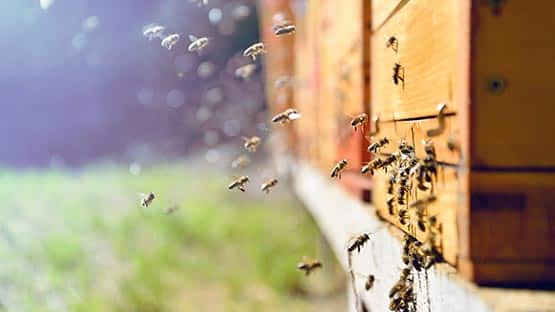
I was reading about bumble bees recently — specifically, their looming demise, thanks to human greed and ignorance — and started thinking about the Tree of the Knowledge of Good and Evil. We should have eaten from it!
Well, we did, but then apparently upchucked everything we learned and, in the process, fooled ourselves into thinking that technology has allowed us to recreate the Garden of Eden from which we’d been banned. You might call it the Garden of Capitalism, in which humans can take what they want without consequences, forever and ever and ever. This seems to be the myth at the core of dominant global culture.
But of course there are consequences, which we officially refuse to let ourselves see. For instance, Amy van Saun, an attorney for the nonprofit Center for Food Safety, writing about the shocking disappearance of bees and other pollinators of much of the food we eat (fruit, vegetables, nuts), notes that one of the primary causes is the ever-increasing use of pesticides, in particular, something called neonicotinoids (or “neonics”), which wreak their own special hell on the planet’s ecosystems.
Neonicotinoids “are the most widely used insecticides in the world,” she writes:
“Unlike traditional pesticides, which are typically applied to plant surfaces, neonics . . . are absorbed and transported through all parts of the plant tissue.
“. . . Modeled after nicotine, neonicotinoids interfere with insects’ nervous systems, causing tremors, paralysis, and eventually, death. Neonicotinoids are so toxic that one corn seed treated with them contains enough insecticide to kill over 80,000 honey bees.”
And, like cluster bombs, land mines, Agent Orange, depleted uranium, “they persist in the environment,” almost as though — forgive the analogy — commercial farming is like an ongoing war on nature.
If neonics are so dangerous, what is the Environmental Protection Agency doing about it? Not very much, as it turns out, despite scientific evidence of its danger, which is why Center for Food Safety, along with the Pesticide Action Network North America, are suing the agency. As van Saun writes, “almost half of all U.S. farmland is planted with pesticide-coated seeds,” but the agency refuses to regulate them.
The result, according to a U.N. report, is that cropland is approximately 50 times more toxic than it was a quarter of a century ago, at the beginning of the 21st century, and the world is currently experiencing an “insect apocalypse.”
And indeed, it begins to appear that the EPA has a mission that transcends “environmental protection.” It may well be that this agency — part of a governmental culture that supports and benefits from wealth and war — has a mission that is more about official denial of the dangers of planetary exploitation. The EPA’s refusal to acknowledge the damage caused by neonics is just a small part of it.
“Critics accuse the EPA of being inappropriately cozy with the pesticide industry, and biasing its decisions to favor companies selling pesticides,” the Guardian writes. “Several EPA scientists came forward last year, publicly alleging that EPA management routinely pressures EPA scientists to tamper with risk assessments of chemicals in ways that downplayed the harm the chemicals could pose. . . .
“The scientists complained, among other things, that key managers move back and forth between industry jobs and positions at the EPA.”
This is when I started hearing an alarm go off in my head: Cultural malfunction alert! Cultural malfunction alert! This is what things look like when exploitation prevails: when grabbing all the goodies you can is at the cultural core, rather than something a bit more complex, such as understanding — and revering — the eco-reality (also known as nature) in which we live.
And beyond that, can we not create a culture that faces the paradoxes of life with a certain level of openness and a continued interest in learning? Life is not something to be reduced to simplistic opposites: win vs. lose, good vs. evil. There is darkness within all of us, but we can’t let it determine our fate or shape our understanding of the world. Yet I fear this is the nature of “modern,” as opposed to indigenous, culture.
Humanity, over the past few millennia, has moved its sense of reverence away from Mother Earth and essentially to Father Sky, rather than continuing to revere both. As a result, Mother Earth is ours to do with as we choose.
The opposite viewpoint — apparently the indigenous viewpoint, which European land-grabbers called “savage” — isn’t quite so simple. The natural world, while rife with struggle, can’t be reduced to “survival of the fittest.” Rather, it exists in a state of complex cooperation among all concerned — plants, animals — and evolves via the interdependence of all life.
As Rupert Ross wrote in his remarkable book about indigenous culture, Returning to the Teachings: “The Lakotah had no language for insulting other orders of existence: pest . . . waste . . .weed.”
Back to pesticides then. Back to weed killers. Back to climate change and the apparent inability of the polluters who purport to be in charge of Planet Earth to address it adequately: Superficial change won’t do it. The change has to be cultural. It has to be spiritual.
Believe me, if we fail to change who we are and the bees — the pollinators — disappear, we’ll all feel the sting.
Robert Koehler ([email protected]), syndicated by PeaceVoice, is a Chicago award-winning journalist and editor. He is the author of Courage Grows Strong at the Wound.


 Share