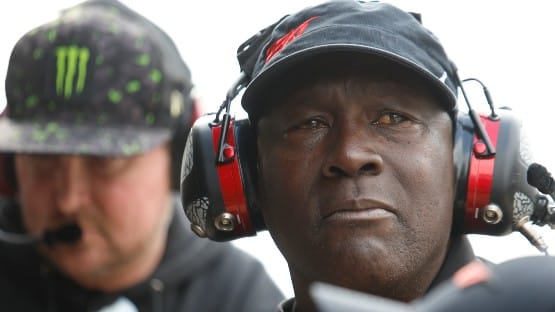
Former NBA superstar Michael Jordan took the stand Friday in the federal antitrust trial against NASCAR, highlighting a day of testimony that examined team profitability and the stability of the sport’s charter system.
Jordan, majority owner of 23XI Racing, testified before a packed courtroom in the Western District of North Carolina. 23XI Racing and Front Row Motorsports are suing the sanctioning body after declining to sign the 2025 Cup Series charter agreement.
“I take it Mr. Jordan is the next witness,” U.S. District Judge Kenneth D. Bell said. “Anyone who’s not already in the courtroom will not be permitted.”
Under questioning by attorney Danielle Williams, Jordan outlined the four primary concessions race teams sought during negotiations for the 2025 agreement:
- A larger share of NASCAR revenue.
- Governance voting power regarding specific cost increases.
- Permanent charters.
- A one-third share of new business.
Thirteen of the 15 Cup Series teams signed the agreement, which did not include those provisions. 23XI and Front Row Motorsports are suing for damages under the terms of the 2016 agreement.
While Jordan jokingly acknowledged his basketball past – telling the court he “used to be” pretty good – he admitted he does not manage the day-to-day operations of the race team. However, he told the court he was well-versed in the issues that led to the lawsuit.
During cross-examination by NASCAR attorney Lawrence E. Buterman, Jordan acknowledged that 23XI Racing has been profitable, outperforming initial projections.
Jordan said he relied on financial adviser Curtis Polk when deciding to launch the team with NASCAR driver Denny Hamlin. While Hamlin’s initial proposal projected a modest profit of $900,000 per year, the company netted more than $2 million in 2022 and more than $3.5 million in 2023.
Jordan also admitted he had not read the 2016 or 2025 charter agreements in their entirety. He confirmed that he had previously praised the system, once telling NASCAR Chairman and CEO Jim France that the France family “did a great service to the sport by starting the charter system.”
When asked if the charter system provided value to teams by attracting sponsors and investors, Jordan agreed.
Earlier Friday, Joe Gibbs Racing co-owner Heather Gibbs testified in favor of permanent charters. She described them as a “vital” safety net for organizations like JGR, which she noted has no outside revenue sources.
“I think they’re absolutely vital to the teams,” said Gibbs, whose husband, Coy Gibbs, died in November 2022.
NASCAR President Steve O’Donnell later testified to explain the sanctioning body’s opposition to permanent charters.
O’Donnell cited the need for flexibility regarding uncertain revenue streams, broadcast rights, and racing schedules.
The session concluded with testimony from John Marshall, executive director of the Race Team Alliance (RTA).
Marshall acknowledged that the RTA had trademarked the name “U.S. Racing League,” but said the organization had not actively pursued a rival series.
Under cross-examination, Marshall conceded that NASCAR differs from major “stick-and-ball” sports leagues, where teams own the league, and entry fees are significantly higher.
Marshall’s cross-examination is scheduled to continue when the trial resumes Monday.
Friday was considered to be the halfway point of the anticipated 10-day/two-week trial.


 Share
Share