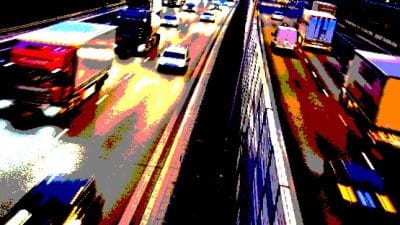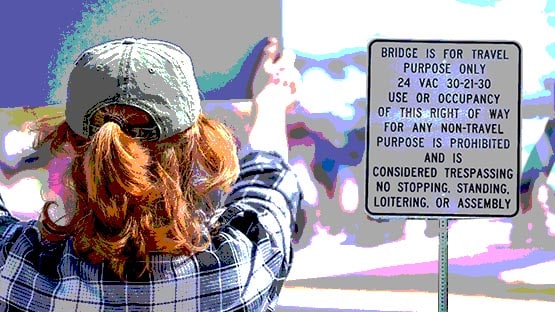
Bridge activists have become a regular sight on interstates and main roads throughout Virginia and the nation as a way to peacefully protest the current administration, immigration enforcement and other pressing issues.
In recent months, signs have been prevalent on bridge overpasses on Interstate 64 and 81 with messages including “No ICE,” “Free Palestine,” “Tax/Eat the Rich,” “Free DC” and “F*ck Fascism.”
The activism has garnered the attention of the Virginia Department of Transportation, which has begun to erect signs prohibiting any kind of assembly or loitering on the interstate bridges.
It is unknown exactly how many of these signs have been installed, we’re waiting on that information, but AFP is aware of at least one placed on a bridge over I-81 in Woodstock.
The sign reads in part that the “bridge is for travel purpose only” and “any non-travel purpose is prohibited and is considered trespassing. No stopping, standing, loitering or assembly.”
The sign in Shenandoah County was placed at one bridge “in response to safety concerns,” according to Jessica Cowardin, VDOT’s assistant director of communications. “The sign relays that bridges and right-of-way are for travel purposes only.”
Some have been questioning online if the move to threaten the bridge activists could be politically motivated in a state with a Republican MAGA governor at the helm.
VDOT said the “sole reason” for the sign is to protect pedestrians and motorists.
“VDOT installed these signs for the sole purpose of public safety,” Cowardin said. “Signs and banners placed or waved over bridge railings directly over traffic pose a safety hazard to travelers should these items fall onto the roadway or create a distraction to drivers.
“Additionally, the limited separation between groups of people on the bridge and adjacent traffic results in an increased risk of safety for both pedestrians and motorists.
“In several cases, pedestrians have stood in or stepped out into the roadway, creating significant safety concerns,” she said.
The latter argument, of pointing the finger at the unsafe actions of the protestors, is a tactic used by police to close off streets around a rally, as one example. In Staunton, police shut down the streets around a courthouse at a “No Kings” rally after an incident weeks before where a driver claimed a protestor had banged their hand on his truck, though there was no video evidence to prove that. Instead, the claim was made to justify his actions, blowing smoke, or rolling coal, as it is called, and screeching his tires creating a potentially dangerous situation for hundreds of people on sidewalks nearby.
ICYMI
- Staunton judge dismisses reckless-driving charge against local towing company owner
- Staunton PD officer warned Armentrout about ‘spinning tires’ before letting him walk
- Protestors gather across the street from Augusta Health to protest Medicaid cuts
- Glenn Youngkin has called out the National Guard for Saturday No Kings Day protests
- Staunton Police arrest, then quickly release, man who shouted death threats at protest
Back to bridges, the tactic of holding signs at overpasses is nothing new with its roots dating back to civil rights movements. The goal is usually to capture the attention of travelers as well as the media to draw attention to a cause.
Banner protests have been used throughout history including the mass dump of “Build Bridges Not Walls” banners on iconic bridges across the world during Donald Trump’s first term as president.
Virginia Governor Glenn Youngkin seemingly followed Donald Trump’s playbook calling out the National Guard to “No Kings Day” protests held statewide in June – likely under the guise of safety but more likely to intimidate protestors and depress turnout.
The move to erect the signs for the “sole purpose of safety” reeks of the same motivation.
In Virginia, a trespassing charge is a Class 1 misdemeanor for entering or remaining on property when forbidden to do so by signs. Penalties can include a fine up to $2,500 and up to one year in jail.
NOTE: AFP has requested more information from VDOT including the number of these signs installed at bridge overpasses since November, as well as how many were installed before the presidential election. We’ve also requested more information on whether these signs were placed at the request of another party other than VDOT.



 Share
Share

Crystal Graham