
A few weeks ago, I started asking questions about the Flock Safety license plate cameras that appeared in the Town of Elkton. Nobody seemed to want to answer them.
Along with another Elkton resident, Tyler Lam, I filed public records requests under the Virginia Freedom of Information Act.
The town initially denied the request, then acknowledged the documents existed.
When they finally provided an itemized fee estimate to produce the records, they charged me $30 more than they charged the other resident — same attorney, same hours, same day — later citing a “typographic error” that only materialized after I formally challenged it in writing and notified the Virginia FOIA Advisory Council.
We pushed back. And eventually the records came out.
All 353 pages of them.
The authorization chain
The town manager in Elkton, Greg Lunsford, signed a $23,300 surveillance contract with Flock Group Inc. on Nov. 12, 2024. No Town Council vote. No public notice. No purchase order. The PO field on the contract literally says “NA.”
The contract was initiated by Cpl. Ryan Insana, who had been in contact with Flock’s sales team since February 2023. By the time the contract was finalized, he had been promoted to sergeant.
During that period, he applied for Virginia State Police HEAT program grant funding — drawn from Virginia car insurance premiums, not a Town Council appropriation — to pay for the cameras.
The FY2025 HEAT application requested the maximum $12,500. The contract’s Year 1 price was $12,300. That match is not a coincidence. The entire package was priced specifically to fall within the HEAT reimbursement cap.
About the Author
- Zach Caudle is a resident of Elkton, and a cloud and network engineer. Contact: [email protected].
When the grant came through for the full $12,500, Sgt. Insana forwarded the Flock sales pitch to Lunsford with this exact note:
“Here is some reading on the products that we are looking at, just I anyone is ever to ask about it.”
Lunsford replied, “Thanks Ryan!” – and signed the contract 35 days later.
That is the authorization chain for a $23,300 surveillance contract in a Virginia town. Not a Town Council vote. Not a public meeting. A sergeant briefing the town manager privately so he’d have something to say if anyone asked questions.
On the day he signed, Lunsford emailed Flock Safety to confirm:
“I just want to confirm that we will be billed $12,300 now and the follow-up $11,000 annual recurring costs will be billed a year from now?”
Lunsford knew on signing day that this was a multi-year financial commitment totaling at least $23,300 — with auto-renewal extending it further. When he sent the signed contract to Flock at 4:07 p.m. that same day, he CC’d Donna Curry, the town treasurer, alongs with the police chief, Mike King, and Sgt. Insana.
The $11,000 annual recurring cost was known to town finance from the moment the contract was executed.
The town attorney flagged concerns
The documents reveal that Elkton’s own attorney reviewed this contract before it was signed and flagged items requiring additional clarity.
A Flock Safety email to Chief King and Sgt. Insana on Oct. 25, 2024, references “the items your attorney flagged for additional clarity,” and notes that Flock’s legal team was reviewing and responding.
The town had legal counsel examine this contract. Issues were identified. It still proceeded — without a council vote and without public disclosure.
The cemetery that wasn’t
The justification Sgt. Insana gave to the Flock sales representative for purchasing the Condor PTZ camera — the one that streams live video and can pan, tilt and zoom remotely — was vandalism at the local cemetery.
That camera is mounted on Goodfellas Pizzeria’s sign on Route 340.
It is not near any cemetery.
This matters beyond the obvious contradiction. The HEAT program explicitly requires that funds be used to combat vehicle theft and vehicle parts theft. Sgt. Insana’s grant applications cite stolen vehicles, stolen license plates, and hit and run investigations — consistent with HEAT’s requirements. Yet his own emails to Flock’s sales representative document the Condor was justified internally by cemetery vandalism, not vehicle theft.
Cemetery vandalism does not qualify for HEAT funding.
The entire $12,300 package — including the Condor — was funded by that grant.
Virginia State Police may want to examine whether this was an appropriate use of those funds.
The VDOT workaround — documented by Flock in writing
All three cameras are on private business property along Routes 33 and 340. This was not a coincidence or a preference. It was a deliberate documented strategy.
Flock Safety’s own Oct. 18, 2024, strategy email to Chief King and Sgt. Insana states explicitly:
“As we discussed, 33 and 340 are VDOT right of ways so depending on what your contact over there comes back with, we will likely need to try to find private property off the right of way.”
The Virginia General Assembly has rejected expanding ALPR authority to state highway rights-of-way for four consecutive years. Rather than seeking that authorization, Flock Safety and Elkton PD documented a strategy to place cameras on private property directly adjacent to the same roads — same surveillance coverage, zero legislative oversight, no VDOT permit required.
Chief King was not a passive observer of this strategy. On Nov. 4, 2024, King emailed Flock directly:
“I think Friday of this week is our best bet and will give us time to contact the business owners.”
The police chief was personally coordinating the recruitment of private businesses to host surveillance cameras, using the same private property workaround that Flock’s sales team had explicitly documented to avoid VDOT requirements.
A statutory violation
Chief King did not adopt a written ALPR usage policy until Jan. 2, 2026 — 14 months after the cameras were already running, and at least six months after Virginia law required one.
Virginia Code § 2.2-5517(H), which took effect July 1, 2025, requires every agency operating these cameras to maintain a written governing policy. Chief King violated that statute by operating the system without one for at least six months after it became law.
What the data shows
According to Flock Safety’s own transparency portal for Elkton, in the last 30 days, the cameras logged 55,031 unique vehicles. Of those, 76 triggered a hotlist hit. Officers conducted three searches total. That is a 0.14% hit rate. Which means, 99.86% of the vehicles logged had no law enforcement relevance whatsoever.
Every one of those innocent people’s movements was captured, uploaded to Flock’s private servers in Atlanta, and made available to thousands of law enforcement agencies across the country — including, in other Virginia localities, federal immigration authorities.
The contract says so explicitly. It is a named, sold feature.
The town spent $23,300 of public money, connected every person who drives through Elkton to a nationwide surveillance network, violated state law, bypassed the Town Council, and had the town attorney flag concerns that were never disclosed to the public — and officers searched the database three times in 30 days.
Town Council’s response
After I notified the full Town Council and formally requested an emergency session, I received a response from Council Member Rachel Michael, who sits on the Personnel and Public Safety Committee.
She wrote that the contract was funded by the HEAT grant and therefore did not require Council approval, that the “just in case anyone asks” email “can be interpreted many different ways,” and that “at this time this is still a legal program in place.”
With respect to Council Member Michael, the documents tell a different story.
On the threshold question: Lunsford confirmed in writing on signing day that the total commitment was $12,300 now plus $11,000 annually — a minimum of $23,300 over two years, with auto-renewal. Whether that total falls below Elkton’s procurement threshold is a question the Council has not publicly answered. It is a question they should answer on the record.
On the email: Flock Safety’s own documentation confirms that Routes 33 and 340 are VDOT rights-of-way and that private property was specifically sought to avoid that permitting requirement. Chief King’s own email confirms he was personally coordinating the business owner contacts. These documents do not require interpretation.
On legality: Chief King operated this system for at least six months in violation of Va. Code § 2.2-5517(H). A program operated in violation of state statute is not simply “a legal program in place.”
Council Member Michael also noted that public comment at council meetings cannot call out specific personnel. That restriction, applied to a matter of documented public concern involving named appointed officials acting in their official capacity, is worth examining.
Virginia courts have repeatedly held that overly restrictive public comment policies raise serious First Amendment concerns.
One camera is already coming down
Within 24 hours of this story becoming public, Allen Yoho Electric — one of the three private businesses hosting a Flock camera — publicly announced on Facebook that they had notified the Town of Elkton they want the camera removed from their property.
A private business pulled consent. That camera has to come down. Two remain.
The surveillance doesn’t stop in Elkton
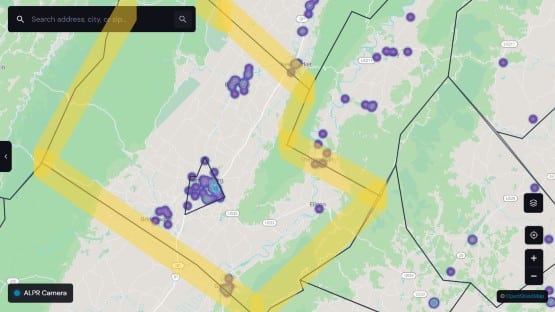
Using DeFlock.me — a crowdsourced national ALPR camera mapping project — I identified and personally photographed eight cameras across two counties. I found four cameras operated by Shenandoah PD in the Town of Shenandoah. I found cameras operated by Luray PD in Luray. I found cameras in Stanley. A Page County Sheriff’s Office lieutenant confirmed to me that every town in Page County operates its own cameras through their respective police departments, and that PCSO itself operates an additional three to four cameras in unincorporated areas of the county.
Back in Rockingham County, I identified 53 Flock Safety cameras concentrated at the entry and exit points of every major municipality — Broadway, Harrisonburg, Bridgewater, Grottoes and Elkton. A map of those camera locations shows clusters at every corner of the county.
You are not tracked while driving rural roads between towns. But virtually every errand, every commute, every trip to a doctor, school, or grocery store requires passing through one of these towns — and every one of those passages is logged, uploaded to Flock’s servers in Atlanta, and made available to law enforcement agencies across the country with no warrant required. And that’s before considering that the same network extends into neighboring counties, neighboring states, and 6,000 communities nationwide.
Transparency that isn’t
Virginia Code § 2.2-5517(K) requires every agency operating an ALPR system to publicly post their usage policy and annual report. I searched the websites of Shenandoah PD and Luray PD. I found no transparency portal, no annual report, and no publicly posted ALPR policy for either department. I emailed the chief of police for the Town of Shenandoah directly. As of publication, I have received no response.
If Chief King’s violation in Elkton was operating without a policy for six months after the law required one, the same question now applies across the Page County towns operating Flock systems — and potentially to every one of the 28-plus Virginia localities the Virginia Center for Investigative Journalism has documented as operating Flock systems statewide.
What happens next
I have formally requested that the Personnel and Public Safety Committee review the conduct of Town Manager Lunsford and Chief King. I have requested an emergency council session to vote on ratification or termination of the contract. Two council members have already responded.
One agreed with me, the other sent a response outlined above.
I will be filing a FOIA request with the Page County Sheriff’s Office for their procurement records and to confirm whether this was ever presented to the Page County Board of Supervisors.
My original community post documenting these findings reached 634 reactions, 317 comments, and 223 shares before an administrator deleted it from a local Facebook group — on the same night Allen Yoho Electric pulled consent for their camera.
I do not know who deleted it or whether they are connected to town officials.
If the Elkton Town Council does not act, I will be calling on them to exercise their authority over the positions of town manager and chief of police. That is not a threat. It is my right as a resident of this town, and I intend to use it.
The cameras need to come down. The contracts need to go before the elected bodies that represent the people who live under them. And the residents of Elkton, Shenandoah, Luray, Stanley, Broadway, Bridgewater, Grottoes, Harrisonburg — and every other Virginia community where this is happening without public knowledge or consent — deserve to know what was done in their name.
Every page of the Elkton documents is a public record. If you want to see them, contact me.
Freedom from surveillance.


 Share
Share