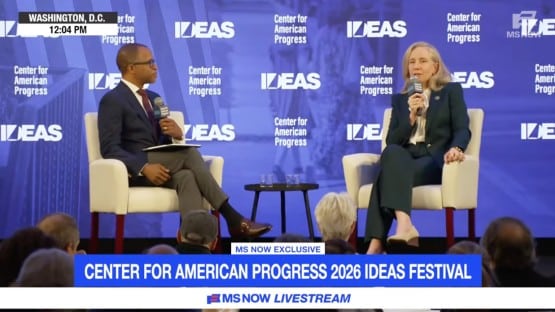
Let’s say you’re Abigail Spanberger, and your approval numbers are already circling the toilet, but you still have some folks on your side.
What could you do to maybe strip it down to the studs?
Here’s an idea: come out, strong, in support of … data centers!
“Voters,” Spanberger said, taking the softball on data centers from MS NOW’s Jonathan Capehart at Tuesday’s Center for American Progress IDEAS Conference, and fouling it off her kneecap, “may not necessarily want a data center, but they certainly want the iPhone with the data on it in their pocket, which I say not to be kind of sassy and disrespectful, but because it’s actually true.
“And so, sometimes, the conversation has to be, if you like ordering things online or watching movies or storing your photos in the cloud, like, that’s, data centers are behind that and are essential to it. Data centers are a driver, in many ways, of Virginia’s economy,” Spanberger said.
Take your medicine, basically.

You want to look at your phones all day, well, you’re going to have to drink some of that dirty water that AOC had in the bottle as a visual at a congressional hearing on data centers on Thursday.
The dirty water is one of the reasons why data centers are polling in the vicinity of the popularity of hantavirus and ebola at the moment, but then, Spanberger doesn’t have to worry about polls.
Governors in Virginia can’t run for re-election, and Spanberger, just 46, doesn’t appear to be interested in a career in politics beyond her four-year term.
I say that based on, well, I mean, you see it – the veto of collective bargaining legislation, and the move to water down paid family and medical leave legislation that she at least did eventually sign into law.
ICYMI
If you’re out there actively pissing off the people who got you your job, you’ve decided that you don’t want to do this long term.
I’m just guessing here, but it looks to me that she’s setting herself up to cash in after her term as a center-right pro-business political lobbyist – which, I mean, can’t really criticize her there; she’s got three kids’ college tuitions to pay for before too long.
I would advise, maybe, being a little less sanctimonious about the data center thing, considering.

Us regular folks aren’t going to be able to make six or seven figures a year hustling for Data Centers USA LLC, so when our electric bills are even more through the roof than we’re paying today, we’re going to have to figure out how to make do with even less than we have in the bank account.
“Across the Commonwealth of Virginia, the taxes that data centers pay into local economies are substantial and essential to the ability to provide basic local services, funding schools and first responders,” Spanberger tried to get away with saying at the IDEAS Conference thing.
Even though we know that data center developers have made an art of leveraging their political contributions to negotiate local property tax abatements and state-level sales tax exemptions.
I shouldn’t be critical there, either – they’re just playing the system by the rules that are in place.
Don’t hate the player, hate the game, and somesuch.
Here’s how Spanberger sees her job, relative to data centers:
“Virginia, as a place that many data centers want to come, has a lot of ability to say what we expect in terms of the requirement that they pay their own share when it comes to energy utilization, everything from the setbacks to the types of greenery that they put around their locations, and, from a gubernatorial standpoint, being able to provide support to localities that really might not know what to ask for in those types of negotiations.
“But what I have incoming to my office so significantly is a lot of localities, because, yes, many of them went to Loudoun first, but it is a lot of smaller, more rural localities that really want to bring the investment and the support that they bring.
“I balance it by saying, yes, there’s real challenges, but in fact, there’s significant benefits, and it’s about what local economies need. Now, I think localities should always have the final say, so, I, as governor, would never force any particular type of industry or investment into a locality that doesn’t want it. But I think that it is wrong for the state to preclude localities that do want to welcome data centers from being able to do so.”
TL;DR: if we can get them to agree to put a few shrubs on the perimeter of their campuses, they can have whatever else they want.


 Share
Share

Chris Graham