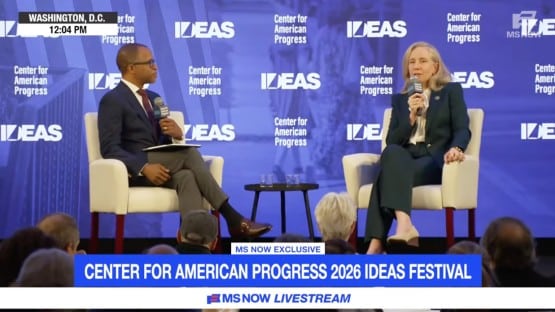
MS NOW anchor Jonathan Capehart gave Gov. Abigail Spanberger a chance at a Tuesday conference to address her veto of public-sector collective bargaining legislation, which her critics in the labor movement have called a “betrayal.”
Her response: “I would defer to them to answer that question.”
So, it’s up to Spanberger’s critics to answer why they think the governor betrayed them, not up to her to explain why she thinks she didn’t, is what she’s saying?
That’s some ivory tower that she’s living in there.
ICYMI
- ‘Shameful’: Spanberger signals upcoming veto for collective bargaining legislation
- Spanberger vetoes collective bargaining: Who does she think she’s fooling?
Spanberger had already tried to deflect Capehart’s line of questions on collective bargaining by talking up her signature on a bill to raise the minimum wage and the measure that she watered down that will create paid family and medical leave.
Scorecard: she took credit for heavy lifting done by Democrats in the General Assembly on the minimum wage, and for undoing important work that they had done on PFML.
Awesome.
She started on the topic at the 2026 Center for American Progress IDEAS Conference, by saying, with a straight face:
“I continue to support public-sector collective bargaining.”
Which is an odd thing for somebody who literally killed public-sector collective bargaining in Virginia for the next four years, and likely longer, if not forever, to say, but, let’s roll with her here.
The legislation that she vetoed would have expanded collective bargaining rights for public employees – including teachers, firefighters, home care workers, state workers, county workers, city workers, higher ed workers.
Current state law gives localities the right to block efforts from their public-sector employees to form unions, by requiring their assent – called an opt-in.
State employees, meanwhile, don’t even have the right to try.
Spanberger’s first response was to send the House and Senate bills back to the General Assembly with a provision delaying the right of employees to unionize until 2030 – that is, after the completion of her single term as governor.
Her reasoning behind that:
“Standing up an entirely new system, as the chief executive who would be implementing it, is a big and substantial shift, and so one of the things that I proposed in the amendment is, as we are creating, we call it the Perry Bacon in Virginia, our Public Employee Relations Board, that state employees, who are currently the class of employees within the Commonwealth of Virginia that have absolutely no right to collectively bargain – at the local level, that right exists, it’s an opt-in by localities, where state employees, the ones I’m most responsible for, would go first.
“So, any hurdles, challenges, kind of getting any of the kind of practice and reps in for the PERB would be tested on the employees that I oversee.”
The way I understand her explanation, she wanted time to see how localities handled collective bargaining before committing the state to the bargaining process.
“By the point in time when our localities across the Commonwealth of Virginia would be implementing an entirely new system, we would have gotten through some of the hurdles. Eighteen months later was the delay,” was how she phrased it.
Capehart didn’t give Spanberger the opportunity to address “eighteen months later” being after her single term as governor would have come to an end, which would put it on her successor to either implement or, in the case of the pendulum swinging back to us having a Republican governor, putting the kibosh on the whole thing.
Or address how collective bargaining was a campaign promise, which she highlighted with criticisms of the Trump administration stripping collective bargaining rights from more federal workers.
Not exactly the hardest-hitting interviewer, this Jonathan Capehart guy.
He let Spanberger get away with actually saying this to conclude the discussion of the matter:
“I look forward to having conversations with my counterparts in the legislature about how we can continue to move forward and get to a place where we can also create an implementable and durable program as it relates to public-sector collective bargaining.”
No, she doesn’t.


 Share
Share

Chris Graham