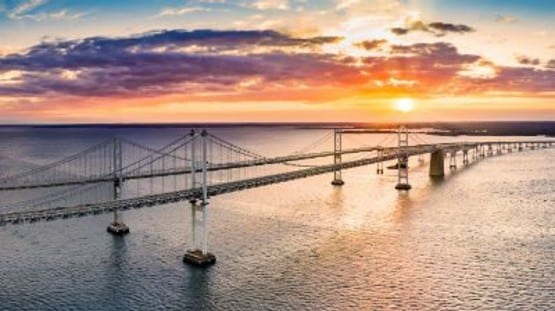
As the deadline looms for the Chesapeake Bay’s 2025 cleanup goals, the annual progress report from the University of Maryland shows that the estuary’s overall health is neither declining nor improving by significant margins.
That can be interpreted as a win of sorts, given the challenges that the Bay faces from a growing population, intensifying farming practices and climate change. But it certainly falls short of the progress that multi-state and federal partnership had in mind when it launched the current iteration of the cleanup a decade ago.
In its 2022 report card, released June 6, the University of Maryland Center for Environmental Science issued a score of 51 points out of 100 for the overall health of the Bay and its tributaries — good for a “C” on the center’s scale. That was a one-point gain from 2021, but it marked the third consecutive year of improvement.
This year’s progress was driven by better water clarity, an increase in underwater grasses, and a decrease in pollution from the nutrients nitrogen and phosphorus, according to the report. The region as a whole also saw lower levels of chlorophyll, a measure of harmful algae blooms. However, dissolved oxygen and benthic communities (the bottom-dwelling creatures) were down.
“While the trajectory of improvements, particularly concerning nutrients in the Bay, is in the right direction, we need to pick up the pace of restoration so that we can hit our nutrient reduction targets in the future and ensure our resilience to climate change,” said UMCES President Peter Goodwin.
Around the Bay, nine of the 17 regions saw increases in their scores. The biggest decline — from a 50 to a 36 — was seen in the Choptank River on Maryland’s Eastern Shore. The Upper Bay experienced the greatest improvement, jumping from a 49 to a 58.
For the first time, researchers wove into the grade a measure of environmental justice, which included indicators for social vulnerability, environmental burden and health vulnerability. The scale suggests that the greatest disparities can be found in urban and rural regions while the lower impacts are in suburban areas.
Overall, the report card showed that the Chesapeake’s health has changed little since its debut in 1986. Then, the Bay scored a 48, three points lower than in 2022. Last year’s score, though, was tied for sixth-best in the record.
This year marks the 40th anniversary of the Chesapeake Bay restoration effort. The program — a collaboration among federal agencies, the Bay’s watershed states and the District of Columbia — faces a self-imposed 2025 deadline for a range of Bay cleanup goals. Restoration leaders, though, have already acknowledged that the region will fall short on many of them, including the core goal to reduce nutrient pollution. Talks are already in the works about how to shape the effort beyond 2025.
The UMCES report card mirrored other recent Bay assessments. The Chesapeake Bay Foundation, a nonprofit environmental group, rated the Bay’s health at a D-plus in its 2022 analysis. That was unchanged from 2020.
Following the release of the UMCES report, the Bay Foundation called on officials to increase funding to address pollution and climate change in the region. Much of those reductions will need to come from the agricultural sector, said foundation President Hilary Harp Falk.
“While it is critical that the U.S. Department of Agriculture increase conservation funding and technical assistance, a recent study from the Bay Program’s Scientific and Technical Advisory Committee has reinforced that more funding alone will not be enough,” she said in a statement.
“We can still leave clean water and a healthy environment to the next generation, but only if Bay leaders listen to the science, target efforts more strategically, and begin paying for the outcomes that matter most to local communities and the Bay downstream.”
Jeremy Cox is a Bay Journal staff writer based in Maryland. You can reach him at [email protected].




 Share
Share