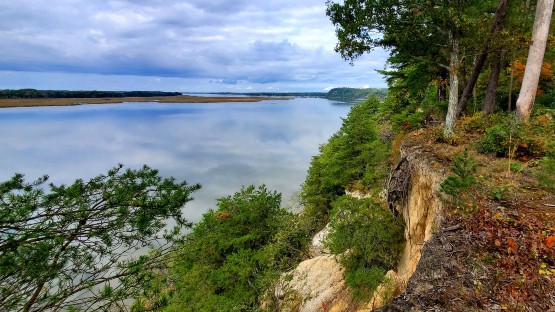
The Rappahannock Tribe rematriated 704 acres of historic land at Fones Cliffs, a four-mile stretch of white-colored diatomaceous cliffs rising more than 100 feet above the Rappahannock River in the Northern Neck.
Fones Cliffs is part of the ancestral homeland of the Rappahannock Tribe, and has been designated by the National Audubon Society as an Important Bird Area with global significance for bald eagles and other migratory birds.
“For millennia, the power of this place has shaped tribal identity and connected the people to the land and to the river that bears our name. It is very rewarding to be able to restore the lands of our ancestors to our citizens of today and for future generations,” Rappahannock Tribe Chief Anne Richardson said.
The acquisition of the 704 acres increases the Tribe’s stewardship of land at Fones Cliffs to a total of 2,391 acres. This includes land the Tribe co-stewards through partnership with the Rappahannock River Valley National Wildlife Refuge, as well as land that has been regained between 2017 and 2026, totaling 2,139 acres.
The newly acquired land, mostly comprised of forest and deep ravines, was purchased from the Chesapeake Conservancy with support from federal funding, the Virginia Land Conservation Foundation, and The Conservation Alliance.
The rematriated land is protected in perpetuity through conservation easements held by the U.S. Fish and Wildlife Service, with the Tribe serving as co-steward incorporating traditional ecological knowledge.
Within this landscape, two parcels have easement exceptions totaling approximately 38 acres, allowing the Tribe to build structures for tourism and tribal use.
History
For generations, Fones Cliffs was home to the Rappahannock people and three of their 14 historic towns: Pissacoack, Matchopick and Wecuppom.
The high ground of the cliffs provided expansive views up and down the river and served as a place of protection for the Rappahannocks.
In the summer of 1608, when Captain John Smith mapped the Rappahannock River, the Tribe used the cliffs to their advantage to defend their homeland against English invasion.
By the 1650s, the Tribe’s connection to the cliffs was severed. Settler colonists claimed Rappahannock land, without payment, destroying tribal towns and forcing the Rappahannock people to abandon their ancestral homeland on the Northern Neck.
Pushed off the River, the Tribe relocated to their hunting grounds on the Middle Peninsula, along the ridge between the Rappahannock and Mattaponi rivers, where the Tribe is headquartered today.
“This rematriation reflects what true partnership looks like when many hands and hearts come together and work tirelessly over time. Inspired and guided by Chief Anne Richardson and the citizens of the Rappahannock Tribe, this work honors the enduring spirit of a people who are the true stewards of these lands,” said Chesapeake Conservancy CEO Susan Shingledecker.
“As the nation marks its 250th anniversary, there is something profoundly fitting about this moment. The Tribe will once again steward its ancestral homeland in perpetuity. I am grateful to donors, funders, conservation nonprofits, and government partners whose support made this work possible over many years,” Shingledecker said.
“It has been an honor to support the Rappahannock Tribe, USFWS, and the Chesapeake Conservancy in the quest to preserve thousands of acres at Fones Cliffs,” said Richard Remmer with the Dr. William Dodge Angle Conservation Office. “We are confident that under the joint management of the Tribe and USFWS, the environmental, historical and cultural assets at Fones Cliffs will yield untold returns for generations to come.”


 Share
Share

Chris Graham