The recent surge of “community outreach” videos published on social media by law enforcement agencies is staggering.
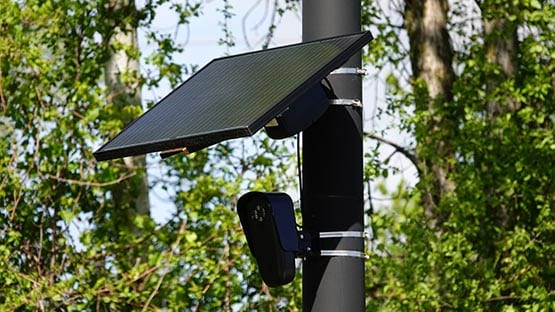
We’ve all seen them: a thief steals a car, passes a Flock Safety camera, and is caught minutes later. While these glossy success stories manufacture immediate comfort, they obscure a nightmarish reality. Flock Safety is quietly building the most pervasive node-to-node mass surveillance network ever unleashed on the American public, and the corporate mindset behind it is chilling.
When regular citizens began mapping these public cameras for transparency, Flock CEO Garrett Langley branded them a “terroristic organization.” This isn’t an isolated burst of corporate arrogance; it’s a pattern.
Right here in Virginia, the City of Staunton terminated its Flock contract after Langley sent an unhinged email to the police chief, blasting public records requests and accusing critics of wanting to “normalize lawlessness.”
ICYMI
This is why the sudden surge in polished police videos matters so much. These aren’t just innocent updates; they are a coordinated public relations smokescreen. By flooding the public conversation with hyper-specific, emotionally charged success stories, the goal is to proactively smother any dissent and normalize dragnet surveillance before regular citizens realize what their towns have signed up for.
When public agencies act as the marketing arm for a multibillion-dollar private corporation, they bypass the very democratic debates our communities deserve. We are being “volun-told” to trade our foundational right to privacy for a tech company’s false sense of safety, the exact same company that treats public oversight and basic transparency as a grave threat.
The marketing labels themselves are a deception. We are told these devices are merely Automatic License Plate Readers (ALPRs), but the reality stretches far beyond a simple license plate scan. Flock’s proprietary technology relies on what they call a “Vehicle Fingerprint.” Do you have a niche paint job, a roof rack, a distinct bumper sticker, or a visible dent from an old fender bender? Flock’s machine-learning algorithms log those exact details, building a unique profile of your car even if the license plate is entirely missing or obscured. Every single time you drive past one of these nodes, it catalogs the precise time, date, and location. It isn’t just looking for stolen cars; it is quietly mapping a comprehensive pattern of life for every innocent driver on the road.
The raw data from our own backyard exposes the sheer scale of this dragnet. In just a recent 30-day window across the Shenandoah Valley, the numbers speak for themselves. Harrisonburg logged over 307,000 scans with a 99.8 percent innocence rate. Bridgewater and Elkton combined for over 120,000 scans, where a staggering 99.9 percent of drivers had absolutely no law enforcement involvement. Across Broadway, Grottoes and Timberville, the story is identical: hundreds of thousands of local citizens tracked, logged, and fed into a private corporate database on the microscopic chance that a fraction of a percent might be attached to a crime.
ICYMI
What happened to “innocent until proven guilty”? Flock effectively obliterates the constitutional requirement for a warrant and probable cause. Instead, the system treats entire communities as suspects, often weaponizing deeply unreliable eyewitness descriptions to broadcast blanket alerts. We are sacrificing the fundamental rights of nearly 100 percent of our population to build a digital checkpoint system that flips our legal system completely on its head.
This sweeping network raises a critical question: Who owns this massive repository of citizen data? Flock explicitly tells its public-sector customers that the agencies own the data, and it assures the Commonwealth of Virginia that scans are automatically purged after 21 days, as mandated by state law. But as a cloud systems specialist, I looked past the marketing brochures to examine the actual architecture. Flock stores its data in Amazon Web Services GovCloud, specifically in the S3 storage service. More importantly, this data is encrypted using AWS Key Management Service (KMS), and it is Flock, not our local police departments, that controls the encryption keys. In the cloud engineering world, there is a fundamental truth: if you do not control the encryption keys, you do not own the data. Our local agencies are merely renters in a corporate panopticon.
ICYMI
The next time these videos surface on your feed, look past the high-tech editing. Recognize them for what they are: polished talking points designed to curb your dissent. True public safety does not require handing the keys to our privacy over to a defensive, unaccountable corporation.
These systems only operate on our streets because our representatives have failed to restrict the funding used to obtain them.
Do not simply fold. Speak up at local government meetings, email your state representatives, and demand transparency. Across the country, communities are making their voices impossible to dismiss, and localities are ending their contracts left and right. Your voice might be exactly what is needed to end it in your town.
To track the numbers locally and find more resources, visit LiveFreeVa.org.


 Share
Share