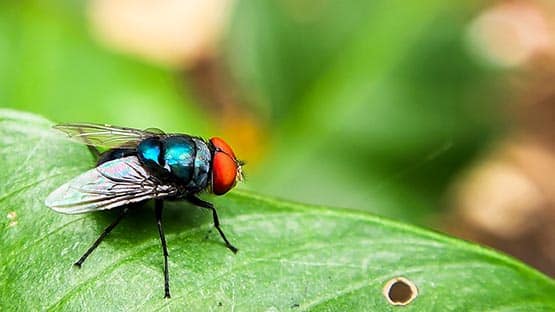
A parasitic fly known as the New World Screwworm has been located 400 miles from the U.S. border causing a major uproar in the agriculture industry.
The maggots from the fly infest and eat the flesh of livestock and wildlife, and in rare cases, humans, often resulting in death.
It’s not the plot of a horror book folks, it’s real life, and the potential infestation is threatening the southern border’s billion-dollar cattle industry.
The head of entomology at Texas A&M University said the female fly finds a living host, lands on its wound and lays up to 300 eggs.
“After 12 to 24 hours, those eggs all hatch, and they immediately start burrowing and feeding on the tissue of that animal, causing very, very large wounds to form,” said Phillip Kaufman in an interview with CNN.
“This can kill a thousand-pound cow in two weeks,” Michael Bailey, president-elect of the American Veterinary Medical Association, told USA Today. “The federal government is being very aggressive in working to contain this.”
The United States Department of Agriculture, or USDA, announced a pause on livestock imports along the U.S.-Mexico border as part of a multi-prong plan to combat the New World Screwworm, or NWS. Live cattle, horse or bison imports through U.S. ports of entry along the southern border have been suspended.
U.S. Secretary of Agriculture Brooke Rollins has launched an $8.5 million plan that includes a sterile domestic fly production facility at Moore Air Base in South Texas to detect, control and eliminate the pest.
NWS has been eradicated from the U.S. for decades but has been detected in Mexico as far north as Oaxaca and Veracruz, according to the USDA.
“The United States has defeated NWS before, and we will do it again,” said Rollins. “We do not take lightly the threat NWS poses to our livestock industry, our economy and our food supply chain.”
The strategy to eradicate the population of NWS includes breeding sterilized males of the species and dispersing them to mate with wild female flies, resulting in no offspring. To combat the potential outbreak, experts think 400-500 million sterile flies will be needed each week.
An outbreak in Texas could lead to devastating consequences for the state’s cattle and hunting industries with a potential economic loss of more than $10 billion, according to estimates from U.S. lawmakers.
The Texas & Southwestern Cattle Raisers Association said that it believes that pausing the plan to reopen the border to live cattle imports due to NWS is warranted.
“Texas cattle raisers are taking the threat of NWS seriously,” said Carl Ray Polk Jr., TSCRA president. “These actions, including steps to protect our beef supply at key entry points, will be essential to prevent the spread of NWS and safeguard the livelihoods of ranchers and landowners across the continent.”
Related stories
- The spotted lanternfly: Virginians should brace for three to five years of ‘heavy infestation’
- Quarantine of spotted lanternfly lifted; no longer effective in preventing the spread
- Many farmers forced to confront mental health with added stress, less sleep
- Red fox in Northern Virginia tests positive for highly pathogenic bird flu
- Spotted lanternfly continues infestation of Virginia; ‘learning to live with them’
- Avian influenza, bird flu present on Eastern Shore, eastern half of state
- Aggressive hybrid fire ants expand home territory, infiltrating Southwest Virginia
Support AFP



 Share
Share

Crystal Graham