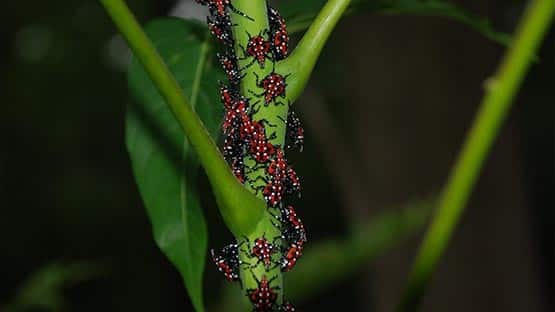
A growing number of invasive spotted lanternfly nymphs are invading commercial farms and residential backyard gardens, and in Virginia, it appears they are here to stay.
For most homeowners in the region encompassing the Shenandoah Valley, the sight of the spotted lanternfly, or SLF, has increased this year.
“We are continuing to see rising populations of SLF in the Shenandoah Valley,” said John Benner, a Virginia Cooperative Extension agent in Augusta County
The spotted lanternfly, originally from Asia, was first discovered in Berks County, Pa., in 2014; it was not found in Virginia until four years later. The pattern in Pennsylvania, therefore, provides a good roadmap for the future of the species in Virginia.
“The folks in Pennsylvania have learned to live with them,” said Tom Stanley, an agent with the Rockbridge County office of the Virginia Cooperative Extension. “It is likely we will have to endure three to five years of very heavy infestation, and then the population will probably subside but not go away.”
According to the Virginia Department of Agriculture and Consumer Services, the spotted lanternfly has now been found in more than half of Virginia’s counties and independent cities.
There is no longer any need to report the lanternfly in the region.
“VDACS is no longer seeking to actively slow the spread of spotted lanternfly,” said Benner. “This is due to it now being endemic in many areas of Virginia.”
The population is well-established and on the brink of “exploding,” Stanley said. “Pennsylvania has not seen significant plant losses. The greatest risk is the fruit trees or vineyards.
“The viticulturists I’ve talked to indicate they are doing some additional insecticide sprays, and this is controlling the worst damage, but vineyards appear to be the only operations doing significant treatments specifically for lanternfly, but some orchards will, as needed.”
Organic flower farmer Molly Mauzy, with the Staunton-based Brown Dog Blooms, said she’s seen an increasing number of spotted lanternfly nymphs on her flower stems this year. In contrast, last year, she only saw one lanternfly.
“I’m starting to see lots of spotted lanternfly nymphs, so I’m kind of afraid what that’s going to look like this year. I’ve seen so many of the nymphs, and they’re so fast. They’re so hard to kill.”
For most of us without commercial enterprises, the advice is simple: “squash them,” Stanley said.
The other thing Virginians can do is get rid of its preferred host plant, the Tree of Heaven, also known as the Paradise Tree or ailanthus, on or near your property, he said.
“In addition to removing habitat, such as ailanthus, I would try to use an approved insecticide in areas where there are large populations,” said Benner.
Benner expects the life cycle and expectancy to be similar to the brown marmorated stink bug.
“Talking to our entomology folks, we expect SLF populations to continue to grow, remain elevated, then eventually plateau and decrease to a more modest, but still nuisance level,” Benner said.
For advice on getting rid of host plants or more information on the spotted lanternfly, contact your local Extension Office.
- Further reading: Spotted lanternfly article by Tom Stanley
Ants may be key to early detection of the spotted lanternfly
In addition to the Tree of Heaven, the spotted lanternfly also feeds on other plants including grapes, hops, stone fruits and hardwood trees. When it feeds, it excretes a sticky, sugary fluid, called honeydew, that causes sooty mold, which can further damage plants.
Experts have found that ants love the honeydew excreted from feeding, and it could serve as an early-warning system for spotted lanternflies arriving in new areas.
According to a study conducted by researchers in the College of Agriculture and Life Sciences at Virginia Tech, ants that forage in areas with spotted lanternflies carry traces of the bugs’ DNA in their bodies. By analyzing the ants in a lab, scientists can now detect whether spotted lanternflies are present in an area.
“Ants are nature’s sugar seekers,” said VT researcher Scotty Yang. “If there’s even a tiny drop of honeydew left behind by a spotted lanternfly, ants are likely to find it. They’re constantly on the move, searching for food, and their ability to cover a lot of ground makes them surprisingly effective at picking up traces of the spotted lanternfly.”
The sooner they’re detected, the easier it is to stop them from spreading, Yang said.
“One of the biggest advantages of using ants is that they live almost everywhere, such as forests, farms, cities – you name it,” Yang said. “Their constant search for food makes them ideal frontline samplers for spotted lanternfly DNA. This approach isn’t limited by habitat type, and thanks to well-established ant collection methods, we can easily scale it up.”
VDACS: Infestation areas
VDACS no longer requires reports of spotted lanternfly from the following counties and independent cities:
- Alexandria
- Arlington
- Augusta
- Bedford
- Buena Vista
- Campbell
- Caroline
- Carroll
- Charlottesville
- Clarke
- Culpeper
- Fairfax County
- Fairfax City
- Falls Church
- Fauquier
- Frederick
- Greene
- Harrisonburg
- Henry
- Lexington
- Loudoun
- Lynchburg
- Madison
- Manassas
- Manassas Park
- Orange
- Page
- Prince William
- Radford
- Rappahannock
- Roanoke City
- Roanoke County
- Rockbridge
- Rockingham
- Salem
- Shenandoah
- Stafford
- Staunton
- Warren
- Waynesboro
- Winchester
- Wythe
If you find a spotted lanternfly in an area not listed above in Virginia, you are asked to report it online.
Related stories



 Share
Share

Crystal Graham