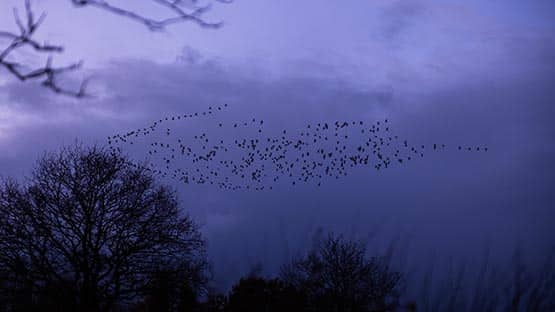
Millions of birds are currently in flight in the U.S., traveling at speeds from 20 to 30 miles per hour, and homeowners can help them travel safely by doing one simple thing at night: turn off the lights.
In Virginia alone, 1.2 million birds are presently in flight, according to a migration dashboard.
During peak nocturnal bird migration, birds face a variety of threats including collisions with windows and other large structures, predators like cats and storms, and above all else, light pollution, which may causes birds to get disoriented.
“The three most important things you can do for birds this time of year are to keep cats indoors, turn your lights off, and use window mitigation,” said Dana Hawley, a professor of biological sciences at Virginia Tech.
Recommendations for migration season
In addition to turning off lights during the migration season, which generally takes place each year in September and October, experts recommend:
- Turn off security lights during migration (use timer or motion activated)
- Close your blinds so home lights aren’t visible
- Keep your cats indoors
- Add screens or UV tape to windows to help avoid collisions
Experts watching for HPAI in birds
Experts are also concerned about Highly Pathogenic Avian Influenza, or HPAI, in the bird population.
“As wild bird migrations are underway along the Atlantic Flyway, the HPAI virus remains present in our environment. All poultry owners, especially backyard flock owners, should maintain the highest level of biosecurity to protect their flocks,” said Veterinarian Dr. Charlie Broaddus.
HPAI is a highly contagious airborne respiratory virus that spreads quickly among birds through nasal and eye secretions and manure. The virus can be spread through interaction between wild birds and domestic birds, flock to flock, equipment, vehicles and on the clothing and shoes of caretakers.
The USDA Animal and Plant Health Inspection Service maintains a list of all HPAI detections in commercial and backyard flocks.
People are asked to report wild bird deaths including dead vultures, sick or dead eagles, hawks, owls or turkeys.
State agencies are also on the lookout for 10 or more birds dying in the same area in a short period of time.
In Virginia, wild bird deaths may be reported to [email protected].
Sick or dying birds may also be reported to the USDA at (866) 536-7593.


 Share
Share

Crystal Graham