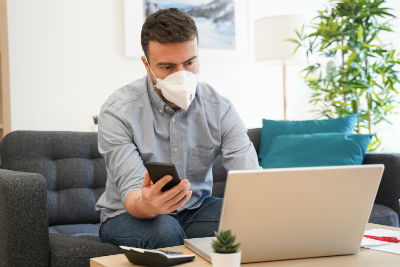
A clear and meaningful policy on telework makes a positive difference to employees who now have to work from home, as does trust in the organization, early results from a new research project show.
Bill Becker, an associate professor of management in the Pamplin College of Business at Virginia Tech, is one of the researchers examining telework and electronic communications during COVID-19 in the new study. The preliminary findings, he said, suggest “the value of leaders being more proactive and expressive and establishing clear guidance and expectations for employees.”
The mass movement to telework resulting from the pandemic raises important questions for research inquiry, Becker said. Among them: how the crisis is affecting employees’ work-life balance, well-being, and attitudes toward their leaders and organization. “We are trying to identify factors that help explain when the changes will be positive versus negative for employees.”
The results so far, from the study’s first survey, suggest that the shift to working at home is affecting people in different ways, he said.
“Some are enjoying the freedom and autonomy, while others are struggling to adjust or are feeling less productive. Many reported feeling increased loneliness. We are following up on this and other factors that might help us understand the differences.”
Becker, whose research interests include work emotion, turnover, organizational neuroscience, and leadership, is working on the project with researchers Liuba Y. Belkin, of Lehigh University; Samantha A. Conroy, of Colorado State University; and Sarah Tuskey, a Virginia Tech Ph.D. student in executive business research.
One of the group’s best known studies, extensively covered in national and international media outlets, showed that employer expectations of work email monitoring during nonwork hours are detrimental to the health and well-being of not only employees but their family members as well.
“The move to telework is a pretty natural extension of the research we have been doing on electronic communications during off-work time,” Becker said. “A colleague suggested starting this new study during the pandemic, when work, family, and schooling are all occurring in peoples’ homes simultaneously.”
The research opportunity aside, forced teleworking during the pandemic has presented him with unexpected challenges and personal stresses.
Becker, who teaches graduate students at Virginia Tech’s Northern Virginia Center in metro Washington, D.C., has found the virtual classroom wanting. “The shift to online instruction has been pretty difficult, as my MBA courses are so interactive and incorporate lots of discussion,” he said. “Breakout rooms have helped accomplish some of this, but I miss interacting with the students.”
The extent of that loss, he came to appreciate as a result of the pandemic’s shutdown, said Becker. “In fact, I have underestimated how much I count on interacting with students for social connections. I live primarily by myself, so I have felt quite isolated and lonely. Despite a greater amount of time, I have sometimes struggled to get motivated to be productive and have watched a lot of TV and done puzzles.”
The first survey, sent to current and former MBA students as well as to individuals on the authors’ personal networks who work more than 30 hours per week, attracted more than 300 responses. A follow-up survey is currently underway.
“We should know more after that follow-up survey is complete,” Becker said, “when we can look at changes as the shutdown drags on.”
Becker’s project is among the numerous research projects Virginia Tech faculty, staff, and students have initiated, in immediate response to the COVID-19 pandemic, in an effort to support the local community and to affect humanity on a global scale.


 Share
Share

Chris Graham