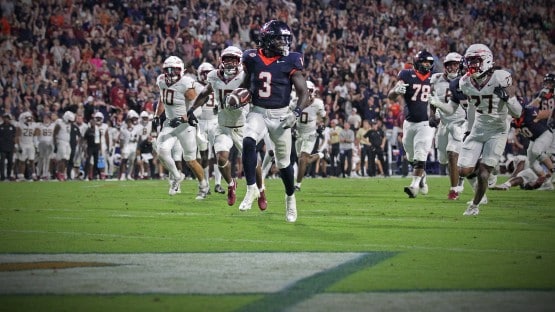
Shocker, right, that I got emails from a trove of White guys who think a young Black man named J’Mari Taylor should consider it a privilege to entertain them.
How dare the kid prioritize his future earning potential when our favorite college football team needed him out there to win an exhibition game.
That, you know, they won anyway, without him.
To me I see greed $$…Should be about the game. Your there for a reason…Why we pay ridiculous $$ to watch.
This was what reader Philip Shipp wrote in a quick response to my article, J’Mari Taylor didn’t play in the Gator Bowl: Let’s make a federal case out of it,
I mean, at least he got straight to the point.
We pay “ridiculous $$” to watch – assuming you’re among the “we” who actually go to the games.
Ergo, because we, or other people, pay “ridiculous $$” to go to the games, the young Black man needed to be out there to sing and dance like a Stepin Fetchit Sambo for their benefit, his own future prospects be damned.
I feel ya.
I thought football was a team sport. You and Taylor are wrong. As for Poindexter, shit happens, in case you haven’t noticed.
This was the pithy response from one William Dove.
Football is a “team sport,” meaning, a kid set to get a job paying him a million a year for the next four years, as long as he’s healthy come this coming April, should put that at risk.
Gotcha.
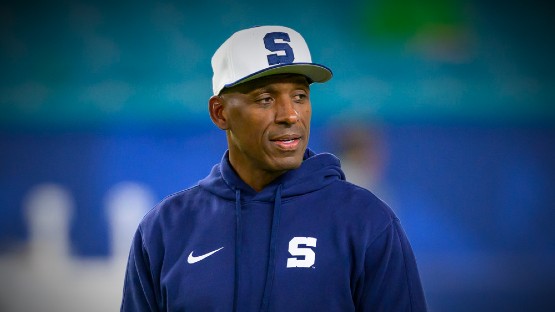
The reference from Mr. Dove to “Poindexter,” incidentally, is to my allusion in the article about Taylor’s decision to skip the Gator Bowl to Anthony Poindexter, the all-time UVA Football great who was a projected Top 10 pick in the 1998 NFL Draft, decided to return for his senior season at Virginia, violently tore the ACL and two other ligaments in his left knee late in that senior season, was a seventh-round pick of the Baltimore Ravens in 1999, and spent two seasons on special teams.
Instead of the millions that go to first-round picks, Dex made the league minimum $175,000 his rookie year, $241,000 his second year, and that was it.
As for Poindexter, shit happens.”
I wrote Mr. Dove back to ask him if it would be OK for me to put him in touch with Dex so he could tell Dex directly that his life-changing injury was just another example of “shit” happening.
No response, as of yet.
The doozy in the responses came from Val Prochaska, a 1980s-era UVA alum who writes for the SI.com Virginia Cavaliers blog.
Here we go:
You are free to be supportive of J’Mari Taylor’s decision to sit out the Gator Bowl as a way of protecting his professional prospects. He wasn’t the first and he certainly won’t be the last to ditch his team at the pinnacle of the season.
You are certainly correct in stating that we don’t know the contracts that are being signed between school and player but I think you’ve wandered pretty far afield in your assumptions of what contracts aren’t.
Are you aware of any contract, in any professional sport, that is based on number of games played? I’m not. Contracts are based on seasons, and playoffs are part of those seasons. Performance bonuses aside, Jalen Hurts is going to get the same amount of money whether the Eagles miss the playoffs or go all the way to the Super Bowl, right?
This is where I need to remind you that Val writes for an SI.com sports blog.
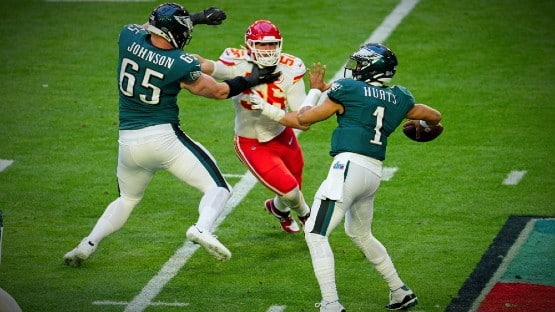
Val, the sportswriter, thinks Jalen Hurts “is going to get the same amount of money whether the Eagles miss the playoffs or go all the way to the Super Bowl.
This guy gets paid to write about sports.
Not much, I hope.
Just to be clear on this, and I can’t believe I need to point out to a supposed fellow sportswriter that this is the case, no, NFL players (and players in other sports) absolutely do not work the playoffs for free.
Podcast
Their employment contracts compensate them for their regular-season work; for their work in the postseason, they share in postseason revenue from a pool.
The compensation is fixed based on how far one’s team advances in the playoffs – for instance, players on the 2025 Super Bowl-winning Philadelphia Eagles got $171,000 each for their playoff work; Los Angeles Dodgers players each got $484,000 for their playoff work in 2025; members of the OKC Thunder each got $828,000 for their NBA Finals run last summer.
(NFL teams have more players and staff sharing in their pools.)
These are the topline numbers; players (and staff) are compensated for their work all the way down to the teams that don’t advance from wild-card or play-in rounds.
Back to our buddy Val:
And your whole tangent into federal employment law applying with regards to being forced to work is misguided. Do you know any salaried workers? Lots of people work more than 40 hours a week. And don’t get paid for it. I usually spend an hour every weekend on phone calls, trying to put out fires, and beyond time on the phone, I spend a couple of hours trying to figure out what to do and expending mental energy on the 9-5 job. You know any lawyers, accountants, architects, or even convenience store managers? They all work more than 40 hours and don’t get paid more to do so.
OK, I’ll bite: you choose to take a salaried job where you’re expected to work more than 40 hours a week without additional compensation, working nights and weekends “on phone calls, trying to put out fires, and beyond time on the phone, spend a couple of hours trying to figure out what to do and expending mental energy on the 9-5 job,” hey, that’s on you, for willingly letting your employer take advantage of you.
And anyway, college student-athletes can certainly commiserate with you on that: they go to summer school to get ahead academically, considering the time constraints they have during their active seasons; have to continue progress toward a degree to maintain their eligibility; have to get into and remain in tip-top shape; and of course participate in practices, study game film, travel back and forth to road games, and do the medical triage thing after games.
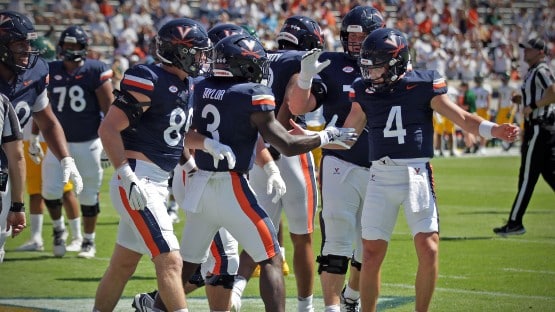
That $400,000 in NIL and revenue-sharing compensation that J’Mari Taylor was paid for the 2025 season wasn’t just for the 12-game regular season plus Charlotte.
If you’re a Power 4 college football player, your life is dictated to you down to what you eat, when, how much sleep you get, when the lights are turned off, what time you wake up in the morning.
You think that’s a 40-hour-a-week job there?
Sounds like 24/7 to me.
Back to Val.
If I were Tony Elliott, I would have left Taylor at home. Going forward, I would make sure that all future contracts have a performance clause, as in, if you don’t perform, you have to pay back your scholarship at a minimum. I also would have final payout of NIL monies after the conclusion of the season.
Let’s say UVA Athletics were to decide to implement this policy.
You can guess what would happen next.
Remember that 11-win season that we just wrapped, and are still celebrating?
Yeah, that never happens again.
Any kid worth a damn looks at that “performance clause” that Val suggests and says, no, thanks, I’m taking my talents somewhere else.
Taylor may have good reason to sit out. But let’s not pretend that it is a mature, or particularly professional reason. Taylor quit on his team, when his team needed him the most.
This, from a “sportswriter” who doesn’t even know that the pros don’t play the playoffs for free.
I own my own business, work for myself, work many more than 40 hours a week. By choice.
I have employees. Who are paid for 40 hours a week. I don’t expect them to answer calls or emails on weekends off the clock.
If you do that, you do that by choice, and you do so for the material benefit of your employer.
Anyone who works off the clock for the material benefit of their employers does so by choice.
Val wants to improve the profit margin of his employer, I mean, he’s free to do so.
At least in his case, he’s not at risk in so doing of getting hit in the knee, blowing his ACL, and not having a job next week because he’s damaged goods.
Let’s not pretend, though, that his decision to donate his time to his employer is either mature or particularly professional.

 Share
Share

Chris Graham