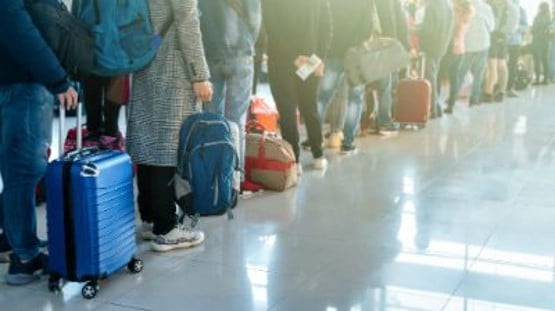
The war in Iran may be causing some families to rethink international travel with a growing number of flight delays and cancellations in the Middle East.
For those planning to travel out of the country for spring break or something else, a pair of Virginia Tech hospitality and tourism professors recommend exercising caution.
“What we are currently witnessing is unprecedented and very unsettling for frequent travelers or those traveling with families,” said Mahmood Khan, a professor in the Howard Feiertag Department of Hospitality and Tourism Management at Virginia Tech’s National Capital Region Center.
“The biggest culprit is the fear of the unknown and the uncertainty in an unfamiliar location and circumstance,” he said. “Getting stranded in an unknown city is very unsettling. For a tired traveler, the worst situation is when they do not know how and when they will be able to proceed to their destination.”
Khan recommends selecting destinations carefully and simply avoiding regions where problems could arise.
“Particularly for pleasure travel and traveling with family and children, it is important to plot every step of the journey carefully since even a small mishap may hinder full enjoyment,” Khan said.
The disruptions to flights in the Middle East follow recent disturbances in Mexico related to cartel violence, and unfortunately, it isn’t expected to be a short-term issue.
“Even if you aren’t headed toward the Middle East, you can be impacted,” said Nancy G. McGehee, the R.B. Pamplin Professor of Hospitality and Tourism Management for the Howard Feiertag Department of Hospitality and Tourism Management in Virginia Tech’s Pamplin College of Business. “Strikes in Iran and other parts of the Middle East have forced airlines to cancel thousands of flights. Tens of thousands of flights have been canceled since the conflict in Iran began Saturday and subsequent attacks by Iran and responses by the U.S. and Israel continue to impact other parts of the region.
“This absolutely has ripple effects beyond the affected regions.”
“Among those effects: Fewer airplanes, less availability. If an airline is currently located in a no-fly zone, that puts them out of commission globally. And not just no-fly; no-sail as well. Cruise ships have also been impacted by the conflict,” she said.
While trips in the U.S. may prove more safe for Americans in the current political climate abroad, the effects of what’s happening elsewhere will still impact how much the vacation costs.
“Even your domestic ‘see the USA’ car trip is going to cost more when you factor in higher gas prices, hotel room rates, food and attractions,” said McGehee.
Cruise ships and flights that have to be rerouted due to the current turmoil in the Middle East may incur additional costs for fuel which will likely be passed on to the consumer, she said.
“Traveling will cost you more. Airspace closures and no-fly zones leave travelers with few options, and re-routing around no-fly/no-sail zones takes more fuel, which can impact prices. The response in terms of oil prices from Saudi Arabia and other major oil producing countries will affect everyone’s travel costs.”




 Share
Share

Crystal Graham