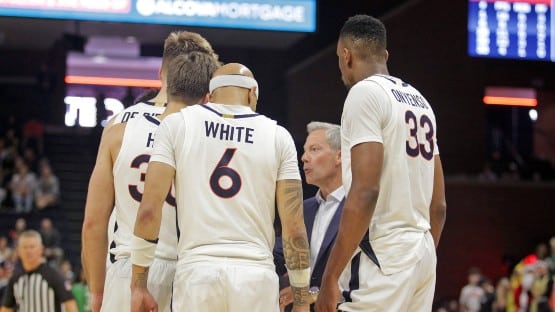
When you watch Ryan Odom’s UVA Basketball team’s games closely, the thing you notice with the opponents is, the tongues, dragging.
The secret to the sauce to how Odom’s first Virginia team is out to a 22-3 start is how the coach employs his depth – nine guys averaging between 16.8 and 28.2 minutes per game.
One thing about his guys: any lineup he throws out there, you feel good that the guys can score, and that they can defend.
Now, I’ll admit to thinking, back in the spring, as we were writing about his recruiting efforts on the transfer portal, that some of these guys are going to be unhappy with their minutes.
Then you see the way he plays – full-court man pressure on defense, pushing tempo, lots of dribble drives and kickouts, ball reversals, constant motion – and you know what he’s doing.
It becomes most obvious in the closing minutes of games; it’s not so much that Odom’s team wins as it outlasts the other side.
The Odom Effect

A reader asked me to try to quantify the Odom Effect, by looking at scoring margins in the second halves of games.
The thinking being: if your goal is to use your depth to wear the other side out, that, you know, is where you would see it.
This isn’t intended to meet peer review-level scrutiny, but what I did was, winnowed down the schedule – no cupcakes, also, left out the Texas and NC State games, which didn’t involve cupcakes, but Virginia had big early leads in both, and thus, a lot of garbage time – to see what we could see.
Admittedly, this is a cursory overview.
First Odom Effect win: Nov. 21, Northwestern, 83-78
Northwestern led 61-60 at the 10-minute mark, and 69-66 with five to go.
Score in the closing stretch: Virginia 17-9
Odom Effect: Virginia +8
Dec. 22: Virginia 80, Maryland 72
This was the game that was just 24-19 UVA at the half.
Virginia led 48-40 with 10 to go, and got the lead to 70-56 with 3:11 to go before we got to garbage time.
Score in the closing stretch: Virginia 22-16
Odom Effect: Virginia +6
Jan. 10: Virginia 70, Stanford 55
This one was 41-34 ‘Hoos at the break; by the six-minute mark, and the start of garbage time, it was 68-46 Virginia.
Score in the closing stretch: Virginia 27-12
Odom Effect: +15
Jan. 31: Virginia 73, Boston College 66
BC led by five at the half, and it was 62-60 Virginia with five left.
Score in the closing stretch: Virginia 11-6
Odom Effect: +5
Feb. 7: Virginia 72, Syracuse 59
UVA led by three at the break, and it was 61-57 good guys at the five-minute mark.
Score in the closing stretch: Virginia 11-2
Odom Effect: +9
Feb. 10: Virginia 61, Florida State 58
FSU led 54-45 with eight minutes left, then made one bucket from the floor the rest of the way.
Score in the closing stretch: Virginia 16-4
Odom Effect: Virginia +12
Feb. 14: Virginia 70, Ohio State 66
Ohio State led 59-53 at the 9:50 media timeout, and made one bucket in the next nine-plus as UVA took control.
Score in the closing stretch: Virginia 17-7
Odom Effect: Virginia +10
The value of depth
In addition to leaving out the wins over Texas and NC State, you’ll notice I didn’t submit the OT games at Virginia Tech (a 95-85 loss) and Notre Dame (a 100-97 win) to this analysis.
The loss in Blacksburg still makes no sense to me.
The Notre Dame win has an Odom Effect quality, in that the Irish led by 19 in the first half, by nine at the break, but Virginia wore them down.
I also left out the comfortable, but not quite blowout, win at Louisville, and the slog that was the road win at SMU, which was tight throughout.
Even more inexplicable than the loss at Tech is the home loss to UNC, in a game that Virginia led by as many as 16.
Hubert Davis used 10 guys in that one, but three got single-digit minutes.
The result there was more about strategy – Davis pushing tempo with his big four, Jarin Stevenson, and Odom not making the right adjustment.


 Share
Share

Chris Graham