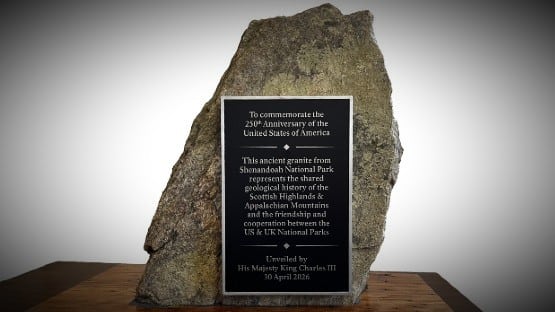
A Rockingham County-based dentist-turned-craftsman was commissioned to complete a commemorative granite piece from Shenandoah National Park that was presented by King Charles III as part of an international exchange on Thursday.
“This piece represents where it came from – the United States, Virginia, and more specifically, Shenandoah National Park,” said Chris Angelopulos, founder of Angelopulos StoneCraft, who worked with the park on the granite piece, which is based on the geological links between the Appalachian Mountains and Scottish Highlands – regions that were once physically connected prior to the separation of the continents.
The U.S. contribution to the exchange is a small natural granite boulder sourced from Shenandoah National Park.
Angelopulos StoneCraft was brought in to preserve the raw granite while providing an etched inscription of international importance.
After evaluating the inscription and selected granite piece, Angelopulos identified limitations that would prevent engraving from producing an acceptable result. The available inscription area was approximately 9 by 13 inches and further reduced by natural surface variation which was insufficient for the original text.
The irregular surface and color variation of the granite would not allow for consistent depth, clarity, or long-term readability, Angelopulos said.
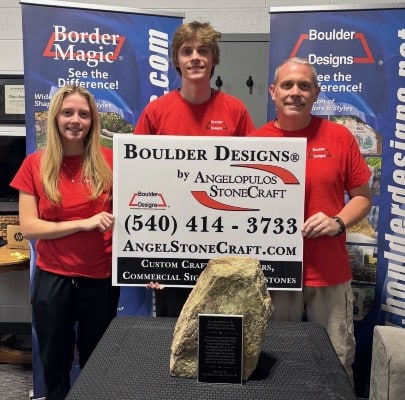
“At that point, it became clear the project wasn’t going to be solved through fabrication alone,” Angelopulos said. “The stone, the message, and the method all had to be reconsidered together. Our role shifted from fabrication to guiding the design and execution of the project.”
Multiple alternative stones and engraving methods including sandblasting, laser engraving, and diamond cutting were evaluated.
Each alternative method had similar limitations. Replacing the original stone or significantly reducing the original text became options that were set aside.
“We discussed replacing the material or reducing the demands of the text,” Angelopulos said. “But the significance of the piece was tied to that raw original stone. Once that decision was made, everything else had to work around it.”
Working within those constraints, Angelopulos designed a revised approach that restructured the inscription, reduced and reorganized the text, and developed a layout that could be executed cleanly within the limited usable surface.
Rather than forcing a direct engraving, a plaque-based solution was introduced to allow for precision while preserving the integrity of the original granite.
Digital proofs were developed to visualize the revised direction, including layout refinements, design elements, and a structural base to stabilize and present the piece.
The project required rapid coordination and execution, including full-scale prototyping and plaque fabrication completed within a compressed timeline in collaboration with Muddy Feet Graphics of Rockingham County.
The completed piece will be displayed in the UK as part of the international exchange.


 Share
Share

Chris Graham