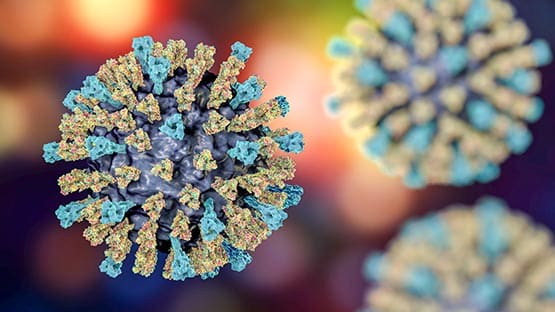
No surprise – that last week’s report from the Virginia Department of Health that there was a confirmed measles case in Buckingham County has now turned into what VDH is calling a “measles outbreak.”
As of Wednesday, the state health department had confirmed 12 outbreak-associated measles cases in the area.
Because none of the patients reported recent travel, the timing of these cases suggests local transmission, VDH said.
Also from VDH: there are likely more measles cases than have been reported.
The Virginia Department of Health actually has a dashboard reporting the percentage of local populations that has received the two-dose series of measles, mumps and rubella (MMR) vaccines – and it tells us that the percentage of 7-year-olds in Buckingham County that has completed the MMR series is at 80.1 percent.
Because measles is one of the most contagious diseases known, the standard community immunity threshold for the MMR vaccine is considered to be 95 percent.
Folks in our area – Augusta County, Staunton and Waynesboro – take note.
The VDH dashboard has the percentage of the 7-year-old population that has completed the two-dose series at 91.4 percent in the county, 88.0 percent in Staunton and 92.2 percent in Waynesboro.
That’s borderline alarming, and more alarming are these data points: the percentage of 2-year-olds who have completed the first dose is just 63.4 percent in Staunton and 77.5 percent in Waynesboro.
Augusta County’s 2-year-old population is beyond the 95 percent first-dose threshold, per the dashboard.
Vaccine skepticism has taken hold in our cities, unfortunately.
Recommendations
- Infants aged 6 to 11 months are advised to get an early dose of the MMR vaccine. Infants who receive an early dose of MMR vaccine before their first birthday should receive two more doses at the recommended ages at least 28 days apart.
- Children aged 12 months to 18 years old who have not yet been vaccinated or never had measles infection should receive their first MMR vaccine dose with a second dose at least 28 days after the first dose.
- Children aged 12 months or older who have previously received only one MMR dose should receive a second MMR vaccine dose at least 28 days after the first dose.
- Adults born after 1957 who have not previously been vaccinated or never had measles infection should receive at least one dose of MMR vaccine. Adults in the following groups should receive two doses of MMR at least 28 days apart:
- Attend school beyond high school (e.g. college, trade school).
- Work or volunteer in a healthcare facility of any type.
- Travel internationally, including on cruise ships.
- Family or close contact of people with compromised immune systems.
- People with HIV infection without severe immunosuppression.
A small number (<5%) of adults vaccinated between 1963–1967 received an inactivated (killed) measles vaccine.
Adults who received this type of vaccine, or do not know what type of vaccine they received between 1963–1967, should receive one or two doses of MMR vaccine.
Free or low-cost vaccines are available through the Vaccines for Children and Vaccines for Adults programs for those who are eligible.
You can locate a VFC or VFA provider on the VDH website.


 Share
Share

Chris Graham