Babies with microcephaly — a debilitating condition in which an infant’s head and brain are much smaller than those of other children — were thrust into the medical spotlight because of the emergence of the Zika virus and its effects in pregnant women.
But for some children, the condition is not the result of a virus; it may be because of a mysterious gene called CASK, which has been associated with a condition known as mental retardation and microcephaly with pontine and cerebellar hypoplasia, or MICPCH.
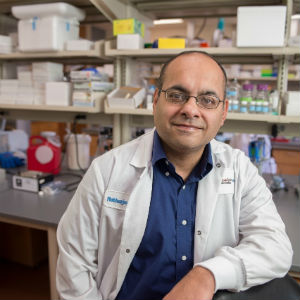
As the leader of perhaps the only research team in the world that is exploring CASK’s role in neurological disorders, Konark Mukherjee, an assistant professor at the Virginia Tech Carilion Research Institute, said families are desperate for answers.
“There is little knowledge out there,” Mukherjee said. “By sharing experiences on social media pages, all of us have learned a lot. Every child has some level of illnesses during their childhood. How do you know whether that illness is associated with a gene or something else? So you need a certain degree of expertise to be able to associate the two. My lab team’s approach has been able to help them to an extent and provide new insights.”
CASK is located on the X chromosome, meaning that girls have two copies of the gene and boys have one.
“In boys, if there is a significant mutation in the gene, they won’t survive,” Mukherjee said. “In girls, because there are two doses of the gene and a single gene is mutated, it is not necessarily a lethal condition. With CASK mutations, the entire brain is smaller than normal with the cerebellum being disproportionately small.”
In recent studies published in Cellular and Molecular Life Sciences and in Acta Neuropathologica Communications, Virginia Tech Carilion Research Institute scientists led by Mukherjee have used mouse models to search for therapeutic targets to prevent abnormalities associated with CASK gene mutations. Such mutations also include autistic traits, intellectual disabilities, and a rare infantile epilepsy known as Ohtahara syndrome.
“If there is a mutation in humans that is associated with a disease, and you can make the same mutation in a mouse and create the same disease, you can make the case that the disease may occur because of loss of this gene, and you continue to gather additional evidence to determine if there is causality,” Mukherjee said. “We try to find the mechanism of the disease first and then try to find therapeutic strategies to undo the mechanism that leads to the disease. The effect of a CASK gene deletion involves extracellular signaling mechanisms. That means we have an opportunity to do something about it by manipulating the system so as to negate the disease condition.”
Mukherjee suspects metabolism — the chemical reactions that maintain life by breaking down molecules to obtain energy or by synthesizing compounds needed by cells — is involved.
“If that turns out to be the case, we may be able to manipulate metabolism using diet or using small molecules or drugs,” he said. “Since we suspect an extracellular molecule to be the culprit here, we could actually think of two reasons why the brain is small — something outside is toxic and killing the cells, which would need to be removed, or something that is important is not being supplied adequately, and in that case, we could replace it.”
CASK was discovered about 40 years ago in a roundworm known as C. elegans — an important research model organism in neuroscience. Since then, it has been discovered to exist in all animals and people.
“Clearly it is an important molecule but we really don’t know most of what it does,” Mukherjee said. “From a biological standpoint, figuring that out will be very important.”
Additional research could provide scientists with insight into a variety of health problems, he said.
“CASK mutation patients share overlapping symptoms with other disorders, like Angelman syndrome and Rett syndrome,” Mukherjee said. “In fact, many kids with CASK mutations are initially suspected to have these syndromes. In CASK mutations and these syndromes, brain growth is hampered after birth.
“If we really focus on this disorder, we think we will eventually understand the key steps or signaling mechanisms that are required for adequate brain growth after birth,” Mukherjee said. “You can imagine that has widespread applications in everything from malnutrition to infectious diseases.”
Support AFP

 Share
Share

Contributors