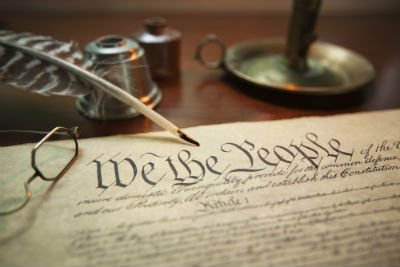
Virginia voted in 2020 to ratify the Equal Rights Amendment, the 38th state to do so, pushing the measure past the required three-fourths majority to make ERA the 28th Amendment.
It’s not recognized as such yet, but should be, according to two constitutional scholars.
Congresswoman Carolyn Maloney, chair of the House Oversight and Reform Committee, released today opinion letters from Laurence Tribe, a Harvard Law School professor emeritus, and Russ Feingold, president of the American Constitution Society.
“My conclusion as a constitutional scholar is that the ERA is currently a valid part of the United States Constitution, that Congress should act concurrently to recognize it as such, and that even if Congress takes no such action the Archivist should publish it as the Twenty-Eight Amendment,” Tribe said.
“It is my opinion that the ERA has met all constitutional requirements and the Archivist can and should certify and publish the ERA as the 28th Amendment to the Constitution without delay,” Feingold said.
Prior to this, Kathleen Sullivan, former Dean of Stanford University Law School and partner of Quinn Emanuel, Urquhart & Sullivan, LLP, Counsel for Amici Curiae Constitutional Law Scholars last month presented an amici brief for some 16 constitutional scholars, including Tribe, in the U.S. Court of Appeals for the District of Columbia in the case of Virginia, Illinois, and Nevada v. David S Ferriero, in his official capacity as Archivist of the U.S., and Alabama, et al.
The scholars’ brief concluded: “The Court should reverse the judgment of the district court and recognize the ERA has been validly ratified under Article V as an amendment to the Constitution expanding our equality and enhancing our democracy.”
The ERA was passed by the House on Oct. 12, 1971, and by the Senate on March 22, 1972, 50 years ago today.
Feminist Majority Foundation president Eleanor Smeal, who was in the Gallery of the Senate when it approved the Equal Rights Amendment in 1972 and has worked for its passage ever since, said on this 50th anniversary: “There are only two very difficult requirements for ratification of an amendment to the U.S. Constitution. One, it must be approved by a two-thirds vote of the House and the Senate and then two, ratified by three-fourths (or now 38) states legislatures. Take it from me who has worked on ratification of the ERA for over 50 years, this is really difficult. Don’t make it impossible.”


 Share

AFP