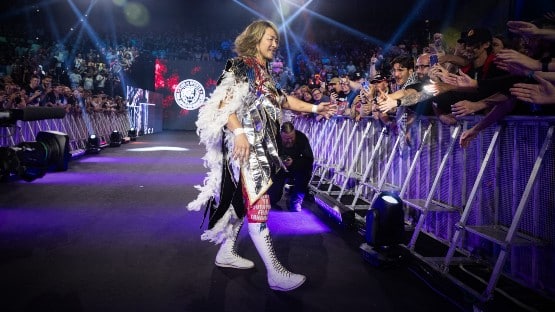
After 26 years, the curtain has closed on the career of New Japan Pro Wrestling legend Hiroshi Tanahashi.
For over three decades, Jan. 4 has marked NJPW’s annual show in the vaunted Tokyo Dome. Rechristened as “Wrestle Kingdom” in 2007, no wrestler is more synonymous with puroresu’s grandest stage than Tanahashi. So, it was only fitting that Tanahashi’s career came to an end at “Wrestle Kingdom 20.”
His opponent was longtime rival Kazuchika Okada, who defected from NJPW nearly two years ago to join All Elite Wrestling.
The show marked Okada’s long-awaited return to Japan, albeit under contentious circumstances.
In the years since his departure, Okada has become a caricature of the “Rainmaker” of old — indignant and irreverent towards the “sport of kings.” In November, Okada caustically remarked that he would put an end to the Heisei era of puroresu by defeating Tanahashi.
A product of the famed NJPW Dojo, Tanahashi and his peers, Shinsuke Nakamura and Katsuyori Shibata, were hailed as the “New Three Musketeers” in 1999; groomed to inherit the new millennium from their predecessors, Keiji Muto, Masahiro Chono, and Shinya Hashimoto.
Rarely does the course of fate unfold so uniformly. Tanahashi and Nakamura defied the odds; however, it was the former who took the reins at the end of the aughts and ushered in a new golden era for NJPW.
At the height of the Bushiroad era, Tanahashi defined New Japan Pro Wrestling. His epithet, the “Ace of the Universe,” was proof positive of his eminence.
It was none other than a nascent Okada, who Tanahashi ceded his throne, too. Together, the duo spent the better part of the teens vying for control over NJPW’s crown, the IWGP Heavyweight Championship. As Tanahashi’s body quickly began to betray him, Okada slowly came into a more singular focus. So, it was only fitting that it was Okada who stood opposite Tanahashi in his final hour.
Nearly 50,000 fans descended on the Tokyo Dome to pay their respects to NJPW’s ace, marking Japanese wrestling’s largest audience in two decades. Under normal circumstances, Okada’s return to the cerulean blue ring would have been a phenomenon unto itself. Here, it paled in comparison. Even in defeat, this was Tanahashi’s night.
In professional wrestling, it’s widely accepted that a performer has reached their zenith when they’ve achieved mainstream appeal. John Cena and The Rock, for example, are recognizable in every corner of the globe. On the other hand, there are a select few who become synonymous with a particular arena, city, nation, or culture, like Bruno Sammartino in Madison Square Garden or Mistico in Arena Mexico.
Tanahashi has achieved that rare distinction for New Japan Pro Wrestling. In Korakuen Hall or the Tokyo Dome, Tanahashi has the allure of a god. With that comes a keen understanding of a performer’s own gravity. Everything Tanahashi does carries weight; whether he’s sent careening over a barricade or delivering a thunderous High Fly Flow off the top rope. As both the antagonist and more physically capable combatant, the onus was on Okada to manipulate Tanahashi’s gravity.
Okada tried his best to extinguish the flames of Tanahshi’s fighting spirit, but the “Ace of the Universe” conjured more than embers. He set his heart ablaze.
It would have been easy for the 49-year-old to play the hits and lean on nostalgia, but Tanahashi is a pro-wrestler’s pro-wrestler. Instead, this match had a discernible structure — grounded by the ace’s unwavering vigor. And, it was that unyielding determination that necessitated more from Okada.
Tanahashi used every tool in his arsenal, and even some of his contemporaries, to even the odds. In doing so, Tanahashi forced the “Rainmaker” of old to return, forgoing his irreverence for something earnest and true. It was only fitting that, at the center of a cerulean blue ring, against his eternal rival, Okada recaptured his love for professional wrestling.
That’s the gravity of Hiroshi Tanahashi. Only the “Ace of the Universe” can create miracles.
Afterwards, luminaries from Tanahashi’s past joined him in the ring — paying their respects to puroresu’s one, true ace. “Switchblade” Jay White, Will Ospreay, Kenny Omega, Kota Ibushi, Katsuyori Shibata, Keiji Muto, Tatsumi Fujinami, and even Tetsuya Naito all joined Tanahashi in the ring before one final encore.
I’ve never had so much to say, and so little at the same time. Even now, hours removed from the main event, the words escape me. Before I was a columnist, I was a fan. In all aspects of life, professional wrestling or otherwise, all we can hope for is that the things that profoundly resonate with us feel worthwhile. Hiroshi Tanahashi has made professional wrestling feel worthwhile.
Go Ace.
Rating: *****


 Share
Share