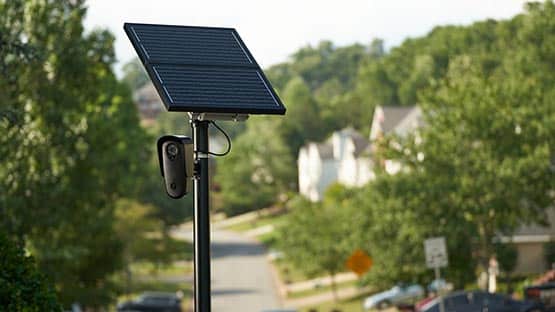
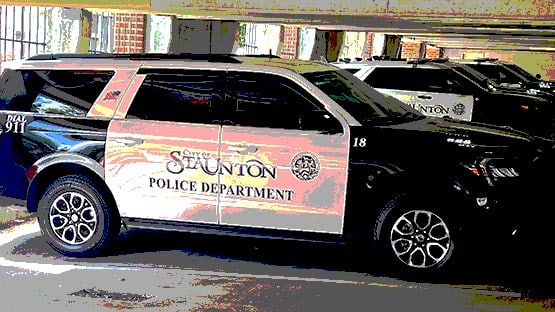
A vocal group of citizens is pushing back on the Staunton Police Department’s use of Flock cameras as the city begins its second year of using the automated license-plate reader technology, known as ALPR or LPR.
The six cameras, located strategically on major thoroughfares in the city, snap a photo of a vehicle whenever it drives by them, storing the image in a database for 21 days.
Staunton resident Deborah Kushner scrutinized the city’s use of the LPR technology at a recent City Council meeting.
Among her concerns is the use of the cameras at a time when immigration enforcement has been ramped up, and many migrants are living in fear, regardless of their status in the country.
“I bring up privacy and security concerns because these issues affect the wider Staunton community,” Kushner said. “Harrisonburg has had more than 200 members of its community kidnapped in recent months. Charlottesville has been similarly targeted. DC is under siege. The decisions you make have huge repercussions for individuals and the community.”
Charlottesville recently took measures to block access to its database from outside agencies, a move that was made to deliberately to prevent immigration enforcement officials from using its private data.
While the system isn’t supposed to be used for immigration enforcement, there have been thousands of searches related to ICE and removal operations, proving that even if one department plays by the rules, it’s possible that the hundreds of other agencies who have access to the data may be more than willing to bend them.
Flock safety cameras have been marketed to police and private communities across the U.S. since 2017. The use of the cameras has led to heated debate throughout the nation about the value of the tools for crime prevention versus a perception of creating a mass surveillance network.
Flock: A national surveillance network?
There are more than 4,000 active Flock cameras nationwide, capturing billions of photos each month.
The American Civil Liberties Union, or ACLU, asserts the use of the cameras is a violation of privacy and thinks citizens like Kushner are right to speak up.
The ACLU has seen numerous cases where the ALPR technology is implemented by police with little or no public discussion of the matter.
“It can be very routine for city councils, board of supervisors, local police departments, to just acquire technology that they hear about,” Chris Kaiser, policy director for the ACLU of Virginia, told AFP. “I think sometimes it’s very well meaning, but often there is not an adequate opportunity for the public to weigh in and really understand what types of technologies are about to be rolled out into their communities.”
Staunton Police Chief Jim Williams made a presentation to City Council in November, shortly after the city PD signed up for a trial of Flock. No update has been provided to the public since its implementation.
Staunton Mayor Michele Edwards told Kushner in an email shared with AFP that she will request an update on the program from Williams, but also stated that she has “no concerns about abuse with the use of license plate technology,” due in part to the “excellent reputation of the Staunton Police Department.”
While the Staunton PD’s reputation may be beyond reproach, according to Edwards, one problem is that the data isn’t limited to officers in the City of Staunton.
The good: Cameras bring people to justice
Locally, Charlottesville (10 cameras), Harrisonburg (30 cameras) and Staunton (six cameras) use the Flock LPR technology; Waynesboro and Albemarle County do not use Flock cameras. Augusta County appears to have two Flock cameras in operation at this time, something Sheriff Donald Smith confirmed to AFP but did not elaborate on; he also did not respond to AFP’s request for an interview to discuss the county’s use of the system.
Local law enforcement cited many reasons for using LPRs.
Among them, Williams told AFP that it’s difficult to hire police officers right now, and the data collected helps “bring people to justice that need to be brought to justice.”
From stolen vehicles, robberies, kidnappings and missing persons, the data collected certainly benefits a community by helping police put criminals behind bars.
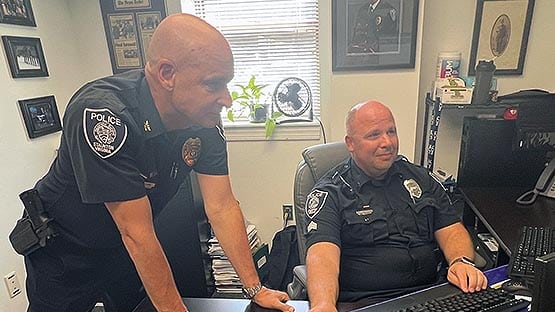
Sgt. E.L. “Butch” Shifflett walked us through a scenario where he searched the Flock database for his own department vehicle using his license-plate information.
For audit purposes, there is a field for a case number and reason for the search, as well as the option to search by a license plate or vehicle description. While his vehicle popped up multiple times on the city’s six cameras, the driver was not identifiable in the image.
The search itself isn’t real-time; it’s retroactive, so it showed Shifflett’s vehicle driving by the cameras at different times and on different days.
The system also allows for a hotlist, something that officers use when they have a license plate or description of a vehicle in a kidnapping or in the theft of a car or truck. If the license plate pings on the network, dispatch will get a notification, and officers can use that information to find the driver.
Williams and Shifflett believe the benefits of Flock cameras outweigh the drawbacks.
“Do you throw in the towel and get rid of this technology, which is already proven? Everything’s a tool, right? A taser is a tool; a body-worn camera is a tool. They’re all tools. Can they be abused? Yeah, they absolutely can, and human beings are always a weak link on all this stuff,” Williams said.
“I’ve got a couple dozen cases that we’ve made that are perfectly good cases using sound, logistical investigative processes that they just need a little help; they need to know what was the license plate for the blue Honda that was involved in the case, or whatever.”
ICYMI
- Charlottesville: License plate readers installed at 10 city intersections
- Advanced tech used to find Hampton Roads man who robbed postal worker
- License plate reader technology helps nab suspects in Virginia Beach armed robbery
- Virginia-based skimming operation shut down after video footage helps identify culprit
Williams believes it’s incumbent on the department to use the technology that’s available and wishes the city had cameras in place sooner for crimes that remain unsolved.
“There’s just been some cases that we’ve had over the years that have driven me crazy,” Williams said.
Is it an invasion of privacy? Depends who you ask
Privacy advocates point to the U.S. Constitution and its protections as grounds for not using LPRs.
“I certainly understand the goals that agencies are trying to solve with these devices, but the fact of the matter is that the Fourth Amendment has always been a bulwark against invasions of privacy by the government,” Kaiser told AFP. “It is a fundamental right of everybody in this country to be free from arbitrary and excessive invasions of privacy by the state and by police. What these devices do, essentially, is track everybody’s movements on our roads, regardless of whether they’re suspected of any kind of crime.”
Williams said his department isn’t monitoring No Kings rallies or anything like that; 99.9 percent of the data collected never gets looked at, he said.
“We don’t have any interest in surveilling citizens of Staunton,” Williams said. “What we’re trying to do is catch criminals after they’ve committed offenses. That’s the whole purpose.”
Members of local city councils and boards may be desensitized to monitoring of citizens – with face-recognition technology at airports, closed-circuit television surveillance and even the routine use of speed cameras by law enforcement, but the ACLU cautions that LPR cameras are another beast altogether.
“We’re so far beyond those kinds of old-school technologies that I don’t think even local governments often realize how plugged in these technologies are to national or even global networks, and they present much, much more significant vulnerabilities than we were dealing with even 10 years ago,” Kaiser said.
Case study: Harrisonburg’s take on Flock

Thirty miles away, the City of Harrisonburg implemented Flock cameras almost two years before Staunton, in January of 2023, but it’s also been using license-plate reader technology for more than a decade.
While Staunton has six cameras, Harrisonburg has 28 stationary cameras and two mobile cameras in use.
Former Harrisonburg Police Chief Kelley Warner learned more about Flock specifically at a law enforcement conference and brought the information back for consideration.
“We could spend all day talking about the successes of finding missing people, finding missing property that we’ve been allowed to do because of this technology,” said Michael Parks, director of communications and public engagement for the City of Harrisonburg. “I don’t know how you would possibly put a price or a weight on the value of finding those individuals that otherwise we might not have been able to do without this technology.”
The data from the cameras is used in cases of larceny, breaking-and-entering and even homicide.
“I think our citizens demand and expect us to use technology to our advantage, to try to solve crimes,” Harrisonburg Police Lt. Todd Miller told AFP. “I think they expect us to use technology that’s available in order to solve these crimes and keep this community a safe place to live.”
Miller said he understands the concerns citizens have about surveillance but offered assurances that the system isn’t being abused by the HPD.
“I could understand the fear that, hey, the police are out here tracking these people down, doing this and that, finding their movement and things,” he said. “One, we don’t have the time and means to necessarily do that, and I’m not concerned about shopping habits or other things.
“We only have limited manpower, and our job is to target criminal investigations, and that’s what we do.”
There are safeguards in place to try to prevent misuse of Flock: the cities’ policies, its audit trail, and state code, among them. While admittedly, they can’t speak for other police departments, the City of Harrisonburg takes pride in its efforts to gain community trust.
“We are extra careful with the responsibility that is given to our officers to be in these very difficult roles,” Parks said. “We talk a lot about that here and making sure we’re taking the right steps whenever possible, and if we don’t, making sure that people are held accountable and that we’re doing what we can to correct those actions and making sure, you know, to use those examples as learning experiences for all of our departments.
“We entrust our law enforcement officers with a great deal of responsibility that other departments don’t have,” Parks continued. “We’re cognizant of that and the concerns that the community may have about an individual that has that level of authority.
“We know with the smallest misstep, we can lose that trust.”
Flock, like most other evolving technology, appears to be testing the waters adding Artificial Intelligence tools; something the ACLU vehemently opposes.
“These devices are supercharged with AI tools and other very state-of-the-art technology,” said Kaiser. “Where there’s a device, people can not only track a vehicle based on its license plate, but also things like bumper stickers or a dent in the bumper or any other range of identifying details that make it an even deeper invasion of privacy than it would be if we were just collecting the numbers and letters on a license plate.”
ICYMI
- Trump administration prepares to upload AI Action Plan for America
- OpenAI | Parental controls to be installed on ChatGPT in response to teen’s suicide
- State-level AI ban in Trump’s mega bill among points of tension between Democrats, Republicans
Flock has a whole menu of options that they offer, but Harrisonburg has focused specifically on the cameras, Miller said.
When AFP spoke with Miller and Parks last week, city staff were taking part in an AI class about how it could be used in local government, but Parks said, the city is moving forward “cautiously” with incorporating AI programs into its day-to-day work.
The Flock system has been used successfully in the city to find stolen vehicles, to identify a homicide suspect, and to find people reported missing.
“It has been a very, very valuable tool that we’ve acquired, and it’s shown to be very successful for us,” Miller said.
“We could send you stats and stats and stats and stats of successes that the Flock cameras have allowed us to do here in Harrisonburg, but as always, if a member of our community has a concern about an of our services or any of the actions that we take here in Harrisonburg, I would ask our community to reach out to us,” Parks said. “We’re always open to having those conversations.”
Is law enforcement playing by the rules?

There is some proof that the private system is flawed, with multiple instances of it being misused by law enforcement.
Prohibited uses of the system include immigration enforcement, traffic enforcement, harassment or intimidation, usage based solely on a protected class (i.e. race, sex, religion) or personal use.
ICYMI
- Immigration enforcement? ATF access to Richmond license plate readers terminated
- Harrisonburg: Immigrants rounded up by ICE were covered in dirt, appeared scared
- Plain clothes, masks, unmarked vehicles: ICE agents target immigrants in Virginia
- Albemarle County: Authorities working to maintain the trust of immigrant communities
While the data can be limited to local-use only, most law-enforcement agencies share the information collected with external organizations including the Virginia State Police, Virginia Department of Corrections, as well as university police and other law-enforcement offices throughout the state, and in some cases, nation. Since July 1, Virginia law enforcement can only share data with other in-state members of the network.
While one department may play by the rules, there appears to be no way for a locality to audit incoming queries of the system from other agencies; each agency is responsible for auditing its own staff, Shifflett said.
“We have to trust our cohorts and what they’re searching,” Shifflett, who is in charge of the technology operations unit in Staunton, said. “And they have to trust us with what we’re searching. They have to trust us to do the right thing, and that’s what we have to do with them.”
“Humans are always a weak link,” Williams added.
The misuse by officers has serious consequences including termination or criminal charges. Despite this, there are clear examples of cases where LPR technology has been misused by once trusted members of the law enforcement community.
The ACLU points to a recent case in Illinois where sharing data with the federal government is not permitted.
“A federal agent just got the password from a local law enforcement officer and was able to access it,” Kaiser said.
“That was illegal, but it still happened, right?”
Some of the cases with possible abuses of LPR technology include:
- Numerous searches were conducted in a handful of counties in Virginia related to immigration and ICE, revealing a potential vulnerability in the system; i.e. compliance is up to local law enforcement, not Flock.
- More than 4,000 searches have been completed to date with immigration, ICE or enforcement and removal operations listed as the reason.
- In the early days of LPR, Virginia State Police recorded the license plates of people attending campaign rallies for Barack Obama and Sarah Palin; the data was only purged after the Attorney General said that ALPRs may be used for specific vehicles related to criminal activity but not to surveil the general public
The LPR cameras have also made errors that have put citizens in precarious situations. In one case, a Black mother was forced to lay face down on concrete after her plate was misread; in another, a K9 dog was released on a man, again with his plate misidentified by the system.
Virginia beefs up code related to LPR systems
In May, Virginia’s General Assembly addressed the use of automatic license-plate recognition systems by law-enforcement agencies, requiring data collected to be purged after 21 days of its capture.
In addition, all agencies must now create an audit trail that is reviewed at least once every 30 days by local agencies.
State Police are also tasked with aggregating the data from agencies and reporting it to the governor, the General Assembly and the Virginia State Crime Commission by July 1 each year.
The updated code specifically states that a law-enforcement agency many only use the LPR as part of a criminal investigation, or for finding someone with an active warrant, for a missing or endangered person case or for other crimes including human trafficking, a stolen vehicle or stolen license plate.
The code also provides a penalty for anyone who willfully and intentionally uses the system for an unauthorized use: a Class 1 misdemeanor. In Virginia, the offense carries a maximum penalty of up to one year in jail and a fine up to $2,500.
Localities who signed up for Flock cameras may not fully utilize some of the functions of the system, including recent developments in artificial intelligence, but even if they don’t use them, it’s possible someone accessing the data is.
“The vendor can just add new software, new features once these devices are up … and in very little time, stop resembling what local police thought it was when they first acquired the technology,” Kaiser said. “It is extremely concerning to put so much discretion and authority in a corporate, for-profit vendor who has incentives that are just different from our civil rights and civil liberties.”
There is also potential for the system to be compromised by people outside of law enforcement.
“There are examples of trusted vendors being hacked and so nefarious actors get at sensitive data, not from the government or a local law enforcement agency, but by hacking the vulnerable vendor, so there are a lot of side-door access vulnerabilities.”
Why speaking up matters
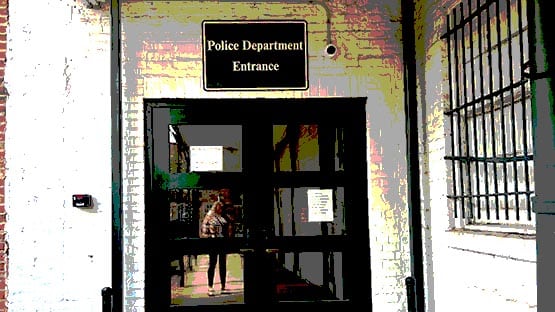
Charlottesville is one example of a locality that uses the Flock technology, but limits its use. Instead of the 21 days allowed under state law for data retention, the city has an ordinance in place that reduces that time to seven days.
After vocal resistance from citizens, the Charlottesville Police Department also disconnected its camera data from outside searches, out of fear that the city’s information could be exposed and used by cities and counties in Virginia participating in immigration enforcement. The downside is that the change also limits the CPD from using the wider system for its own searches.
“Even to the extent local governments want to have these devices and use them, there are areas where localities can go further to protect people’s rights, and that’s what the public wants,” Kaiser said.
Kushner is hoping Staunton will reconsider its use of Flock cameras. While she agrees that Williams’ endorsement of the LPR cameras “is a big thumbs up,” she questions whether his successor one day will be equally trusted.
With America’s apparent crackdown on anyone who isn’t White, one has to wonder if the cameras are appropriate at this moment in history.
“The human toll for the price of this ‘fix’ is high at a time when many in our city are already living in fear,” she told AFP.
“Remember Nixon’s war on drugs? That was a war on people of color. The prison industry boomed as huge numbers of African American people were incarcerated. That scenario feels all too familiar at this moment.”
Outside of not using the LPRs altogether, the ACLU recommends citizens advocate for:
- Restrict camera data to local use; cut off access beyond the local department
- Delete non-hit data within three minutes (New Hampshire follows this model)
- Limit the amount of time data is stored (some localities limit the retention to only three hours)
Some of the ways to speak up include:
- Contact your local councilperson or elected representative with your concerns
- Attend public meetings to express your opposition
- Write letters to the editor to local news outlets
- Use social media and tag elected officials
Response: Flock Safety
LPR technology has been challenged in appellate and federal district courts in at least fourteen states, including in the 9th and 11th Circuits, and the overwhelming opinion is clear: LPR does not “track everybody’s movements” nor does it violate the 4th Amendment right to privacy.
As recently as March 31, 2025, the US District Court for the Northern District of Illinois added to the unanimous judicial response supporting LPR, stating, “It is not a search under the Fourth Amendment”.
The case law states that LPRs do not constitute a warrantless search because they take point-in-time photos of cars in public and cannot continuously track the movements of any individual.
—
Every agency automatically has access to Flock’s robust auditing tools, including a Network Audit which shows exactly which other agencies are accessing the original agency’s cameras, when, and why they accessed that data.
—
It is extremely common for local law enforcement to choose to work with federal authorities for the safety of their communities. This is not a “back door” into Flock — these cases and many others represent active choices, within the boundaries of the law, made by local police to protect the people they are sworn to serve.
Video: Breaking down Flock
Support AFP


 Share
Share

Crystal Graham