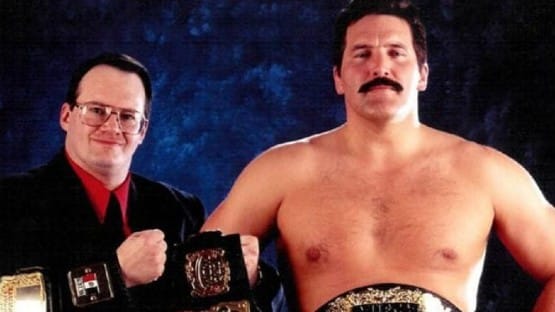
Dan “The Beast” Severn was one of the most decorated amateur wrestlers to ever step foot on the mat and a pioneer in the UFC.
Severn, who joined me for an interview to discuss his legendary career last week, also made a name for himself in the squared circle, taking the professional wrestling world by storm in the 1990s and well into the new millennium.
Severn’s journey in the amateur ranks began in 1969 and led him to the doors of Arizona State University, where he was a two-time All-American. Severn won silver in the 1980 NCAA Division I Wrestling Championship, in the 190-pound weight class.
Severn continued competing as an amateur throughout the 1980s, capturing 13 national AAU wrestling championships and numerous international championships: including a gold medal at the 1986 Wrestling World Cup.
Despite the breadth of his accomplishments, Severn’s goal was to represent his country on the world stage, as an Olympian. Severn tried to qualify for the U.S. Olympic team twice—once in 1984 and again in 1988.
His efforts would go for naught, though “The Beast” did come close in 1984, losing in controversial fashion to eventual gold medalist Lou Banach.
Historically, the Olympic Committee strictly prohibited professional athletes from competing in the Olympics—in an effort to maintain the spirit of amateurism. However, the committee changed its stance towards professionals in 1992, in an effort to allow professional basketball players—most notably in the NBA—to compete in Barcelona.
Finally, Severn could keep his Olympic dreams alive, while being compensated for his hard work.
“In 1992 they allowed amateurs to become involved in professional wrestling. I had a couple of opportunities beforehand in the 1980s, from small companies—who knew my background and thought I had the look—who thought I could do something in the industry,” Severn said. When I finally got the green light, there was a gentleman by the name of Denny Kass who was the president of the Michigan Wrestling Club, but Dennis was also working as a professional wrestler.”
Dan Severn
- Web: www.dansevern.com
- Facebook: Click Here
- Twitter: Click Here
- Instagram: Click Here
- Threads: Click Here
- TikTok: Click Here
While Kass tried to dissuade Severn from entering the professional ranks, “The Beast” was determined. Finally, Kass relented, and introduced him to Al Snow. At the time, Snow managed a pro-wrestling school in Lima, Ohio, known as “Bloody Slammers.”
“That’s why Al was in my corner a couple of different times early in my UFC career,” Severn said. “People would ask what Al Snow knew about the fight world. Well, he was my pro-wrestling trainer.”
Unlike most professional wrestlers of the day, Severn didn’t have a gimmick. Instead, his amateur credentials served as the foundation of his professional persona.
He was a wrestler. Nothing more and nothing less.
And, that made him a perfect candidate for the Union of Wrestling Forces International, better known as the UWFi. The UWFi was a Japanese “shoot-style” professional wrestling promotion that served as a precursor to modern mixed-martial arts promotions. While the matches were predetermined, they blended amateur wrestling, submission grappling, and kickboxing; creating a product that more closely resembled real combat sports.
Severn made his professional wrestling debut on Nov. 25, 1992, in UWFi, against Yuko Miyato, and continued competing for the promotion for the next two years.
While it was the perfect environment for Severn to hone his craft, he left the UWFi in 1994 to embark on a new journey.
In 1994, MMA was still in its infancy. The original Tiger Mask, Satoru Sayama, founded the promotion Shooto, which is widely recognized as the world’s first modern mixed-martial arts promotion, in 1985. In 1993, former UWFi and Fujiwara Gumi wrestlers Masakatsu Funaki, Minor Suzuki and Takaku Fuke formed Pancrase, which became one of MMA’s pre-eminent organizations in the early-to-mid 1990s.
Several months later, UFC 1 was held in Denver—beginning the mixed-martial arts boom in the United States. A boom that has since travelled the world, with UFC events taking place in over 30 countries. It’s truly become a worldwide phenomenon, and that number is surely only set to rise with the number of MMA facilities, from gyms in Beckenham to Wellington.
In 1994, Severn was formally invited to compete in UFC 4.
“It was a tournament,” Severn recalled. “Think about the eight men. The first time you met the other seven competitors was on a Friday night, before the show. I didn’t even know who the other seven competitors were. Then, they used a bingo ball machine to determine the matches.”
In the UFC’s infancy, every show was a tournament—held in one night.
“You didn’t even know who your first opponent was going to be, 24 hours before the show,” Severn said. “Then, you have to realize that the pay-per-views were only two hours long. So, your match might be done, but if the next couple of matches are short, then you have to get back in that cage.”
Still, Severn’s performance was exemplary, reaching the tournament’s finale. While he lost to Royce Gracie, who had previously won UFC 1 and UFC 2, Severn’s UFC debut was a resounding success. So much so that he was invited back for UFC 5.
In the meantime, Severn returned to professional wrestling with more name recognition. Not only was he one of the nation’s most decorated amateur wrestlers, but he was a UFC 4 tournament finalist. With that, a pact was made amongst the promoters of the NWA World Heavyweight Championship, namely Dennis Coralluzzo and Jim Cornette, to crown Severn as the new NWA champion.
On Feb. 24, 1995, Severn made his debut in Cornette’s Smoky Mountain Wrestling, defeating Chris Candido in Erlanger, Ky., to win the NWA title. The victory marked the beginning of his reign with the title and his professional relationship with Jim Cornette.
Two months later, Severn returned to the octagon for UFC 5, in what was dubbed as the “Return of The Beast.” This time, Severn was victorious, defeating Dave Beneteau in the finals and winning the tournament.
Severn’s victory was also a triumph for professional wrestling, as “The Beast” proudly held his NWA World Heavyweight Championship over his shoulder, alongside the UFC 5 Championship.
Severn continued defending his NWA title throughout 1995, until his return to the octagon in December 1995 for the “Ultimate Ultimate.” This time, the tournament featured a mixture of previous winners like Steve Jennum, Oleg Taktarov and Marco Ruas. As well as other standout performers like Paul Varelans, Keith Hackney, Tank Abbot and Dave Beneteau.
Severn was, once again, victorious, winning his second UFC tournament, $150,000, and the Ultimate Ultimate Championship.
In May 1996, Severn competed in UFC 9 against Ken Shamrock for the coveted Superfight Championship. The two had previously met at UFC 6, where Shamrock was victorious—successfully defending his title. This time, it was Severn who proved victorious, winning the Superfight title and becoming the UFC’s first (and only) Triple Crown Champion.
Between his UFC accolades and NWA Championship, Severn was draped in gold and arguably the face of combat sports. The WWF has already acquired Severn’s rival, Ken Shamrock, so it was only natural that they set their sights on “The Beast.”
In 1998, the NWA invaded the WWF, and as the NWA World Heavyweight Champion, Severn led the charge. Accompanied by Cornette, Severn’s credibility made him a lethal force in the WWF.
During his tenure, he competed in the dreaded “Brawl for All,” the “King of the Ring” tournament, and a brief feud with Owen Hart. However, his relationship with the company soured after the creative team approached him with a bizarre idea:
“The road agents approached me and wanted me to become one of Undertaker’s disciples [in the Ministry of Darkness] and write ‘666’ on my forehead—the ‘mark of the beast,’” Severn said.
When Severn refused, the agents threatened to book him in losing efforts, to diminish his stature. Severn wasn’t amused.
“You can ask me to lose matches, but which one of your so-called stars is going to stop me, when I turn fantasy into reality?” Severn said. “The Royal Rumble was on the horizon. I could’ve called WCW and asked for $100,000 to not cooperate? Who would’ve stopped me?”
In the end, “The Beast” chose the path of least resistance. Suffice it to say though, Severn’s time in the WWF came to an end shortly thereafter.
Several weeks after his final match in the WWF, Severn lost his NWA World Heavyweight Championship to Naoya Ogawa in Yokohama, Japan—ending his staggering 1,479-day reign with the championship.
No champion had held the ten pounds of gold that long since Dory Funk Jr.
That includes prestigious company, like Jack Brisco, Harley Race, Dusty Rhodes and Ric Flair.
Severn recaptured the NWA title from New Japan legend Shinya Hashimoto in 2002, but his second reign was brief—dropping the title a month later. However, Severn’s career continued well into the 2020s, performing as recently as 2023, at 64 years of age.
In 2005, Severn’s was enshrined in the UFC Hall of Fame’s pioneer wing. At the time, Severn was only the third fighter to be inducted, behind two of his rivals, Royce Gracie and Ken Shamrock.
In 2018, Severn was inducted into the George Tragos/Lou Thesz Professional Wrestling Hall of Fame—honoring the summation of his work in professional wrestling.
Today, Severn lives a more sedentary life—splitting the bulk of his time between Michigan and Arizona. His commitment to the martial arts has not waned, though. Severn still travels the country for speaking engagements and seminars, sharing his wealth of experience with young athletes and law enforcement.



 Share
Share

Chris Graham