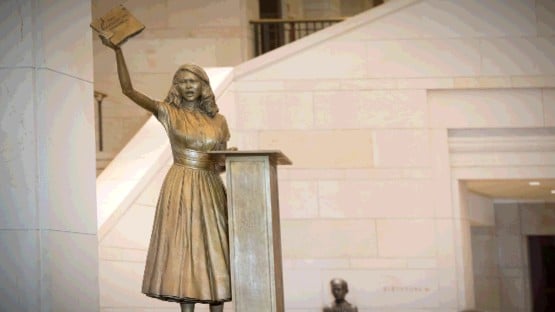
A statue of Barbara Johns, who at the age of 16 led a walkout at her Prince Edward County high school that was the foundation of the U.S. Supreme Court case that led, “with all deliberate speed,” to school desegregation, now stands alongside George Washington representing Virginia the U.S. Capitol’s Statuary Hall.
It has to chap the oversized keisters of the MAGAs that this statue honoring Johns replaces one of Robert E. Lee that had stood alongside Washington since 1909.
You know, because Robert E. Lee was a distinguished White gentleman, but more so, because Lee was the guy who literally led the army of the side in our Civil War that was fighting to maintain slavery.
“At the age of 16, Barbara Johns refused to accept inequality in our public schools. Her determination led to the lawsuit Davis v. County School Board of Prince Edward County, which ultimately became part of the landmark case of Brown v. Board of Education of Topeka. Her strength and unwavering belief in equality and justice helped change the entire nation for the better. It is hard to think of a better example of a Virginian to represent the Commonwealth in the United States Capitol,” said Bobby Scott, a Democrat who represents the Third District, based down in Hampton Roads, in the U.S. House, at the unveiling of the Barbara Johns statue on Tuesday.
Johns was selected for the honor of representing Virginia alongside George Washington by the Virginia Commission for Historical Statues in the United States Capitol in 2020, following its decision to replace the statue of Lee, which was only about 111 years too late, give or take, in coming.
From the AFP archives
- Virginia removes Lee statue from U.S. Capitol collection (Dec. 21, 2020)
Note that the commission acted in 2020. That meant our now-outgoing governor, Glenn Youngkin, a MAGA who has done everything he can to push civil rights back toward Jim Crow in his four years in Richmond, wasn’t part of the process.
Color me shocked that Youngkin didn’t try to stop things from moving forward.
The guy was actually at the ceremony in DC on Tuesday, as if having his cronies fire the superintendent at VMI because he is Black, among his many anti-diversity initiatives, never happened.
Back to Barbara Johns: she was a student at the “separate but equal” Robert Russa Moton High School in Farmville in 1951, and if you’re not familiar with the history, the school was certainly separate – schools in Virginia had been segregated for decades – but anything but equal.
The school had been built to accommodate 200 students, but enrollment was more than double that number in 1951.
Per an account from Johns’ sister, Joan:
In winter the school was very cold. And a lot of times we had to put on our jackets. Now, the students that sat closest to the wood stove were very warm and the ones who sat farthest away were very cold. And I remember being cold a lot of times and sitting in the classroom with my jacket on. When it rained, we would get water through the ceiling. So there were lots of pails sitting around the classroom. And sometimes we had to raise our umbrellas to keep the water off our heads. It was a very difficult setting for trying to learn.
The walkout, on April 23, 1951, had students marching to the county courthouse to take their grievances directly to the school superintendent, TJ McIlwaine, whose dismissive response led students to decide to strike.
Their initiative got the attention of the NAACP, which filed suit on behalf of the students; the case eventually was rolled into the Brown case, which the U.S. Supreme Court finally decided, in 1954, in favor of the plaintiffs, ordering the desegregation of all public schools in the U.S.
It’s noteworthy here that the crackers in Prince Edward County didn’t just up and give in – the school board there actually closed public schools for five years, and opened private schools for White students funded by public tax dollars.
You don’t need to even ask if they did anything for Black students for those five years.
Schools in Prince Edward would finally be desegregated in 1964 – 13 years after the 1951 walkout.
And now, here we are, another six decades later, finally doing our part to mark an event that historians point to as the flashpoint that launched the civil rights movement.
“Her courage forced this country to reckon with its conscience on a scale much larger than she ever could have imagined,” U.S. Sen. Mark Warner, D-Va., said at the unveiling on Tuesday.
“There is a line in the Book of Isaiah, ‘And a little child shall lead them,’ that reminds me of Barbara Rose Johns and the incredible bravery and leadership she displayed when she walked out of Moton High School in Farmville,” U.S. Sen. Tim Kaine, D-Va., said at the unveiling on Tuesday.
“I’m thrilled that millions of visitors to the U.S. Capitol, including many young people, will now walk by her statue and learn about her story. May she continue to inspire generations to stand up for equality and justice,” Kaine said.

 Share
Share

Chris Graham