Are you new to the world of model railroading?
Perhaps you got your inspiration from the tons of model railroad displays you found on TV and social media, and now you feel challenged to come up with ideas for your own layout.
Well, you’re about to have one of the best times of your life.
If anything, making a model railroad is absolutely fun, and you’ll be glad you embarked on this adventure.
However, as a beginner, you’ll likely encounter a series of challenges in need of answers. Without proper clarifications, you might get stuck or make costly mistakes.
To help you avoid all that, we’ve compiled a list of answers to some of the commonest questions asked by newbie railroaders.
Read on to find out about them!
The size and scale of your railroads
The first thing you need to worry about when you start building your railroad is the size and scale of the trains.
Since what you’re building is a model, it’s only logical that it resembles the real thing in every way and form. However, you need not forget that all you have available is a small space to fit all the structures, miniature figures, trains, and other relevant elements.
Scale is the model’s proportion to the real thing, and although there are larger-scale trains including G scale (1:22.5) and O scale (1:48), the most popular sizes are the HO (1:87.1), N scale (1:160), and in the UK OO (1:76.2) scale.
Whatever train sizes you choose, bear in mind that that’s what will determine the amount of space required to build your railroad layout.
Look for the best model trains and miniatures
Your model railroad scenery will be incomplete if it doesn’t feature elements like model trains, miniature figures, and model buildings.
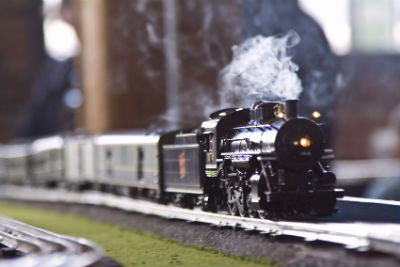
For example, if you’re building a model railroad representing a train station in the 19th century, you have no choice but to add elements like a locomotive train covered in soot, train cars carrying cargos of coal/wood, old-fashioned structures for freights and passengers.
These are the elements that give “life” to the model railroad.
To bring these elements into the picture, you might need to spend a few dollars or get creative with what you have.
For example, you might need to cut out figures from magazines to use as background in your railroad diorama, download, and print paper model buildings from sites like Modelbuildings.org to use as freight buildings, and shop for model toy trains.
Decide on the time and place ASAP
The day you decide you want to build a model railroad is the day you need to settle on the time and place to focus on. For some people, this can be “a time and place” from a book they read or a movie they saw.
For others, it could be a railroad they visited recently.
Equip yourself with the right knowledge
As a newbie railroader and a tech-savvy person, you might think that the internet is the only place to look to get the inspiration and tips you need to build your railroads.
On the contrary, there are lots of experts in the business of railroading – folks who have enjoyed huge successes building model railroads over the years.
Kalmbach Books has a library full of inspirational and educational tips from experts that cover various aspects of model railroading, including track plans, benchwork, scenery, wiring, gluing, assemblage, etc.
Pick the best materials for layout
The point where you begin the layout is where the bulk of the work starts, and as such, you want to ensure you pick the best of materials to use.
Normally, the commonest material people use for their layouts is plywood. And the acceptable grade is either grade AC or BC.
As far as sizes go, most modelers start with a 4 X 8-foot layout. And the fasteners they use are wood screws, glue, or the combination of both.
Use generous curves as much as possible
Most train sets come with tight radius curves for use with short cars, small steam locomotives, and four-axle diesels. The larger radius curves don’t force the trains to their mechanical limits, so they’ll run smoother.
Most scale turnouts (switches) branch away from the straight route at an angle instead of the sharp curve found in the toy train track. Scale turnouts are specified by a number that indicates this diverging angle: a no. 6 turnout has a 1:6 ratio, and a no. 4 has a sharper 1:4 ratio. Like the wider curves, a higher number of turnouts work better with long cars and large locomotives.


 Share
Share

AFP