It’s perfect for me, as a writer, that the first bye week in the 2025 season for UVA Football comes after six games, the midway point.
It can be hard to squeeze a midseason report card into a week of game prep; and also, would you really want a 5/12ths-season report card, or a 7/12ths-season report card, if the first bye had come sooner, or later?
(You might not care to read this one.)
As it is, we’re halfway through, we’ve got plenty of numbers, and with three ACC games under our belt, plus the nonconference game with NC State, which is an ACC school, but the ACC is so big that we would never play them without pretending that they’re nonconference, ahem, sorry, I’ve digressed.
Seems to me, we can start making some assumptions about this group.
QB: Man, I love that Chandler Morris
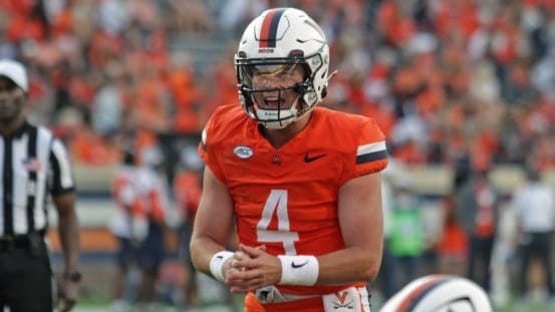
I’ll start off telling you how much I love that Chandler Morris by first telling how you well Anthony Colandrea is playing out at UNLV.
Colandrea, last year’s QB1, didn’t start the opener at UNLV, but took over early in the first game, and his numbers are solid – 69.5 percent completion rate, 208.4 passing yards per game, nine TDs, one rushing TD, 345 sack-adjusted rushing yards.
The negatives: 13 sacks, three INTs, three fumbles.
UNLV is 5-0, so, good for them, good for him.
Colandrea wouldn’t be doing what Chandler Morris has been able to do for UVA this season.
Morris’s numbers: 69.9 percent completion rate, 238.0 passing yards per game, 204 sack-adjusted rushing yards, 11 passing TDs, four rushing TDs, four sacks, four INTs, one fumble.
The UVA offense, which ranked 93rd nationally in 2024, averaging 360.9 yards per game, is several levels beyond what we saw the past couple of years.
The 2025 ‘Hoos are averaging 489.2 yards per game, which ranks 13th nationally, and UVA is 10th in scoring, at 43.0 points per game, up from the 21.6 points per game the UVA offense put up in 2024, which ranked 105th nationally.
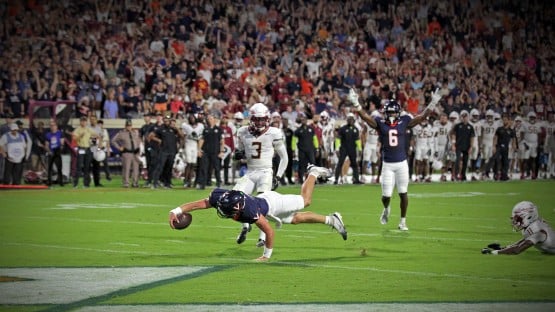
What Morris does that Colandrea didn’t do is most noticeable in the area of decisiveness, which is quantified in the sacks numbers.
Morris knows what the defense is doing – and either gets rid of the ball, or pulls it down and gains yards with his feet.
The two back-to-back bad-read INTs in the FSU game are a case in point to the trust that offensive coordinator Des Kitchings has in him.
Two INTs from Colandrea would have changed the play-calling dramatically last year, but Kitchings had the faith in his guy to continue pushing, and Morris was able to bounce back from the bad decisions to lead Virginia on a TD drive that turned the momentum back into the Cavaliers’ direction.
There’s actually a running game!
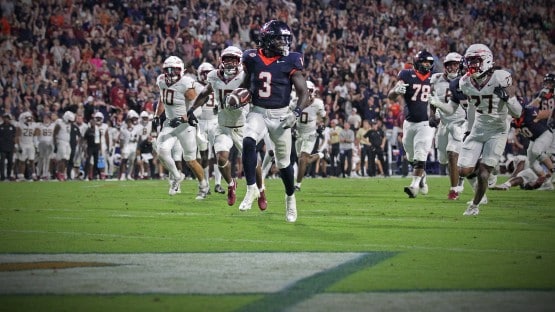
We’ve been hearing it since the Mike London years – this is the year that we’re going to establish the run.
Finally, in 2025, the run is established.
The 2024 group averaged 131.9 rushing yards per game, which ranked 94th nationally; the 2025 group, at the midpoint of the season, is putting up 217.5 yards per game, which ranks 19th.
J’Mari Taylor, a former North Carolina Central walk-on, has been a revelation – averaging 77.5 yards per game, 5.1 yards per game, with eight TDs – but he’s one of four guys who Kitchings can count on to get the tough sledding.
Backups Harrison Waylee and Noah Vaughn have each had 100-yard games this season, and Xavier Brown is second on the team in rushing with 227 yards.
O line: Grading on a curve
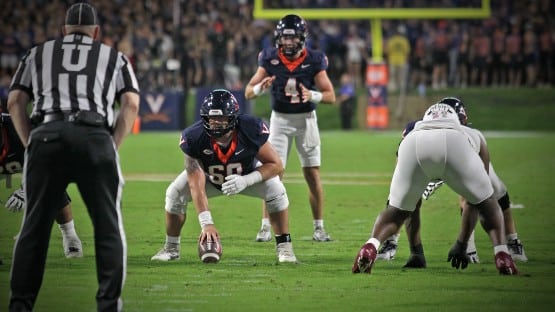
It’s a testament to the depth that head coach Tony Elliott and general manager Tyler Jones was able to bring in ahead of the season that Virginia has been able to be productive despite a spate of injuries to starters on the O line.
The Week 1 starter at right tackle, Wallace Unamba, went down after 20 snaps; starting center Brady Wilson has had to miss the past two games after an injury in the second half of the Week 4 win over Stanford, forcing the move of starting right guard Drake Metcalf to center in his stead; and last week, starting left tackle McKale Boley was injured in the first half of the OT win over Louisville, beginning another game of musical chairs for O line coach Terry Heffernan.
Even with the issues, the line has allowed just five sacks, and has been able to clear the way for the run game to put up big numbers.
D: Good work up front
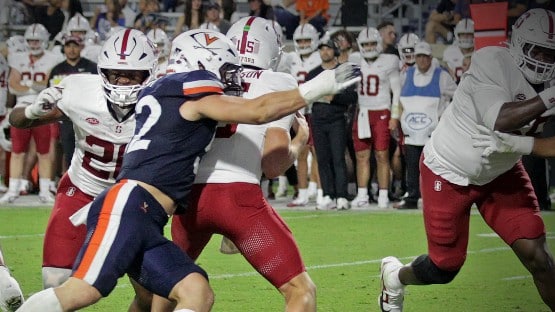
The Virginia D is second in the ACC and tied for 12th nationally with 16 sacks, after recording a total of 19 in 12 games in 2024.
Daniel Rickert, a smallish (6’2”, 232-pound) edge rusher who transferred in from Tennessee Tech, leads the unit with 24 QB pressures and four sacks.
It’s one thing for Rickert to have 12 sacks (as he did in 2023) at the FCS level, but, the kid has been a find, we can just leave it at that.
Mitchell Melton, a more traditionally sized edge rusher – 6’4”, 256 – who transferred in from Ohio State, has 19 pressures and three sacks.
Melton has also been a big contributor in the run D – with 16 run-game tackles, ranking second on the unit (safety Devin Neal leads with 21).
I also like what we’ve seen from UNLV transfer Fisher Camac, who only has four pressures from the edge, but has a sack, and 15 run-game tackles, and two batted passes, which leads the team.
Secondary: work in progress (we hope)
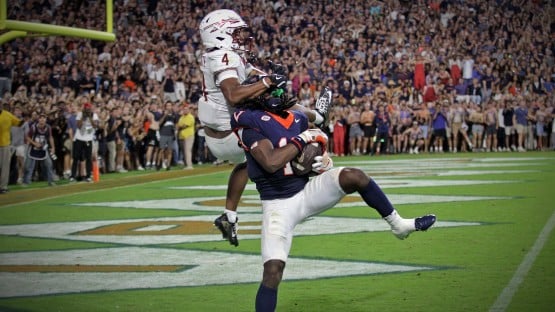
The pass defense is ranked 11th in the ACC in pass efficiency allowed and in yards per game.
Going into the season, I had liked what Elliott, Jones and defensive coordinator John Rudzinski had done to staff the secondary, but the corners, Jordan Robinson (146.7 NFL passer rating against), Donavon Platt (142.5 NFL passer rating against) and Emmanuel Karnley (112.0 NFL passer rating against) are just not getting the job done.
Neal is the top-graded defender, per Pro Football Focus, with an 81.0 grade through six games; he leads the team in tackles (30) and pass breakups (four) and has held opponents to an 82.8 NFL passer rating against.
Special teams
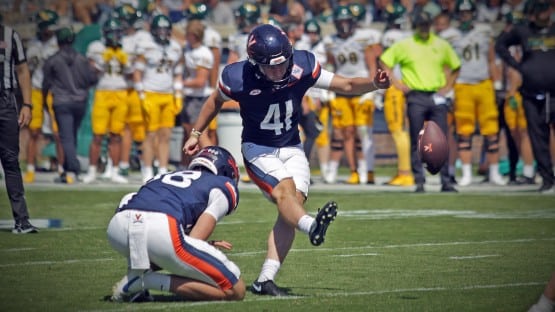
For all the hell I’ve given placekicker Will Bettridge, his 39-yard field goal that sent the FSU game to a second OT is the play of the year to date, and he got a 46-yarder through in the second half of the eventual OT win at Louisville.
Credit here to Elijah Slibeck, the backup punter, who is the reigning and defending ACC Specialist of the Week after averaging 47.4 yards per boot in the Louisville win, with his 71-yarder, downed at the 1, flipping the field ahead of the Bettridge field goal.
Cam Ross is a threat in the return game – he returned a kickoff for a TD in the 48-7 Week 1 win over Coastal Carolina, and his 48-yard punt return in the Week 2 loss at NC State helped set up a short-drive TD.
The kickoff-coverage team is doing its job – opponents have an average starting field position of 25.1, which is basically a sliver beyond the touchback.
Support AFP

 Share
Share

Chris Graham