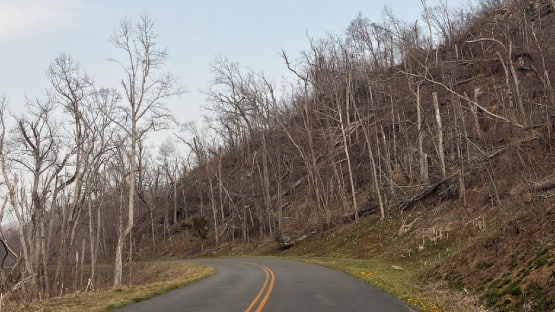
The National Park Service will be working beginning this summer to remove hazardous, storm-generated tree debris from six areas with elevated wildfire risk along the Blue Ridge Parkway in Virginia and North Carolina.
The debris in question are remnants from Hurricane Helene, which you may remember as the storm that the Trump regime exploited during the 2024 presidential campaign, then forgot.
Predictably, it didn’t just go away – the debris from Helene has accumulated in volumes and locations that present a clear wildfire risk to communities, homes and other resources.
Areas identified as having elevated risk and where removal work will take place, include:
- Galax and Hillsville: 292 acres between mileposts 205–215
- Laurel Springs: 129 acres between mileposts 249–267
- Boone: 769 acres between mileposts 280–300
- Linville Falls: 527 acres between mileposts 310–319
- Little Switzerland: 325 acres between mileposts 324–341
- Asheville: 829 acres between mileposts 374–396
As work takes place in these areas, park visitors and neighbors can expect intermittent traffic delays due to one-lane closures.
The park aims to complete initial fuel removal work by spring 2027.
The park will hold three open-house-style informational meetings for neighbors, adjacent communities, stakeholders and anyone interested in the project:
- May 5 (5-7 p.m.): WCC at Crossroads, 1117 East Stuart Drive, Galax
- May 6 (5-7 p.m.): Blue Ridge Parkway Visitor Center, milepost 384, 195 Hemphill Knob Road, Asheville
- May 7 (5-7 p.m.): Caldwell Community College, Watauga Campus, at the Watauga Student Commons, 460 Community College Drive, Boone



 Share
Share

Chris Graham