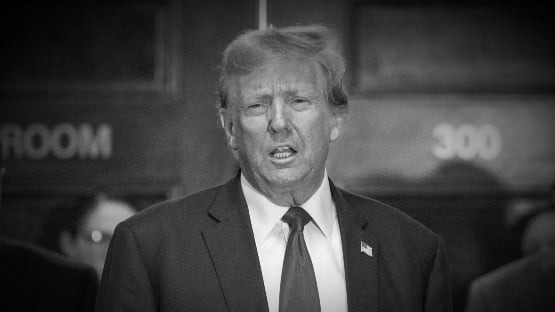
Congressional passage of Donald Trump’s “Big, Beautiful Bill” provides the latest evidence that human greed, despite its primitive nature, remains alive and well.
Perhaps most noticeably, the legislation provides for over $3 trillion in tax cuts that disproportionately help the wealthy and their corporations. This largesse is facilitated by slashing over $1.4 trillion in healthcare and food assistance for low-income Americans and increasing the national debt by $3.3 trillion. Estimates reveal that at least 16 million Americans will lose healthcare coverage and 7 million people (including two million children) will lose food aid or have their food aid cut significantly. Meanwhile, according to the Yale Budget Lab, the nation’s top 0.1 percent―people with an annual income over $3.3 million―will receive tax cuts of $103,500 on average. Condemning the legislation, the president of the U.S. Conference of Catholic Bishops declared simply that it “takes from the poor to give to the wealthy.”
Other measures in the legislation supporting the wealthy and their businesses at public expense include financial subsidies for coal, oil, and gas companies, the opening of opportunities for oil and gas corporations to drill on public lands (including the Arctic National Wildlife Refuge and the National Petroleum Reserve), and the reduction of royalty fees for such fossil fuel drilling.
Of course, this kind of class legislation and the greed that inspires it are nothing new. Throughout history, some people have amassed great fortunes, often with the assistance of governments and other powerful entities. Kings, princes, and their courtiers provided themselves with castles, vast landed estates, and other perquisites of wealth, while millions of their subjects lived in miserable huts and dug a few potatoes out of their fields in a desperate effort to survive. In later years, this situation was replicated to some extent as business titans garnered great wealth by exploiting workers in factories, mines, and fields.
Although this pattern of economic inequality was viewed as immoral by every great religious and ethical system, it did have a brutal logic to it. After all, in these situations of overall scarcity, some people would be poor and some would surely die. By contrast, growing rich helped guarantee survival for oneself and one’s family.
But with the advent of the industrial revolution, these tragic circumstances began to dissipate, for human beings increasingly possessed the knowledge, skills, and resources that had the potential to produce decent lives for everyone. Indeed, as science, technology, and factory output advanced and produced unprecedented abundance, there was no longer any morally justifiable basis for the existence of hunger, homelessness, and mass sickness.
In these altered conditions, avarice has become increasingly irrational―the driving force behind irrational men like Donald Trump and his billionaire friends, who, even as millions of people live and die in poverty and misery, seek to wallow in great wealth.
Gandhi put it concisely when he declared, decades ago: “The world has enough for everyone’s need, but not enough for everyone’s greed.”
Fortunately, over the course of human history, humane thinkers, social movements, and political parties have worked to rein in untrammeled greed in the interest of a better life for all humanity. In recent centuries, they have recognized the fact that sharing the wealth is not only a moral stance, but a feasible one.
Let’s hope, then, that despite this brazen and regressive move by the Trump administration to bolster economic privilege at the expense of human needs, the forces favoring human equality and compassion will ultimately prevail.
Dr. Lawrence Wittner, syndicated by PeaceVoice, is Professor of History emeritus at SUNY/Albany and the author of Confronting the Bomb (Stanford University Press).
Support AFP

 Share
Share