“Since when have we Americans been expected to bow submissively to authority and speak with awe and reverence to those who represent us? The constitutional theory is that we the people are the sovereigns, the state and federal officials only our agents. We who have the final word can speak softly or angrily. We can seek to challenge and annoy, as we need not stay docile and quiet.”
— Justice William O. Douglas, dissenting in Colten v. Kentucky (1972)
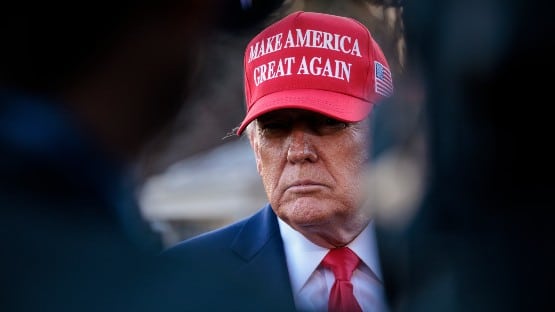
President Trump has no problem criticizing, condemning, insulting, demonizing and threatening those who refuse to fall in line.
He has branded political opponents “communists,” denounced critics as anti-American, lashed out at NATO allies, threatened to cut off trade with Spain, and referred to Iran’s leaders as “scum” amid the ongoing war.
In Trump’s America, the president is free to call other nations bad actors, label his opponents dangerous, and treat disagreement as betrayal.
But dare to criticize Trump, his administration, ICE, the police state, the war machine, the surveillance state, or the government’s steady assault on the Constitution, and you may find yourself treated as the threat.
This is the hypocrisy of the moment: those in power claim an unlimited right to criticize everyone else, while increasingly denying the people the right to criticize them.
Criticize the government, question the police state, object to ICE raids, oppose war, challenge corruption, reject propaganda, refuse to salute the party line, or insist that public officials obey the Constitution, and you may find yourself accused of being anti-American, extremist, subversive, ungrateful, communist, terrorist-adjacent or worse.
This is how free speech dies: not all at once, but by redefining dissent as disloyalty.
Yet the First Amendment was not written to mandate flattery and applause for those in power. It was written to safeguard the right of the people to criticize, condemn, expose, challenge and resist government abuses without fear of being investigated, surveilled, threatened, prosecuted or treated like enemies of the state.
The American Revolution itself began as an act of criticism.
The Declaration of Independence was a bill of complaints against a government that had abused its power, violated the rights of the people, used the military to intimidate civilians, obstructed justice, imposed unjust burdens, and treated resistance as rebellion.
By today’s standards, the Founders would likely be labeled extremists, agitators, radicals, anti-government dissidents and threats to national security.
What was once rebellion against tyranny is now being recast as a warning sign of extremism.
That is the police state’s playbook for discrediting dissent: start with finger-pointing and name-calling, then turn criticism into subversion, dissent into danger, and those who demand accountability into enemies of the state.
On cue, President Trump and his allies have increasingly wrapped political opposition in the language of extremism, communism, terrorism and anti-Americanism.
We have seen this movie before. It was called McCarthyism.
Then, as now, the charge of “communism” was less about ideology than control: a smear used to discredit critics, frighten citizens, ruin reputations, trigger investigations, justify blacklists and make government power appear patriotic.
The accusation did not have to be true. It only had to be useful.
In the Trump administration’s telling, criticism of the country is evidence of ideological rot, radicalism or disloyalty. The message is unmistakable: love America or leave it; praise it or be punished; comply or be watched, surveilled and targeted.
That is not patriotism. That is tyranny dressed up in red, white and blue.
This campaign against dissent is not limited to protests, political speeches or social media posts. It extends to the past itself.
Consider the administration’s war on historical memory.
The Trump administration has now accused the Smithsonian’s National Museum of American History of pushing “extreme political activism.” In a 162-page report, the White House has attacked the museum for presenting aspects of American history that do not conform to the administration’s preferred ideology.
The Smithsonian’s offense, apparently, is that it has failed to sufficiently sanitize its depiction of American history by removing references to slavery, exploitation, Native displacement, civil rights struggles, labor unrest, police abuses, government lies, war crimes and the long, hard fight to make the words “We the People” mean something more than political decoration.
This is not about history. It is about whitewashing history.
A government that gets to dictate how the past is remembered will soon dictate how the present may be discussed. A government that insists museums must celebrate America rather than tell the truth about America is not defending patriotism. It is manufacturing propaganda.
In an Orwellian throwback to 1984’s requirement that “you must love Big Brother. It is not enough to obey him: you must love him,” the Trump administration has proposed installing signs at every entrance to the Smithsonian’s exhibits that read, “Warning: the exhibits in this museum were prepared by people who don’t want you to love your country.”
History is not supposed to be a Hallmark card. It is supposed to be a warning.
That same demand for state-mandated devotion — the insistence that to love America one must flatter it, sanitize it and never demand better of it — was on display in the backlash to New York City Mayor Zohran Mamdani’s 250th anniversary remarks invoking the promises of the Declaration of Independence.
Whatever one thinks of Mamdani’s politics, the reaction to his speech was telling. Critics blasted the speech as ungrateful, divisive and hostile to American values, and Mamdani was denounced as anti-American for daring to suggest that America’s greatness lies not in pretending that its promises have already been fulfilled but in demanding that they be fulfilled for all.
Yet that is precisely what the Declaration of Independence was about.
The Declaration was a protest document. It did not flatter the king. It accused him. It did not praise the empire. It indicted it. It did not say, “Everything is fine.” It said the government had become destructive of the rights it existed to secure.
That is the American tradition.
Not government-approved history. Not obedience to presidents, police, generals, bureaucrats or political parties.
The American tradition is dissent. The American tradition is resistance to tyranny.
The American tradition is the right — and the duty — to criticize the government.
This is why the First Amendment stands first as a chain placed around the neck of government power: Freedom of speech. Freedom of the press. Freedom of religion. Freedom of assembly. The right to petition the government for a redress of grievances.
These are not separate freedoms. Together, they protect the ability of the people to speak, gather, organize, investigate, expose, protest and demand accountability from those who govern in their name.
Without the right to criticize the government, every other right becomes conditional.
Once the government is allowed to decide which criticism is patriotic and which criticism is dangerous, the Bill of Rights becomes a permission slip. Rights once guaranteed become privileges reserved for those who flatter power, obey orders and keep their grievances to themselves.
Once criticism is treated as extremism, constitutional rights become privileges reserved for the compliant.
This is why the government’s increasing tendency to equate dissent with danger should alarm every American, regardless of party.
We have already seen what this looks like.
Americans who criticize ICE online, write angry emails to government officials, document raids, protest enforcement actions, or speak out against official misconduct increasingly risk visits, warnings, subpoenas, surveillance or investigations by the government’s secret police.
The government does not need to jail everyone in order to silence a population. It only needs to make examples of a few.
A knock on the door. A warning from agents. A subpoena. A phone call from law enforcement. A file opened. A name entered into a database. A social media post flagged. A protest monitored. A journalist questioned. A nonprofit investigated. A student visa threatened. A donor list scrutinized. A museum audited. A professor disciplined. A mayor denounced as anti-American. A citizen taught to think twice before speaking again.
This is how a free people are trained to censor themselves.
Let us be clear: violence and true threats can and should be investigated. No one has a constitutional right to assault, threaten, stalk, bomb, kill or terrorize.
But criticism is not violence. Anger is not terrorism. Dissent is not extremism. Opposition is not treason. Petitioning the government for redress of grievances is not a crime. It is the essence of citizenship.
Yet every administration, sooner or later, discovers the convenience of labeling its critics as threats.
John Adams used the Sedition Act to punish critics of the federal government. Woodrow Wilson used the Espionage and Sedition Acts to prosecute antiwar speech. Richard Nixon kept enemies lists. George W. Bush gave us the Patriot Act, warrantless surveillance, watchlists and the language of “with us or against us.” Barack Obama targeted whistleblowers. Joe Biden’s administration leaned on agencies and platforms in the name of combatting misinformation and domestic extremism. Donald Trump has taken all of that machinery and openly aimed it at political enemies, protesters, immigrants, journalists, universities, museums, law firms and anyone else who refuses to bow.
Do not make the mistake of thinking this is merely a Trump problem.
Trump is not the disease. He is the symptom.
The disease is power.
The disease is a government that believes it may define truth, patriotism, extremism, history, loyalty and acceptable opinion. The disease is a police state that has learned to speak in the language of safety, order, border security, anti-terrorism, anti-communism, anti-radicalism, public health, national unity and American greatness.
The disease is the dangerous idea that government exists to be obeyed rather than restrained.
The Founders knew better.
They did not trust government. They bound it down.
They did not assume that rulers would be virtuous. They divided power, checked power, limited power and gave the people the tools to expose and resist power.
They understood that the greatest threat to liberty would not come from citizens criticizing the government. It would come from government officials who believed themselves entitled to silence criticism.
That is why the right to criticize government cannot be treated as a partisan indulgence.
No matter which party holds power, the people must be free to criticize the government.
When Republicans are in power, Democrats must be free to criticize the government. When Democrats are in power, Republicans must be free to criticize the government.
When police, ICE, the military, the courts, Congress or the president abuse their authority, citizens must be free to say so — loudly, publicly and without fear of being branded enemies of the state.
This is not incitement. This is accountability.
A government that cannot tolerate criticism does not deserve power. A president who treats dissent as disloyalty has betrayed his oath of office. A nation that punishes its truth-tellers has lost sight of its principles.
And a people who self-censor because they are afraid to criticize their government are no longer free.
This is the great danger of the moment.
We are being told that to love America, we must stop seeing what has been done in America’s name. We must stop talking about the bodies, the prisons, the raids, the wars, the surveillance, the corruption, the cages, the lies, the poverty, the brutality, the stolen land, the stolen labor, the broken treaties, the broken families, the broken promises and the broken Constitution.
We are being told that patriotism requires amnesia.
That is a lie.
Real patriotism is not worship of government. Real patriotism is not loyalty to a president. Real patriotism is not blind obedience to police. Real patriotism is not a flag big enough to cover up injustice.
Real patriotism is the willingness to tell the truth about your country because you believe it can and must be better.
Those who criticize America are often the only ones still taking America seriously.
The abolitionists were called agitators. The suffragists were called radicals. The labor organizers were called subversives. The civil rights marchers were called outside agitators and communists. The antiwar protesters were called traitors. The whistleblowers were called criminals. The journalists were called enemies of the people. The immigrants demanding dignity are called invaders. The citizens filming police are called threats. The protesters opposing ICE are called extremists. The historians telling the truth are called activists.
The pattern never changes. Power always has a vocabulary for discrediting those who challenge it. Yet history has repeatedly vindicated the critics.
America did not become freer because citizens kept quiet. America became freer because citizens made themselves impossible to ignore. They marched. They wrote. They spoke. They published. They exposed. They resisted. They refused to comply with unjust laws. They demanded amendments. They challenged police. They sued officials. They filled jails. They confronted presidents. They forced the country to look in the mirror.
That is not anti-American. That is how America survives.
The irony is that the loudest defenders of “American greatness” are often the most eager to criminalize the very conduct that made America possible.
They celebrate 1776 while condemning the spirit of 1776. They praise the Founders while fearing the people. They quote the Declaration while attacking those who petition for redress of grievances. They wrap themselves in the flag while trampling the freedoms for which the flag is supposed to stand. They call themselves patriots while demanding servility.
They insist that America is exceptional while treating the Constitution as optional.
They want citizens who salute, not citizens who think. They want history without victims, rights without resistance, liberty without dissent, and patriotism without conscience.
That is not freedom. That is authoritarianism with fireworks.
In such a climate, silence is surrender.
When the government claims the power to decide what history may be taught, what speech may be tolerated, what criticism may be investigated, what protest may be monitored, what viewpoint may be flagged, and what truths may be spoken, the people have a duty to push back.
We must insist that the First Amendment protects the speech government hates most. We must insist that criticizing ICE is not a crime. We must insist that criticizing the president is not treason. We must insist that criticizing police is not extremism. We must insist that criticizing America’s failures is not anti-American. We must insist that history belongs to the people, not to politicians. We must insist that no president, no agency, no party and no bureaucrat gets to decide what patriotism requires.
We must insist that the Constitution means what it says.
After all, the government works for us — not the other way around. The moment Americans forget that, the experiment in self-government is over.
So criticize the government.
Criticize it loudly. Criticize it relentlessly.
Criticize it when it spies, lies, censors, raids, detains, prosecutes, propagandizes, militarizes, profiteers and abuses.
Criticize it when it rewrites history, calls truth anti-American, mistakes obedience for patriotism, and forgets that “We the People” are the masters and the government is the servant.
That is the duty of a free people.
As I make clear in Battlefield America: The War on the American People and its fictional counterpart The Erik Blair Diaries, the police state does not need everyone to agree with it. It only needs enough people to fear disagreeing with it.
We do not owe the government our silence.
We owe the Constitution our vigilance.



 Share
Share