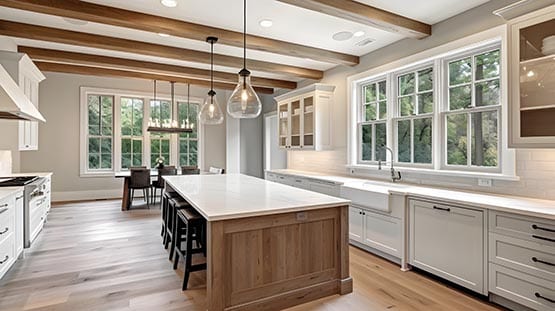
As we move through 2026, the Dallas-Fort Worth (DFW) metroplex continues to defy national real estate cooling trends. Driven by a decade of corporate migration and a sustained influx of high-net-worth professionals, the Dallas housing market has evolved into a “flight to quality” environment. In this landscape, the distinction between a “house” and a “prime asset” often comes down to the quality of the permanent infrastructure.
Among the various home improvements available to North Texas homeowners, none carries the weight — both aesthetically and financially — of hardwood flooring. In 2026, hardwood is no longer viewed merely as a design choice; it is a strategic investment in a property’s “Layer 0.” For a market as discerning as Dallas, where architectural styles range from the historic charm of Lakewood to the sleek, glass-heavy designs of West Plano, hardwood provides the essential foundation for value appreciation.
The Dallas real estate resilience of 2026
The North Texas market in 2026 is defined by a sophisticated buyer who prioritizes “move-in ready” excellence. The days of the speculative fixer-upper have largely given way to a demand for finished, high-specification interiors. Buyers relocating from coastal tech hubs or international financial centers bring with them an expectation of premium materials.
In competitive neighborhoods like Preston Hollow or the Park Cities, flooring is the first thing a prospective buyer notices. It sets the “thermal and acoustic” tone of the home. Properties featuring high-end, wide-plank hardwood consistently see shorter “days on market” (DOM) compared to those with synthetic alternatives. The reason is simple: hardwood suggests a level of permanence and structural integrity that aligns with the premium price points of the Dallas market.
The humidity equation: Hardwood in the North Texas climate
One of the most misunderstood aspects of homeownership in Dallas is the relationship between materials and the local climate. North Texas is a region of extremes, characterized by blistering summers, sudden “Blue Northers” in the winter, and significant humidity spikes in the spring. These environmental shifts present a technical challenge for natural materials.
In 2026, the technical solution for the Dallas home is almost exclusively engineered hardwood. While solid hardwood remains a classic choice, engineered planks are specifically designed to handle the expansion and contraction cycles of the Texas climate. By layering a real wood veneer over a multi-ply, cross-grained core, these floors provide the same visual and tactile experience as solid wood but with significantly higher dimensional stability. This is a critical factor in Dallas, where a home’s HVAC system works overtime to manage the transition from 105-degree heat to high-humidity rain cycles. Proper acclimation and professional installation ensure that the floors remain “gap-free” and silent for decades.
The ‘light and wide’ aesthetic: 2026 design trends
The “Texas modern” aesthetic has reached its maturity in 2026. This design movement focuses on the marriage of natural materials with open-concept, light-filled spaces. The current trend favored by Dallas interior designers is the shift toward light-toned oaks, particularly European White Oak, and wide-plank formats.
- Wide planks (7″ to 10″): These create a sense of scale and continuity, making large Dallas living rooms feel more cohesive and less cluttered by “seams.”
- Natural and matte finishes: Gone are the high-gloss, cherry-toned floors of the early 2000s. In 2026, Dallas homeowners prefer wire-brushed or low-luster finishes that highlight the grain and texture of the wood, providing a more organic, “grounded” feel.
- Neutral palettes: Light greys, soft blonds, and sandy tones have become the standard. These colors interact beautifully with the intense Texas sun, reflecting light deeper into the home and creating an airy, expansive atmosphere.
This aesthetic shift is not just about fashion; it is about architectural compatibility. Whether the home is a Mid-Century Modern in Northaven or a new build in Frisco, light-toned hardwood serves as a neutral canvas that accommodates evolving decor trends while maintaining its own inherent value.
Longevity vs. fast fashion: The sustainability of hardwood
As consumers in 2026 become more environmentally and financially conscious, the concept of “fast fashion” in home decor is being rejected. Homeowners are looking for materials that won’t end up in a landfill in ten years.
Hardwood is the ultimate sustainable choice because of its lifecycle. Unlike luxury vinyl plank (LVP) or laminate — which must be completely torn out and replaced when damaged or outdated — hardwood can be refinished. A high-quality engineered or solid wood floor can be sanded and re-stained multiple times over several decades. This allows the homeowner to “update” the look of their entire house without the environmental or financial cost of a total replacement. In the eyes of a 2026 appraiser, a floor that can last for 50 to 80 years is a far superior asset to one with a 15-year lifecycle.
ROI analysis: The hardwood appreciation factor
From a strictly business perspective, hardwood flooring remains one of the few home upgrades with a reliable return on investment (ROI). Real estate data for the DFW area suggests that high-quality hardwood can increase a home’s valuation by anywhere from 2.5% to 5%.
In a $1,000,000 Dallas home, that represents a $50,000 equity bump. More importantly, hardwood acts as a “deal-closer.” When two comparable homes are on the market in the same neighborhood, the one with hardwood consistently wins the “emotional bid.” It creates a sense of luxury and cleanliness that resonates with the 2026 buyer. For those looking to maximize their exit strategy, hardwood is not a cost; it is a capital improvement that pays dividends at the time of sale.
The logistics of the home upgrade: Why local sourcing matters
The final piece of the Dallas hardwood puzzle is the “in-home” selection process. One of the biggest mistakes a homeowner can make is choosing flooring under the flickering LED lights of a big-box warehouse or on a digital screen.
The light in North Texas is unique. It is harsher and more “yellow” than the light in more northern latitudes. A sample that looks cool-grey in a showroom can look beige or even pink when placed under a Dallas window. This is why the modern model of flooring acquisition involves seeing large-format samples in the home’s specific lighting environment. By matching the wood to the home’s specific paint colors, furniture, and natural light, Dallas residents can ensure that their investment looks exactly as intended once the installation is complete.
Conclusion: The permanent upgrade
In the fast-paced world of 2026, where technology and interior design trends change by the month, there is a profound value in the permanent. Hardwood flooring represents the intersection of old-world craftsmanship and modern engineering. It is a material that grows more beautiful with age, developing a patina that tells the story of the home.
For the Dallas homeowner, the decision to install hardwood is an act of stewardship. It is an investment in the comfort of today and the resale value of tomorrow. By choosing a material that respects the local climate, aligns with contemporary aesthetics, and offers a lifetime of service, you are securing the foundation of your most important asset. In the DFW market, quality is the only currency that never devalues — and nothing says quality quite like the timeless appeal of hardwood.
This content is provided for informational purposes only and is not a substitute for professional advice. AFP editorial staff were not involved in the creation of this content.


 Share
Share