 Economic losses from earthquakes are often devastating. The financial damages from the earthquakes in Chile in 2010, Kobe, Japan, in 1995, and Northridge, California, in 1994 were estimated at $30 billion, $100 billion, and $20 billion respectively.
And this total does not include lives lost.
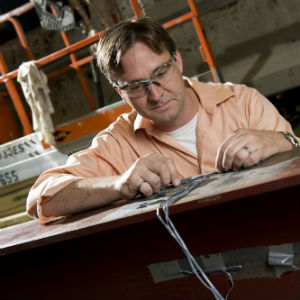
Traditionally, designing buildings to withstand earthquakes has focused on protecting the lives of building occupants, “but the consequence of this type of design is that conventional seismic systems do not explicitly limit the amount of structural damage,” said Matt Eatherton, assistant professor of civil and environmental engineering at Virginia Tech.
For the past two years, Eatherton has used a National Science Foundation grant to develop a structural building component called a self-centering beam (SCB). This self-centering beam would serve several purposes: protect lives, limit or eliminate structural repair costs, and reduce business downtime due to earthquakes.
In the event of an earthquake, the current conventional seismic systems used in construction will experience structural damage in primary structural components throughout the buildings, and can be left with permanent residual drifts that can make repairs uneconomical.
Or, if they are reparable, it will “require significant business downtime because of the complexity and extent of required repairs,” Eatherton said.
By contrast, the self-centering beam virtually eliminates residual drifts and concentrates damage in replaceable elements of the building, he explained.
Eatherton is not alone in his quest. In the past two decades, engineers have developed several self-centering seismic systems. However, the system complexities, erection challenges, and cost premiums associated with implementing prior self-centering seismic systems in building construction has limited their use.
Eatherton’s new approach allows the self-centering beam to be fabricated in a shop and put in place by conventional field construction methods. It also uses approximately the same amount of steel as conventional seismic systems, thereby holding down its costs.
Eatherton is an experienced structural engineer, working for five years in the earthquake prone state of California. Employed by GFDS Engineers of San Francisco from 2001 until 2006, Eatherton designed buildings for a multitude of seismic provisions that had lateral resisting systems of wood shear walls, concentrically braced frames, eccentrically braced frames, steel plate shear walls, steel moment frames, concrete shear walls, as well as others.
His projects were as large as 35,000 square feet with construction costs up to $30 million.
After this stint with industry he returned to the classroom to obtain his doctoral degree at the University of Illinois at Urbana-Champaign in 2010. His dissertation, a collaborative research program with researchers at Stanford University, allowed him to investigate an innovative rocking seismic force-resisting system that self-centers after an earthquake and concentrates structural damage in replaceable fuse elements.
Two years after receiving his doctoral degree, NSF awarded him some $300,000 to support his efforts in inventing and validating the self-centering beam for use in practice.
In the first two years of his three-year award, he has conducted 60 tests on critical components of the self-centering beam. These tests have allowed him to move into a large-scale experimental program on a set of SCB specimens that represent two-thirds scale and full–scale components in a prototype building.
Eatherton has filed a provisional patent as the self-centering beam is a new technology.
“I believe the self-centering beam has the potential to reduce economic losses due to earthquakes by creating buildings that allow targeted structural repair or do not require structural repair after most large earthquakes,” Eatherton said.
Support AFP



 Share
Share

Contributors