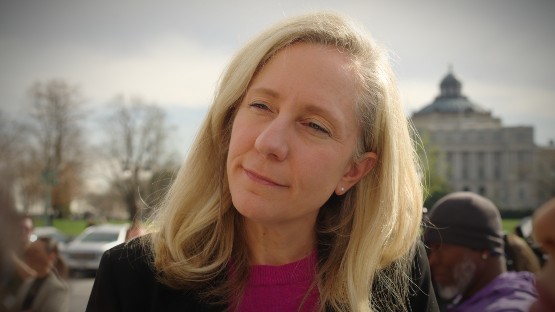
I wasn’t going to write about the recent Abigail Spanberger interview with Politico in which she did a victory lap on data centers, largely because, it’s settled, she won, we’re not going to do anything until a commission does another study, if we do anything then.
But the governor’s PR office is hyping the interview, for the “new first-of-its-kind statewide energy consumption tax on data centers” that was the compromise in the state budget signed into law last week.
ICYMI
“We want data centers to pay their fair share — the way to get at that is by ensuring that they’re paying this consumption tax, based on their energy consumption. And we can couple that into the future with longer-term views of what are the standards we want to set in Virginia for water usage, for backup energy generation,” Spanberger said in the Politico interview.
The quote was highlighted prominently by the governor’s PR team in a release on Monday.
OK, so, we’re going to relitigate this.
The electricity consumption tax on data centers that was the key to the compromise in the budget is projected to generate $600 million a year, about a third of the $1.9 billion a year the state gives in tax exemptions for data center owners.
This, to Spanberger, is data centers paying their “fair share.”
Having the new tax balance out the tax breaks dollar-for-dollar wouldn’t even have data centers pay their “fair share,” relative to the costs data center owners are passing on to the rest of us, in terms of the impact of their operations on power usage and the environment.
Spanberger, in the interview, parroted data center industry talking points – highlighting their contributions to local tax bases, even as a 2024 JLARC report details that “for the five localities with relatively mature data center markets, data center revenue ranged from less than 1 percent to 31 percent of total local revenue,” and job creation from data centers.
The fact check on that, from the 2024 JLARC report, is: most of these economic benefits derive from the construction phase rather than ongoing operations, and that, once operational, “a typical 250,000-square-foot data center may have approximately 50 full-time workers, about half of which are contract workers.”
We’ve already got more than 150 so-called “hyperscale” data centers – defined as being at least 10,000 square feet, using at least 5,000 servers, and consuming more than 50 MW of power annually; for a sense of scale, a 50 MW supply is enough to average out the daily needs of 30,000 to 50,000 homes – in Virginia.
They’re not going anywhere, of course; what folks want to make sure is that any new ones come with contract terms ensuring that the money people behind them really do pay their “fair share.”
ICYMI
This is why we’ve seen pushes from top Democrats in the General Assembly for a moratorium on future data center development until we have a better handle on the lay of the land.
Spanberger, in the Politico interview, made clear that she is a firm no-go on a moratorium.
“Data centers have been part of our economy for quite some time, and so, if we were to end that kind of in one fell swoop, that has a major impact on jobs in Virginia, union jobs, electrical jobs, certainly the building trades, it has a major impact on many of our communities, also many of our rural communities that see great benefit when they choose to because, we’ve got local control on this. When they choose to invite or welcome or approve data centers, they see that benefit,” Spanberger said.
“What I’m hearing from local community members and leaders and mayors and board of supervisor members across Virginia is they want to do the right thing and the best thing by their communities. And this is where Virginia, through the General Assembly and through work in in my administration, can set the highest standard and frankly lead the nation and arguably the world in the type of innovation. Now that’s my position as the governor of Virginia,” Spanberger said.
What I read there is a governor of Virginia who has been bought and paid for by the data center industry.
Sorry, just calling it like I see it.



 Share
Share

Chris Graham