A Rockingham County man is leading an effort to reintroduce the American chestnut to our part of the Shenandoah Valley.
Loren Hostetter started on this venture 10 years ago when his daughter birthday-gifted him a membership to the American Chestnut Cooperators’ Foundation, a nonprofit based in Southwest Virginia.
The “redwood of the East” was once a foundational tree of the Appalachian ecosystem, before a fungal chestnut blight that was accidentally introduced in New York City in 1904 spread outward through the Appalachians over the course of the next 40 years.
More than 3.5 billion American chestnuts were lost to the blight; it is one of the largest ecological disasters ever recorded.
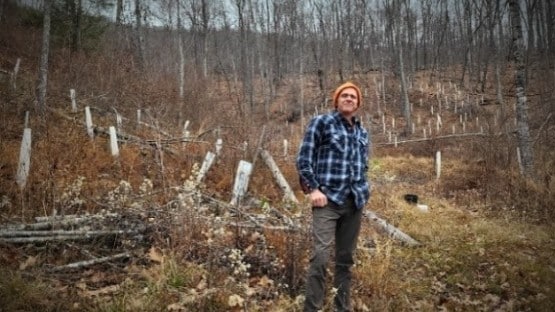
Hostetter has been planting, near Harrisonburg, the progeny of 15 pure American chestnut survivors that proved to have a natural resistance to the blight.
Nuts were provided to volunteer landowners, and annual reports were composed to track the resistance of each progeny.
“This biodiversity was all but destroyed. How do we go back and make sure that for future generations we haven’t lost that?” Hostetter said. “We have an opportunity to atone for the mistakes of our generation or earlier generations. We lost a treasure, so let’s try to bring it back where and when we can.”
Hostetter received one of the first JoinTrees grants to expand his early work. JoinTrees is an initiative of the Mennonite Men organization to partner with tree-planting initiatives. Volunteers assisted to plant 300 trees.
The project continued to expand in the past two years with significant increase in plantations, adding 3,000 seedlings to mimic forest densities that would generate a forest-like growth response to produce that iconic timber as well as intensive cross pollination and future seed.
“Because the forest compensates, now we’ve got basically an oak-hickory forest. Nature has its own ways of adapting,” Loren said. “How well could chestnuts now come in and reclaim their dominance? We’d certainly like to give it a chance and get pockets of chestnut back in a forest and see what nature does to readjust.”
Ten years into the project, some of the trees are at their make-or-break point.
The blight is endemic in the eastern forests, and only begins to lodge in trees as its tree bark begins to deepen around the age of 10 years.
“We want to see this infection, then the capacity of the trees to heal over the canker will be documented to verify that the resistant traits were passed on,” Hostetter said.
Those interested in working with Hostetter on his American chestnut project can contact him by email at [email protected].




 Share
Share

Chris Graham