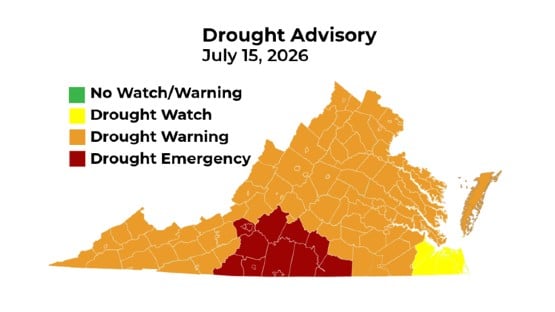
Local and regional leaders are working together to determine next steps if the situation does not immediately improve.
Should the situation continue, a drought emergency declaration may be required, the governor’s office said on Wednesday.
This would trigger mandatory non-essential water use restrictions, as called for in Virginia’s Drought Assessment and Response Plan.
Which is to say: not there yet, but close.
“In the midst of this historic dry period, all Virginians can help preserve our water supply,” Gov. Abigail Spanberger said on Wednesday, per a release from the governor’s office. “Increased water conservation measures are critical to protect access to adequate water supplies for Virginia’s families, farms, and communities as the drought persists. I appreciate the work of Virginia’s Drought Monitoring Task Force to paint an accurate picture of the severe drought conditions. We will continue to evaluate the impacts and how we can contend with this historic drought.”
The release notes that all areas of the Commonwealth continue to experience record historic drought conditions.
The situation in Roanoke has worsened, though, according to key indicators, including:
- Rain is approximately 7.8 inches below normal on average throughout the Commonwealth. This represents the second driest water year on record. The Roanoke Drought Evaluation Region has only received 57 percent of the rain that is normal for this time of year. While the seven‑day forecast calls for continued isolated rain events, below‑normal totals (less than 0.5 inch) are forecast for the New River and Roanoke regions.
- Streamflow within the James River, Meherrin River, New River and Roanoke River watersheds continue to have significant deficits. Surface water flow for the Roanoke Drought Evaluation Region is below the 5th percentile.
- Soil moisture remains well below normal, with the driest conditions persisting along the Blue Ridge Mountains and along the central and eastern portions of the Virginia-North Carolina border.
- Groundwater levels continue to be depleted in the region. Many groundwater wells in the Roanoke Drought Evaluation Region continue to set provisional record daily low water levels. Groundwater levels in the Roanoke Drought Evaluation Region are below the 5th percentile. The long-term outlook for groundwater levels remains a concern and will take a prolonged period of additional rainfall to recover.
- Reservoir levels at Smith Mountain Lake and John Kerr Reservoir are much lower than normal, at 5.5 feet and 4.45 feet below normal, respectively.


 Share
Share

Chris Graham