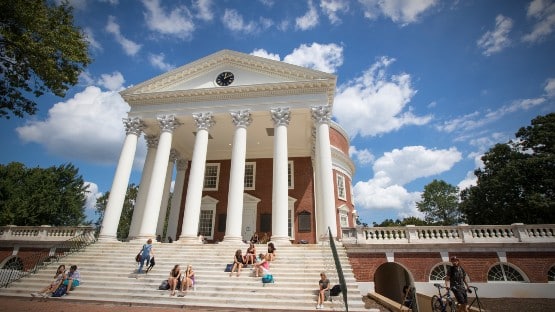
My city, Charlottesville, hosts a world-class university. Or does it host us? In truth, the two are so historically intertwined, so causally interdependent that sussing out “Who needs the other more?” is impossible – and frankly silly. As a City Councilor I quickly learned that both need each other.
Charlottesville is a Southern town. It is also old. So, it bears the scars you might imagine. To be regularly reminded, by itinerant college students, of our social ills and instructed how to address them rankles. Especially given the costs to host them.
In my experience, university administrators are nearly always well-intentioned. Yet they often fail to grasp the externalities they impose on their surrounding communities.
Examples? Thousands of young people let loose on a small town, their parents fretting over crime reports; traffic snarls from building projects; electric scooters dropped in any old spot; demands on infrastructure; competition over employees; the schools (for employees’ children); and (especially) the impact on housing supply. All of these pose enormous costs on adjacent jurisdictions and their residents.
Granted, a public university as an institution has its own aims, its own obligations, its own raison d’être. It exists to create vital public goods – in terms of education, research, public service, and health care. Those comprise its prime directive.
Yet, inasmuch as a university exists for the common good, it makes both logical and logistical sense for it to partner with surrounding jurisdictions. After all, a local government’s only reason for existing is to preserve and promote that same good.
Administrators are, like most of us with jobs, focused on advancing the interests of the institution for which they work. That is natural and good. Yet, given the facts about the common good, they and their trustees ought to take it as essential to credibly engage their adjacent polities. I don’t mean mere “deconfliction” (e.g., setting fraternity party hours) or basic coordination (e.g., agreeing on the route of a water line).
I mean a grown-up, clear-eyed conversation among equals about how an institution impacts its community and vice versa. Institutional defenders have this automatic, almost instinctual response: “But – we contribute so much to the local economy!” The implication seems to be: “You (local government, local community) would not exist without us.”
That that might feel insulting should be obvious. It also neglects history. Communities and their colleges / universities grow up together. The former nurtures the latter for decades (or even hundreds of years), until the institution “takes off” and literally outgrows the community in which it gestated. (In my City, this went hand-in-glove with displacement of Black neighborhoods to make way for our University’s growth.) So, the simple retort to the “You would not exist without us” claim is – “Neither would you.”
One reason administrators fail to credibly engage is that they simply don’t comprehend how constrained a municipality’s funding is. A simple experiment is to traverse their respective facilities. Walk the public-facing buildings of a university or its grounds and then compare those to the nearest public schools or to its City Hall. The former will be modern, gleaming, the latter clean and serviceable yet dated and inadequate.
Again, municipalities don’t have “magical” funding. True, higher education faces economic headwinds of its own; state legislatures have not funded it properly. Yet a world-class university does have a source of money that certainly seems like magic: wealthy alumni. It will also have a massive endowment and a budget that dwarfs its neighbors’.
In my city and county, advocates urge a “payment-in-lieue-of-taxes” (PILOT) scheme. The idea is that, since our state University pays no real estate taxes, it should voluntarily pay what it would pay if it weren’t public. The sums would be less than a rounding error’s rounding error for the U’s finances.
If a university were to contribute something like PILOT, the impacts would be dramatic: A (partial) offsetting of the externalities it imposes. A groundswell of community goodwill. A stronger standing when conflicts arise. A tangible expression of contrition over past harms (especially to communities of color). And an affirmation of its joint commitment to the common good.
I have stomped all around my city, canvassing for office. Signs of our University’s presence – both physical and the less tangible – are nearly everywhere. Plenty of frustration simmers. Yet, deeper down, residents hold genuine pride in our University. We are, after all, a college town.


 Share
Share