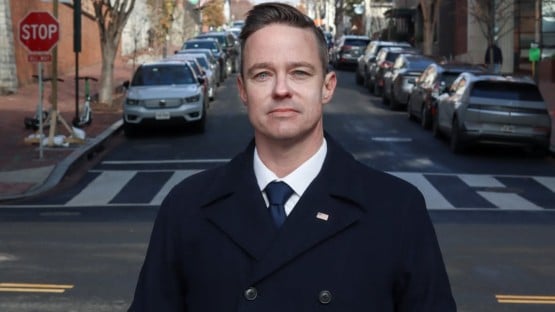
There’s an alternate universe, in which the Virginia Supreme Court follows the law instead of trying to write it, in which Adam Dunigan is running for a congressional nomination in a district that represents Augusta County.
The Marine Corps and CIA veteran is now focused on pulling an upset in the Eighth District, where the incumbent is Don Beyer, a Democrat seeking a seventh term in Congress.
I caught up with Dunigan on Friday to talk about his upstart campaign, and the issues of the day.
AFP: We’re 16 hours from the speech last night, Donald Trump, his so-called election security speech. Your expertise as a former CIA guy, recent former CIA guy, I’d love to get your input on what we heard and what your response would be to what he had to say.
DUNIGAN: Well, first of all, this is a lot dumber than people think, in my opinion. It’s not complicated. It’s a seeding operation, is what we would call it. He’s seeding a narrative to place doubt in people’s minds to overextend eventually into election interference or at least voter suppression. So, you don’t really have to focus on any of the one phrases or terms you heard last night. What you really have to focus on is the intent behind why they’re pushing this message now. We have the empirical data. We have all of the evidence we need to make an informed assessment saying that election fraud, as a concept, is pretty rare, and when it happens, it is caught. There’s plenty of examples to support that.
What really freaks me out about a speech like last night, and this extends to a lot of comments made in the past, too, if you want to get really freaked out, go look at those pictures of Kristi Noem digging through 2020 election ballots, you know. They’re looking for anything that they can spin into a narrative to make Americans doubt the integrity of their own elections, and then they want to play in the margins of that doubt to steal elections in the future. It’s pretty clear to me.
AFP: You’re a recent former CIA officer running for the congressional nomination. Alright, so, you have that position, you’ve got a career, you had a military career before your CIA time. What factored into your decision to say, OK, I’m gonna, you know, quit my job, I’m gonna run for Congress in a district that’s difficult. There’s an incumbent Democrat in that district, so this is a tough battle for you. What factored into your decision to do this?
DUNIGAN: I’ll give my grand unified theory of politics off the top. So, for anybody not tracking or who anybody who hasn’t heard of me yet, I’m running in Virginia’s Eighth District, which is Arlington, Alexandria and Falls Church, parts of Fairfax. If you’re outside Virginia, that doesn’t mean much. But if you’re in, you know, like, that’s the D.C. suburbs. That’s the home of the Pentagon. That is the home of the CIA headquarters. That’s the home of the DIA, half the federal architecture, and every major corporation has presence in this district.
So, it’s important, or it should be, because right now the incumbent that we have, I have a lot of respect for the man. I don’t think he’s one of the worst examples of Democratic politicians. But we’re not utilizing the capacity that we should have in this district. It should be a flagship of the Democratic Party. It’s very safely Democratic, and these districts here, Chicago, Los Angeles, New York, we should be using them to develop thoughts within the Democratic Party. These should be petri dishes or incubators, I suppose, of Democratic thought and pushing the boundaries of not just what’s possible, but, like, what we should be as a party, and the priorities we should be facing.
All the respect in the world to the incumbent, but he’s about 76 years old, and he’s a, you know, 200-millionaire. That profile, when kids look up that are coming out of college and can’t find jobs, they’re going to see that, and they’re going to disengage. That profile, when folks that stopped voting because they felt like the system was unresponsive to them, when they look up, they’re going to disengage. And right now, in this period, we have all of this frenetic energy. Everyone, center right, center left, far left, even some of the far right MAGA types, are a little uncomfortable with the excesses of this administration. So, we need to capture that into the Democratic Party to build a durable voting bloc to create some narrative momentum behind politics in America, to recreate some trust in American institutions. That’s what I’m trying to do.
I know it’s hard, and I know that usually it’s bad math to go up against an incumbent. But I kind of want to see more of that kamikaze mentality in a lot of America’s politicians. You know, if we don’t do things just because they’re difficult, we’ve lost the step as a country that I don’t think we can get back.
AFP: To your point, I mean, Republicans do what you’re talking about, and do it well, when you talk about their safe seats. I’m based in the Sixth District. It’s a safe seat for Republicans. Certainly, we hope out here that Beth Macy can maybe change that narrative. But when they have a safe seat, the people who hold those safe seats, they move things to the to the right, whereas, you know, I’ll say the same thing that you say, all due respect to Don Beyer, but it feels like our Democrats who are in leadership positions are treating those safe seats as, alright, it’s safe for me, let’s just let’s just keep things safe for everybody, and they’re not pushing the agenda. Whereas we have this energy, we have Zohran Mamdani in New York creating a lot of energy, we have others across the country who are winning primaries in other states who are creating energy, and seizing upon the energy that’s already out there.
That’s the divide we have right now within the Democratic Party. I think it’s healthy that we’re having this debate, because we do a lot of people like you, and I think I’m probably qualified to say this, too, that I want to see some change, I want to see some action out of our people in D.C., out of our Democrats in D.C. That sounds like what you’re pushing for.
DUNIGAN: Yes, exactly. And I guess the initial question is, like, why did I do this? Because it has to be done, and there’s nobody doing it effectively outside of these very specific areas in other states. I’m not going to ever claim to be a Mamdani-type character. My background is confusing for people, because, you know, I was in the Marine Corps, and I was a case officer at the CIA, but I’m still a progressive Democrat. You need kind of these Swiss Army-type guys or gals around the country to be in the districts they’re running in, but also be behind the same political priorities and agenda points, like universal healthcare, like fixing the nightmare of American foreign policy as it applies to a million different conflicts, like Israel-Palestine, or now Iran, or our relationship with the EU, this crazy tariff war that we had. You need people with clear eyes on what the American people need right now and what their districts can get behind.
In my district, my background works really well, and I wouldn’t I wouldn’t want to approach politics from with the same slants as Mayor Mamdani up in New York, but at the same time, our priorities are essentially the same. We want to help people, because people are hurting, and it’s really scary watching the backslide of American democracy and the fracturing of U.S. government institutions. We have to stop that, and we need to make sure that whatever comes after it isn’t just a reversion to what we had before, that it’s something better and responsive and moves faster to help people who need it now.
I’m tired of these 18-month, 24-month timelines from incumbents, and I’m really, really nervous about Democrats in safe seats kicking their feet up and saying, Well, there’s nothing we can do until we get a Democratic president in 2028. I will not tolerate that kind of excuse. We need to move now, and we need to be creative about how we do it.
Podcast
AFP: To that point, 2027, let’s say you’re sworn in in January. What are your first priorities?
DUNIGAN: First priorities, I mean, from a legislative perspective, it is going to be difficult to get any momentum on legislation that helps Democrats or was seen as a Democratic victory. The president will veto anything if he thinks it’s helping us too much. However, priorities for me at the front are kind of nonpartisan and bipartisan, potentially.
My big priority is money out of politics, and that applies to Democrats and that applies to Republicans, because from both parties, we seen some malfeasance in the way people interact with finance. You know, online, everybody’s angry at AIPAC, for example, and special interests generally dominating the field, killing the candidacies of otherwise progressive Democrats, for example.
In order to build trust within the American electorate again, you can’t engage with special interest money that way. You just can’t, right? Corporate influence money, corporate PACs, super PACs, dark money in politics as a result of Citizens United. You can’t engage with that and still be a trustworthy legislator in Congress at this point. So, I, and many other people like me, we are keeping ourselves completely clean from corporate finance influence and special interest influence, because that’s the kind of contrition and that’s the kind of moral standard that we need to require of our legislators, even when the law doesn’t require it, you know, just because something’s legal doesn’t make it right. This is kind of the crux.
I have an entire ethics pledge that I’m putting out there, and I think it’s novel. I haven’t seen any other candidates around the country doing the same thing I’m doing. My ethics pledge is essentially completely clean finance from day one. You can go in check my FEC. It is all individual donors, and there is no special interest or corporate money.
Number two is self-term limiting. I’m going to self-term limit myself, no matter what the law says, to no more than eight years in the seat. I’m tired of people dying in office. I’m tired of them sitting there for 40 years, and I’m tired of the guessing game. The succession of the most important government institution is going to go like we’re depending on people’s egos and better judgment to dictate their time in office when we should probably have legal requirements so there’s no surprises, and we can plan substantially, substantively, for how we govern this country.
Next thing that I think is super important is radical transparency. So, basically, a 24/7 review on the personal and political finances of anybody sitting in office, and I think the most interesting part of mine is of my pledge is outside income, if I make any outside income during my time in Congress, I owe at least 50 percent of that back to the people I represent, because they put me there, and I am making money when I should be legislating, and so if I earn any money, and that’s not my intent, but if I earn it, 50 percent of that goes back to my district for free clinics, veteran services, and child care for working families.
It’s not a solution to the budgetary problems that we have, but it is a sign of contrition, and it’s an element of sacrifice that I think people really want to see from their elected officials right now. I there’s a there’s a phrase that we use at CIA where, service without sacrifice is just a job, and I’m tired of legislators treating Congress like it’s a job.
AFP: I would think someone with your background, with the CIA background, the House certainly has very important investigatory powers under our Constitution. That, if nothing else, that’s something that Democrats, when they take the majority back in 2027, can exercise to keep the excesses of the Trump administration in line.
DUNIGAN: Oh, yes, sir, and I I would say that some of the failures that we’ve seen, the inaction that we’ve seen, even from a minority position, there are parliamentary rules, there’s ways to do signaling votes, there’s ways to call people to account. You have to at least speak for what they’ve done.
The war in Iran is my favorite example, but it’s not it’s not a happy example. Jared Kushner and Steve Witkoff are two real estate pros, and they were out there negotiating on behalf of the American government, and they failed so profoundly that we then launched a war.
Maybe that was always the case, but nobody really knows, because they’ve never had to answer for it. They’ve never been in front of the House Foreign Foreign Relations Committee, Foreign Affairs, right. There’s a subcommittee on Foreign Affairs specifically dedicated to oversight of special appointees like Kushner and Witkoff. There are Democrats on that, right. They’re not leading that subcommittee, but they’re there, and there has been no signaling, there’s been no messaging. There’s been very little in terms of attempts to hold the people filling this country accountable.
I don’t know, this is my first time running for anything, I don’t know exactly what it looks like from inside, but I do know what it looks like as an American outside. And all I see is nothing. I want to change that. I want to give people back some hope that, whoever we have in these elected positions and positions of influence, maybe not leadership, but influence, at least, that they’re using that influence for the moral good of this country. And I just don’t see it.
AFP: Last question, I want to ask about get the campaign and the mechanics of the campaign. OK, an August primary is odd-timed, and I mean, so are June primaries. Honestly, you know, voter turnout is always lower in the summer, but August, even more so. For people who are wanting to say, well, I mean, Don Beyer has the advantage of incumbency, you know, this should be an easy walk for him, the timing of this is interesting. Your district is so geographically compact that I would think that that could be an advantage to the challengers. Just your thoughts on how things are going and how you can approach this and maybe pull the upset here.
DUNIGAN: Anybody listening within Virginia is probably aware of the April referendum that we had. So, let me tell you about a nightmare year to come into politics for the first time. I announced my candidacy for the Eighth District where I live, where I’ve worked. I’ve been resident out here for about 15 years. I announced for the Eighth District, and then from about March into late April, there was all this ambiguity about what the congressional maps in Virginia were going to look like.
The idea was we were going to gerrymander our state in favor of Democrats to fight back against the shenanigans that they were pulling in Texas and Florida and a million other places. I had my reservations because I don’t believe gerrymandering to be a healthy function of our democracy. But you know what? Fire with fire in extraordinary circumstances. I got behind it. I had to hold my nose a bit, but I got behind it. So that means my district that I announced for my first ever congressional run changed from the Eighth to the new Seventh District, which went from Arlington out to you guys out in Augusta County.
What did I do after that? I jumped on my motorcycle and I went to Staunton, Augusta County, I went up to Harrisonburg. I went out there, and I started reassuring people that, even though this was a period of upheaval, even though these aren’t typically democratic strongholds, I was still willing to put in the work and make eye contact and reassure somebody that whatever your party affiliation is, there’s at least one American above all else that’s trying to put some sanity back in our government.
I had some really some early success, I had some some media spots out there, and then the Supreme Court flipped it, and we went straight back to the districts that we announced for. That extended the primary from June into August, and so, yeah, now I budgeted my life, I cashed out my retirement to do this, I budgeted my life to get through June, and we’ve had to struggle through to August.
But right now, there’s already murmurs out here that there’s a possibility of an upset here, because the anti-establishment sentiment in the minds of every single American right now is so strong. Nobody trusts politicians, and so if my whole thing is trying to build that trust in American institutions, and all of my conduct and the things I’m trying to accomplish are oriented toward that, I think we’ve got a real shot at surprising a lot of people out here, and that would be a big deal within the Democratic Party in this country, and I don’t intend to waste the momentum that comes from something like that.
I want to use this position, and I hope every other candidate, just like me, who’s running on progressive politics, I hope they’re not afraid of their own shadow once they get in. I would be very disappointed if I see them moderating back to center because they’re looking for higher office afterwards. I’m not doing that, and I never shall. I think we need to get in, do the job that needs doing, and make sure people get help, and then honor our word and get out when we say we will.
Video

 Share
Share

Chris Graham