By Kathy Reshetiloff
For the Bay Journal News Service
As I walked through a tiny wooded trail near my home, I tried to tread softly so I could spy any birds or mammals remaining for the winter. It was impossible as my feet crunched on the crisp orange, yellow and brown leaves that covered the ground.
Here and there leaves still hung, almost desperately, to a few large oaks. But, for the most part, what had been a fiery autumn landscape a couple of months ago was now a dull palette of grays and browns.
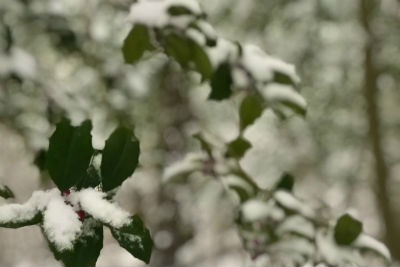
Amid this background, one tree stood out with glorious color. Overlooked most of the year, an American holly (Ilex opaca) now took center stage with its bright green leaves and ripe red berries, feeding my hunger for color.
Like all evergreens, the American holly does not lose its leaves en masse at the end of the growing season — largely because the thick and waxy leaves don’t lose water, which is the primary trigger for deciduous trees dropping their leaves in the fall. Smooth and satiny green with a yellowish green underside, American holly leaves are usually easy to identify; most have needle-sharp spines protruding from their edges, though that’s not always the case. Often there will be both spiny and smooth-edged leaves on the same tree — with the spines more common on lower branches, perhaps as the tree’s defense against foraging mammals.
Ilex opaca is only one of several hundred holly species found throughout the world. People have long had a reverence for these evergreens. Druids viewed the holly as a tree never abandoned by the sun that they worshipped. Romans presented holly boughs with gifts to esteemed friends. And, of course, many people nowadays “deck the halls” with holly, using them as seasonal decorations.
People aren’t the only ones who enjoy these evergreens. Hollies provide excellent shelter for many types of birds — especially in winter, when leafy shelter is harder to come by. And of course birds are the principal consumers of their bright red fruit. Northern flickers, gray catbirds, cedar waxwings, mourning doves, ruffed grouse, northern bobwhites, cardinals, blue jays, northern mockingbirds, white-throated sparrows, eastern towhees and wild turkeys all are known to feed on holly berries.
And birds return the favor, by dispersing holly seeds. Perhaps the most important in seed dispersal are the large winter-migrating flocks of small birds, such as cedar waxwings and American goldfinches.
Many other animals eat American holly, including white-tailed deer, gray squirrels, chipmunks, meadow voles, red foxes, raccoons, cottontail rabbits, white-footed mice and box turtles.
Hollies are dioecious, meaning that a single tree will have either male or female flower parts, and only the female tree bears fruit. Both male and female flowers are small and creamy white. They appear in late spring or early summer, and pollination occurs thanks to bees, wasps, ants and moths.
Often appearing more like a large shrub or small tree, the American holly is a slow grower, but it can reach up to 60 feet. The berries, known to botanists as drupes, ripen from September through December and, if not eaten, stay on the tree throughout the winter.
Ilex opaca does best in well drained, sandy soil but will tolerate somewhat poorly drained areas. In nature it is commonly a shade-tolerant understory tree, but it also thrives in full. It’s natural range, generally speaking, is the southeastern U.S., reaching north along the coast as far as Massachusetts and west across the deep South as far as eastern Texas. In cultivation it does well in areas well outside its native range.
This native holly makes a wonderful landscaping tree when planted singly and given sufficient space to grow. It is important to plant both males as well as females if berry production is desired. Many homeowners choose to group them as hedges to screen their yards from activity and noise or to serve as background plantings.
Hollies planted near our homes attract wildlife activity, especially the birds that use them as both shelter and sustenance.
And for us humans, the sustenance is spiritual; hollies not only symbolize the season of giving, they give our winter-weary eyes a splash of color, of dazzling red and green, at home and in nature.
Kathryn Reshetiloff, a Bay Journal columnist, is with the U.S. Fish and Wildlife Service’s Chesapeake Bay Field Office in Annapolis. Her views do not necessarily reflect those of the Bay Journal. This article first appeared in the Bay Journal and was distributed by the Bay Journal News Service.
Support AFP



 Share
Share