 The airline industry has the ability to sustain significant fuel savings and greatly reduce its greenhouse emissions, according to the conclusions reached in a Virginia Tech led study for the Federal Aviation Administration (FAA) for traffic in the North Atlantic oceanic airspace.
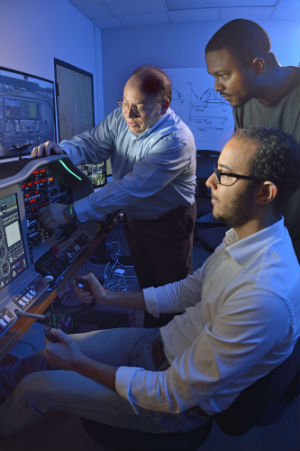
Antonio Trani, director of Virginia Tech’s Air Transportation Systems Laboratory and a professor of civil and environmental engineering, led the study that provided evidence for tactical recommendations on restricted cruise altitudes for aircraft crossing the North Atlantic oceanic airspace. The research is part of the Future Air Navigation System started in the 1990s that focused on communication between aircraft and air traffic control services.
Commercial traffic represented the majority of the operations studied by Trani in the North Atlantic space used by Canada, Denmark, France, Iceland, Ireland, Norway, Portugal, the United Kingdom, and the United States. In this space, the aircraft are subjected to large separation standards due to safety considerations, and these criteria can cause large vertical deviations that call for greater fuel usage.
As Trani and his colleagues developed a computer model based on improved surveillance between 2010 and 2015, they showed aircraft could fly at a closer spacing of five minutes apart instead of the current 10 minutes.
“If the lateral separation between the aircraft can be reduced, they can be spaced closer and remain more in line with their optimum flight paths. Overall, this would produce fuel economy as most aircraft save fuel at higher cruise altitudes,” Trani explained.
The FAA defines a large height deviation as any vertical departure of 300 feet or more from the expected flight level.
The researchers called their new computer model the North Atlantic Systems Analysis Model (NATSAM III). After they successfully demonstrated its viability, one result was the FAA’s decision to extend the study to the Pacific Ocean aviation operations.
Trani, working with Thea Graham, David Chin, and Norma Campos of the FAA and Aswin Gunnam, a former graduate research assistant in his lab, explained that most of the traffic in the airspace they studied took place along five to seven nearly parallel tracks of aircraft traffic flows. The exact location of these tracks is updated twice a day, one for eastbound and one for westbound traffic, according to projected wind and meteorological conditions.
“This was an unprecedented study, capturing information for 44 major airlines, representing 81.6 percent of the North Atlantic Systems operations and 88.2 percent of commercial operations,” Trani said.
Cost data to upgrade aircraft with the needed communication equipment was gathered through a cost focus group of industry representatives that included more than 40 participants from the aircraft and avionics manufacturers, commercial airlines, International General Aviation representatives, and all of the North Atlantic Systems Air Navigation Service providers.
The upgrades are necessary, Trani explained, because most of the North Atlantic airspace is out of range of very high frequency and radar. “Currently, the majority of communications take place using high frequency voice that is subject to disruption, atmospheric effects, ambiguity in accents, frequency congestion, and a third party relay between pilots and controllers,” he added.
Consequently, with the approximately 2,152 commercial airframes operating in the North Atlantic Systems, Trani estimated that some 838 airframes would need some level of retrofit, totaling an estimated $464 million in 2010 money. The range for a single aircraft would be significant — anywhere from $50,000 to more than $1 million depending on its original level of aircraft equipment.
Trani’s group estimated annual fuel benefits (if changes moving to the five minute intervals occurred this year) at $10 million. If, as he suspects, the time could be moved to two minute intervals, the savings would jump to more than $37 million. Recently this analysis has been applied to Pacific Ocean flights by Trani and his postdoctoral assistant Tao Li with potential fuel savings of $35 million annually.
Support AFP


 Share
Share
Contributors