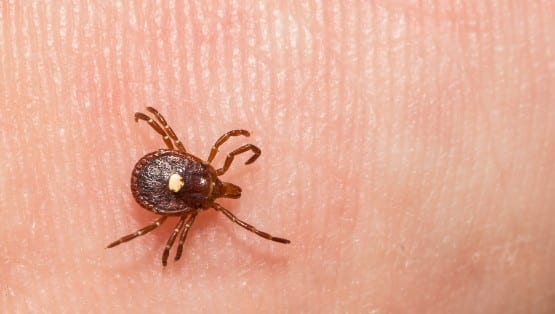
It’s tick season in Virginia, and the Central Shenandoah Health District is sounding the alarm on the dangers of them and the diseases they carry.
Ticks maybe tiny and hard to spot, but they can cause a number of serious medical problems including Lyme disease, Rocky Mountain Spotted Fever, Alpha-gal food allergy, ehrlichiosis, babesiosis and anaplasmosis.
In 2025, the number of cases of Lyme Disease has already surpassed the five-year average for the same time of year. There have been 472 cases reported to date in 2025; the five-year average for the same time of year is 437 cases.
“The best way to avoid these tickborne illnesses is to prevent being bitten by a tick in the first place,” said Dr. Allison Baroco, acting health director for CSHD. “Being well equipped with protective clothing and bug spray will help keep ticks off of your skin.”
If you’ve been bitten by a tick in Virginia, you may send it to the Virginia Department of Health for identification and information about diseases associated with that type of tick.
Tick-related illnesses in Virginia
The VDH has an online database to track tick-related illnesses in Virginia.
In 2025, the number of each to date is:
- Lyme Disease: 472 cases
- Ehrlichiosis/ Anaplasmosis: 51 cases
- Babesiosis: 4 cases
Tips to protect yourself from ticks
Central Shenandoah Health District suggests several steps you can take to protect yourself from ticks when you’re outside.
- Use an EPA-registered insect repellent.
- When outdoors in tick habitats, use repellents containing either DEET, picaridin, IR 3535, 2-undecanone or oil of lemon eucalyptus on your skin or clothing. The American Academy of Pediatrics recommends using products containing no more than 30 percent DEET on children. Never use oil of lemon eucalyptus and para-menthane-diol on children under 3 years of age.
- The repellent called “permethrin” can also be used to treat clothing ahead of time; it will last on clothing, socks and shoes for several washes. When used properly, it will kill ticks before they bite.
- Do not use any insect repellent on babies under 2 months of age.
- When you’re outside in tick-infested areas, get into the habit of tucking your pants legs into your socks will help prevent ticks from climbing up your shoe and sock and onto your skin. Forcing ticks to climb up the outside of your clothing will help you spot and remove ticks before they can reach your upper body. If your shoes, socks and pants were treated with permethrin, any tick that comes into contact with the treated item usually die or become affected within a few minutes – before they can bite.
Checking for ticks inside
When you come inside after being in areas with potential ticks, take these steps to find them:
- Check your clothing after spending time in tick habitats. Tumble dry clothing on high heat for 10 minutes to kill any remaining ticks.
- Use a mirror or ask a friend, partner, or spouse to help check your body for ticks. Pay close attention to the armpits, the groin area, in and around ears and your hairline, belly button, backs of your knees and between your legs. All are warm, moist areas that ticks are drawn to.
- Also remember to check your children, your hiking gear and pets for ticks, too.
Proper tick removal
If you find a tick on your body, remove it properly and promptly using the following tips:
- Use tweezers to grasp the tick as close as possible to the skin.
- Pull upward, with steady even pressure, until the tick releases to avoid breaking the mouth parts of the tick or rupturing the tick’s body.
- Avoid any method of removal that could crush, burn or suffocate the tick.
- After the tick is removed, clean the skin and the bite area with rubbing alcohol or soap and hot water.
- Save the tick in a bag or container with rubbing alcohol for identification in case an illness develops in the days to weeks following a tick bite.
Related stories
- Dogs increasingly vulnerable to Lyme disease, tick-borne illnesses in early spring
- Potential target for treating and diagnosing Lyme disease discovered
- Virginia Tech researchers identify a missing piece of the Lyme disease puzzle
- Raccoon in Mechanicsville tests positive for rabies; health officials track exposure
- Cat in Virginia tests positive for rabies in Mechanicsville subdivision
- Emergency visits up for heat-related illness in Virginia; one fatality this summer
- Accidental drownings claim lives of nine children in Virginia this summer
- Health expert: Limit sun exposure during midday to help prevent skin cancer
Support AFP


 Share
Share

Crystal Graham