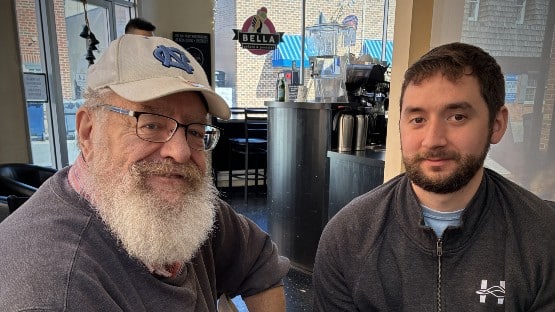
Jack Randalow III grew up in the Richmond area and was an all-ODAC academic selection in soccer at Emory & Henry. Now a resident of Waynesboro, Randalow is still involved in sports – but in a behind-the-scenes way with a company that has Super Bowl connections.
Randalow is one of several employees from around the country for Tony Britt Spotter Charts, which was founded by Rockingham County resident and North Carolina native Tony Britt.
“A Spotter Chart is an essential tool for announcers during game broadcasts. It provides player positions, bios, statistics, and notes to streamline your game day prep. Our charts offer the most up-to-date information, allowing you to focus on delivering an engaging broadcast without the hassle of organizing details on your own,” according to its website.
“In the 25 years we have been doing this we have hired exactly 160 people – and a chunk of them come from this area,” said Britt, sitting in a coffee shop in downtown Harrisonburg.
The list of Rockingham County residents gearing up for the fall season who work for Britt include:
- Julian Alleyne (finance director).
- Nate Avalos (sports data specialist), who also coaches soccer at Turner Ashby High.
- Curt Dudley (quality control manager), a long-time resident of Bridgewater and a veteran voice of JMU Athletics.
- Corey Spector (notes contributor), a multi-sport broadcaster who calls JMU women’s basketball.
- Owen Stewart (data manager), who also coaches baseball at Rocktown High.
- Morgan Wuenschel (social media manager), a former two-sport athlete at Broadway High.
“Jack started as a grad assistant in the JMU master’s program, just like Owen had,” Britt said.
A proud mother
One of the first major clients for Britt and his creation was Sean McDonough, a veteran broadcaster. The Spotter Charts were also used by broadcasters in the most recent Super Bowl win by Seattle over New England and in the college football title game won by Indiana and former JMU coach Curt Cignetti over Miami.
Randalow, who did post-grad work at JMU, joined up with Britt about five years ago. While their work is in the background with little personal publicity, Randalow said his mother has been proud to let people know that her son does work used on broadcasts by the likes of McDonough and others.
“I started as a graduate assistant,” said Randalow, a former Raphine resident who is now full-time with Spotter Charts. “I took classes at JMU, and that is how I got introduced to Tony.”
Wuenschel graduated in 2019 from Broadway High, where she ran cross country four years, indoor and outdoor track for two and played tennis for three years. She graduated in 2023 with a degree in business from Shenandoah University, where she ran cross country and track four years.
“I am the social media manager at Tony Britt Spotter Charts, where I handle creating content, monitoring, and analyzing our LinkedIn, Instagram, X (Twitter), and Threads. I also do production, meaning once all the data and notes are finalized, I create the final product that we will send to the client,” she wrote to AFP. “My favorite part about working for Tony Britt Spotter Charts is that when I am watching almost any game on TV, I get to tell everyone around me that the broadcaster is using a Spotter Chart. There are so many great things about working here, like the great people on the team, waking up every morning and working in sports as I have always dreamed of, and making broadcasters’ lives easier with our product.
“I found out about Tony Britt Spotter Charts when I was accepted to JMU’s Sports and Recreation Leadership Program. Spotter Charts was my graduate assistantship, where I worked through the two years of the program, and they paid for my master’s. After I graduated in 2025, I was hired full-time.”
Britt was a sportswriter beginning in 1978 and worked for newspapers in Orange and North Carolina and worked for the United States Olympic Committee between 1985-1997, including the 1996 Atlanta Olympics.
Vital call

In 1986, Britt got a call from John Justus, who at the time was the sports information director at Wake Forest.
Justus told Britt that ESPN Raycom/Jefferson-Pilot needed a spotter, and they would pay $50 to work a game.
“I said sure, but what does a spotter do?” Britt recalled.
Eventually, Britt travelled with ESPN and other major TV broadcast networks through 2015.
In 2005, veteran broadcaster Pam Ward, the first woman to do play-by-play for a national college football broadcast, complained to Britt that the spotter charts she was getting from ESPN were messy, not always current – and occasionally wrong.
“I think I can do them better on my computer,” Britt recalled.
In addition to American football, Spotter Charts have been used in the most recent NBA and NHL playoffs, Major League Baseball, ice hockey in the Olympics, every NCAA sport, plus the Tour de France.
Virginia school broadcasters at JMU, ODU, VCU, VMI and Virginia Tech use Spotter Charts.
Britt, through the years, has employed 160 people, ranging in age from 15 to 75, all working remotely from 25 of the United States, as well as Canada.
“We make sure we have the most accurate data,” Randalow said.
Britt – ironically – doesn’t watch a ton of sports on television.
“I don’t have cable,” he said.


 Share
Share

David Driver