Prolonged, frequent seizures. Delayed development. Brain damage. These are just some examples from a long list of symptoms that babies born with Dravet syndrome experience. Up to 20 percent of patients with Dravet Syndrome die before adulthood.
In most cases, this extraordinarily rare pediatric disease is linked to a genetic mutation that disrupts how brain cells use sodium molecules to generate electrical signals necessary for transmitting information.
If these sodium channels are faulty due to a mutation, could other excitatory ion channels, namely glutamate receptors, be attuned to do the heavy lifting instead?
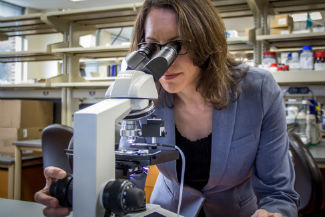
That’s one of the questions that Sharon Swanger, an assistant professor with the Fralin Biomedical Research Institute at VTC, will spend the next two years answering.
“Targeting glutamate receptors is a new idea that hasn’t been explored in this disease before,” said Swanger, who was awarded a competitive $150,000 research grant award from the Dravet Syndrome Foundation.
Patients with Dravet syndrome have altered brain signaling in a number of brain regions, including the thalamus, a brain region linked to the initiation and spread of seizures. Using a mouse model, Swanger will examine if glutamate receptors can be modulated to correct neural activity in the thalamus and suppress seizures.
“Maybe we can’t target the affected sodium channels, but we have the tools to target glutamate receptors that work with those sodium channels to generate electrical signals in the brain,” said Swanger, who is also a faculty member in the Department of Biomedical Sciences and Pathobiology of the Virginia-Maryland College of Veterinary Medicine at Virginia Tech. “The hope is that this therapeutic approach will rectify signaling in affected circuits and temper the excitatory brain activity involved in seizures.”
This project dovetails with Swanger’s other research priorities. Earlier this year, she won a $1.7 million grant through the National Institute of Neurological Disorders and Stroke, part of the National Institutes of Health, to study glutamate receptor modulation.
The Dravet Syndrome Foundation awarded three research grants in 2018.




 Share
Share

AFP