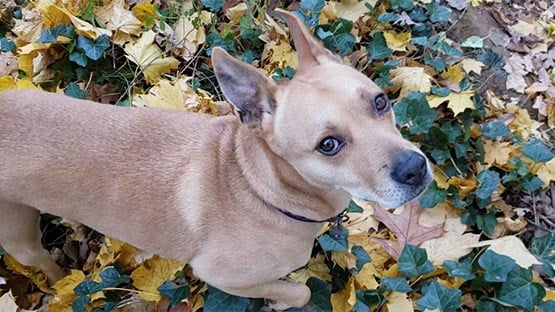
A 10-year-old mixed breed dog adopted from the SPCA is showing remarkable improvement after a leptospirosis diagnosis nearly claimed his life.
Before Rex got sick, he would run in the backyard while his owner, Ross Williams, was at school or work. Like many dogs, he enjoyed wrapping up in the couch with a bundle of blankets.
His routine changed however, and he lost his appetite and wasn’t acting like his normal self.
Williams took Rex to the Veterinary Teaching Hospital at Virginia Tech in Blacksburg where he was admitted.
“Leptospirosis, or ‘lepto, is a bacterial infection that animals can get usually from drinking water that’s been contaminated by the urine of wildlife species,” said Sierrah Travis, a third-year small animal internal medicine resident at the Virginia-Maryland College of Veterinary Medicine.
The disease can cause acute kidney injury and affect the liver, according to Travis. It can also be fatal.
Thankfully, Rex has almost fully recovered and is back to being his energetic self.
“He seemed like he wouldn’t pull through,” Williams said. “But then he started changing a little bit. He started accepting food and was acting more like himself by discharge.”
Rex has now received a lepto vaccine.
Major veterinary organizations have recently moved leptospirosis protection from optional to essential, recognizing the severity of the disease, its increasing prevalence and potential to spread to humans.
“Now we know that leptospirosis can infect any dog year-round, even just from drinking contaminated water from a puddle on the sidewalk,” Travis said.
Williams said knowledge makes all the difference.
“I had a lot of guilt while he was away [receiving treatment at the Veterinary Teaching Hospital] because I didn’t know if he was going to pull through or not, and a vaccine is such an innocuous thing. Had I known, I would have vaccinated my dog for sure.”
Signs of leptospirosis in dogs
- Poor appetite
- Lethargy
- Vomiting
- Unusual urination
- Fever
How to prevent leptospirosis
- Vaccinate all dogs – now a core vaccine
- Avoid standing water
- Use gloves for accident cleanup
- Monitor wildlife exposure
- Maintain regular veterinary care
Related stories
- Miniature donkey recovers after life-saving surgery for eating a towel
- ‘A little miracle kid’: West Virginia dog beats the odds, survives poisoning from fungi
- Stallion recovers from potentially fatal bacterial infection at Veterinary Teaching Hospital
- Dogs increasingly vulnerable to Lyme disease, tick-borne illnesses in early spring
- Siamese cat saved by challenging brain surgery at Blacksburg teaching hospital
- Stars align for morkie poo to maintain sight after cancer diagnosis
- Standard poodle named Tootsie defies odds to return home after wobbler syndrome diagnosis
- A cat named Mona Lisa gets new lease on life with cancer now in remission
- Former police dog takes holiday eating to new level, swallowing décor, toys
- Llamas doing well after emergency C-section at Veterinary Teaching Hospital
Support AFP


 Share
Share

Crystal Graham