As you read this article, your eyes are capturing light and your brain is decoding it into tangible fragments of information – things like colors, edges, words, and ideas.
At the same time, other areas of the brain are reflexively using light-derived information to control other visual functions, such as programming biological clocks, controlling eye muscle movements as you read, and even influencing your mood. A lot of this non-image-forming activity happens in a small, and not yet well understood, section of the midbrain called the thalamus in such structures as the ventral lateral geniculate nucleus (vLGN).
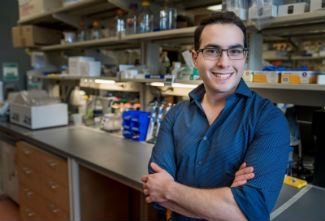
Over the next two years of his dissertation research, Ubadah Sabbagh, a Virginia Tech translational biology, medicine, and health graduate student working at the Fralin Biomedical Research Institute at VTC, will create the first atlas of the vLGN’s cellular and molecular characteristics.
“The vLGN is a remarkably unexplored area of the brain,” said Sabbagh, who is also a Society for Neuroscience Fellow. “To advance our understanding, I’m generating the first comprehensive description of the spatial distribution and molecular signatures of the vLGN’s primary cells. My hope is that by unmasking the landscape of this part of the brain, we will begin to develop a better understanding of the role it plays in processing visual information.”
From there, Sabbagh will use a collection of benign viruses that are engineered to hop across the gaps between neurons, tracing circuits between the eye and the vLGN. This will let him classify the very first cells to receive visual input in this brain region.
To support his research, the National Institutes of Health has awarded Sabbagh a $390,000 Blueprint Diversity Specialized Predoctoral to Postdoctoral Advancement in Neuroscience (D-SPAN) Award. Designed to support outstanding doctoral candidates of underrepresented backgrounds in neuroscience research, D-SPAN was awarded to just 18 students from across the nation in 2018.
Sabbagh’s remaining graduate school tuition, travel to conferences, postdoctoral salary, and research expenses will be covered for the next six years.
“Ubadah is a delightful graduate student to have in our program. He has that rare combination of ambition, passion for science, intellectual curiosity, and a keen desire to change the world through discovery that makes the world a better place,” said Michael Friedlander, executive director of the Fralin Biomedical Research Institute and vice-president for health sciences and technology at Virginia Tech. “The many forms of recognition that he has received are reflective of his hard work and of the exceptional mentorship provided by his dissertation supervisor at the institute, Dr. Michael Fox.”
Late last year, one of Sabbagh’s and Fox’s findings was published in the Journal of Neurochemistry. They discovered the presence of two new populations of perineuronal nets in the vLGN that possess distinct protein markers.
“This is a wonderful award that recognizes Ubadah’s potential as a future scientist and that helps recognize the hard work he has put in, not only to his dissertation research but also to science outreach, advocacy, and education,” Fox said.
Earlier this month, Sabbagh received the inaugural Ben Barres Fellowship presented by Cold Spring Harbor Laboratory. The award, named after the late Stanford professor who was a giant among neuroscientists, recognizes an exceptional graduate student each year.
Sabbagh immigrated to the United States at age 16 when he began to study biology at Longview Community College in Kansas City, Missouri. He earned a bachelor’s degree in biology with an emphasis in bioinformatics at the University of Missouri – Kansas City, where he searched for potential night eating syndrome biomarkers using computational tools. He expects to complete his doctoral degree in 2021.
Using his expertise in the developmental neurobiology of the visual system, Sabbagh hopes to one day obtain a tenure-track position where he can develop therapies to restore vision in diseases of blindness.




 Share
Share

AFP