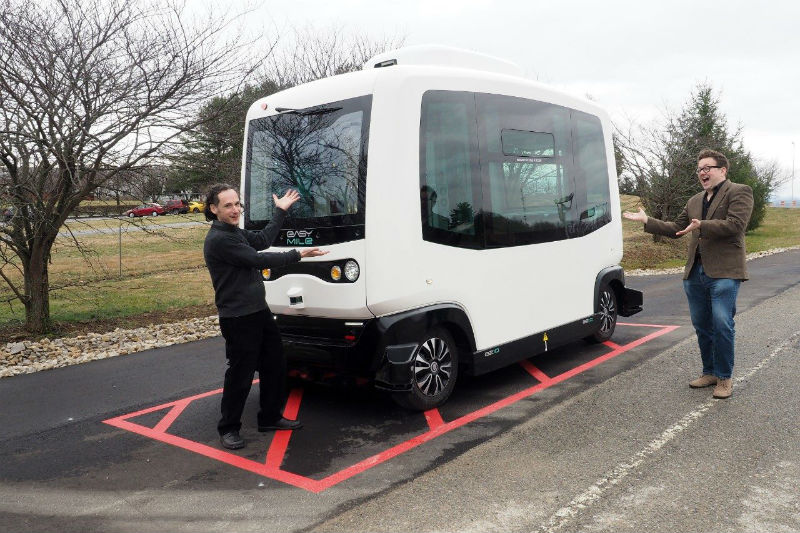
In Blacksburg, drivers ride amid hybrid electric vehicles, gas guzzlers, pickup trucks, and buses. But as a science fiction–like future looms for autonomous-driving automobiles, the Virginia Tech Choices and Challenges Forum is asking what the outlook for self-driving cars will mean to the local community.
In the most common of dreams, mornings begin with an annoying wakeup alarm and harried routines — shower, coffee, a frantic search for keys, the start of an engine. After that, though, the commute might be easy — time for a short snooze, a chance to catch up on news, or an early start to the workday, all courtesy of a self-driving vehicle.
But what are the real issues involved with this new technology? An April 4 forum, “Self-Driving Cars in the New River Valley,” will look at a range of complex issues that both the university and the regional community should consider as automobiles evolve.
“The question for the community is how it might prepare for these technologies,” said Lee Vinsel, an assistant professor in the Department of Science, Technology, and Society at Virginia Tech and a co-director of the forum. “There are many open questions about what kinds of legal and physical changes these cars might require.”
To add breadth to the discussion of such technology topics, the Choices and Challenges Forum — a recently rekindled 30-year-old discussion series — now integrates Virginia Tech’s Destination Areas and Strategic Growth Areas into its content.
“Our goal is to facilitate public dialogue around contemporary and controversial upcoming science and technology issues,” said Saul Halfon, co-director of the forum. “And we plan to do so with a perspective that integrates science and technology into broader ideas, such as how these concepts affect who are we and how we live.”
With self-driving cars often in the news, such a subject seemed a timely pursuit for the forum.
“The media raised the visibility of the cars as both a possibility and as a realm of concerns and problems,” said Halfon, who is also an associate professor of science, technology, and society. “And we as a society have decisions to make around how these cars are regulated and how they should interact with other kinds of transportation.”
Questions abound. Will the cars be privately or publicly owned? Who will have access? What role will the cars play in the larger context of transportation? And what will they mean for people who enjoy driving?
To understand public perception, last year the forum’s planning committee members surveyed people attending Blacksburg’s Steppin’ Out festival. The participants discussed the benefits and drawbacks of autonomous vehicles, along with their hopes and fears about the technology.
From the responses, the committee planned a series of roundtable discussions to answer the many questions that arose. Several of Virginia Tech’s Destination Areas and Strategic Growth Areas — including Intelligent Infrastructure for Human-Centered Communities, Integrated Security, Equity and Social Disparity in the Human Condition, Policy, and Adaptive Brain and Behavior — will each host a session. These topics will range from data security to the impact on vulnerable communities, governance of the technology, accessibility, and infrastructure.
The Department of Science, Technology, and Society will focus on the social and cultural impact.
The Virginia Tech Transportation Institute will open the forum with a plenary meeting to discuss the technical aspects of self-driving cars, while a main panel session will pull all the topics together in a moderated session.
Panelists will include Ronald Arkin, Regents Professor and director of the Mobile Robot Laboratory at Georgia Tech; Giovanni Circella, director of 3 Revolutions Future Mobility Program at the University of California at Davis and a senior research engineer at Georgia Tech; Meredith Broussard, an assistant professor from the Arthur L. Carter Journalism Institute of New York University; and Tabitha Combs, a team member at North Carolina State University’s Institute for Transportation Research and Education.
The forum will culminate in a community dialogue that addresses the unique issues the New River Valley faces. How, as a community, should it regulate, plan, and consider self-driving cars?
Vinsel notes that most previous examinations of autonomous vehicles have focused on how they may affect life in large cities, yet this forum will consider how self-driving cars will affect rural communities.
“It’s important to think about how these technologies fit into all different kinds of localities, not just big cities,” said Vinsel. “In this event, we are starting with a single question: What might these technologies mean for where we live?”
The Choices and Challenges Forum will take place at the Inn at Virginia Tech on April 4 from 1 to 9 pm. Anyone with an interest in the future of autonomous vehicles in the region — and, really, anywhere — is encouraged to attend. No registration is necessary, and the event is free.


 Share
Share

AFP