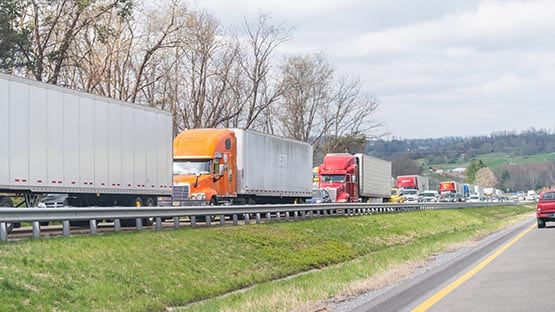
A tractor-trailer passes beneath a highway toll gantry. Several miles later, it passes another. Each system may record a transaction, leaving behind two pieces of information that could become important after a serious accident: where the truck was detected and when. If investigators can verify both timestamps and establish the distance traveled, they may be able to calculate the truck’s average speed between those points.
It’s a surprisingly simple calculation, but one that could add useful evidence to a complicated crash investigation. For Virginia motorists sharing highways with commercial trucks, electronic toll records represent another potential source of information beyond witness statements, police reports, and vehicle data.
What two timestamps can reveal
Average speed is calculated by dividing distance by elapsed time. If a truck travels six miles between two verified detection points in five minutes, its average speed over that interval is 72 mph. The calculation doesn’t require a speedometer reading or an eyewitness estimate, but it does depend on reliable timestamps, an accurate route distance, and confidence that both records concern the same vehicle.
The principle is already used in dedicated average-speed enforcement systems. Victoria, Australia, operates point-to-point speed cameras that measure travel time between locations to determine average speed.
Ordinary tolling infrastructure, however, isn’t necessarily designed for speed enforcement. A toll transaction may record when a vehicle passed a particular point, but the precision of that timestamp, the available location information, and the identification method vary by system. Investigators cannot assume every electronic toll gantry provides the same quality of data as a purpose-built speed camera.
When the numbers challenge a driver’s account
Imagine a tractor-trailer involved in a collision on a tolled highway. The driver reports traveling at approximately the posted speed limit, but investigators later obtain two toll records suggesting the truck covered a known distance faster than that limit would allow. The discrepancy could raise questions about the driver’s account, particularly if other evidence also points toward excessive speed.
Before drawing conclusions, a reconstruction specialist would need to verify that the records identify the correct truck, confirm the route between the gantries, and examine possible timing errors. A truck may have taken an alternate route, and a transponder associated with a trucking company doesn’t necessarily establish who was driving.
An experienced truck accident attorney may seek those records alongside electronic logging device information, dispatch records, vehicle data, and available camera footage. Together, the sources can help investigators build a more complete account of the vehicle’s movements. A toll record might strengthen an allegation of speeding, but it could also reveal that an initial reconstruction relied on an incorrect assumption.
Why average speed isn’t crash speed
The distinction between average speed and speed at impact is one of the most important limitations of this evidence.
A truck averaging 65 mph over several miles might have accelerated above that speed before slowing considerably near the collision. Another truck could spend part of the journey in congestion and then accelerate sharply. Neither average establishes how fast the vehicle was traveling when the crash occurred, whether the driver braked appropriately, or what caused the collision.
The same caution applies when toll records are used to reconstruct a multi-vehicle pileup. Two detections may help establish that particular trucks traveled along a corridor within a certain period, but they don’t reveal every lane change, following distance, or braking maneuver. Even if one truck passed a gantry seconds after another, that alone doesn’t establish which vehicle caused the first impact.
Investigators may need to compare toll records with physical evidence, surveillance footage, witness accounts, and data from the trucks themselves. The value of the timestamps comes from how well they fit with those other sources, not from the calculation alone.
The records may be harder to obtain than expected
Electronic tolling systems identify vehicles through transponders, license plate images, or a combination of technologies. The information they retain is generally collected for billing, account management, and related operational purposes rather than accident reconstruction. As a result, record formats, retention periods, and procedures for releasing information can differ considerably between toll operators.
That creates an unusual challenge after a serious crash. Potentially useful evidence may be held by an organization with no direct involvement in the accident, and obtaining it may require formal legal process. Privacy restrictions can also affect what information is available and who can access it.
Early preservation efforts may help when toll data appears relevant, particularly if routine retention practices could result in records being deleted. The same concern applies to vehicle and fleet information, although investigators must establish what each system actually records before assuming useful data exists.
Another piece of the highway safety puzzle
Modern crash investigations increasingly involve information generated outside the immediate accident scene. A truck’s electronic systems, nearby cameras, dispatch records, and toll transactions may each contribute details that witnesses couldn’t reliably observe.
For Virginia drivers, that makes electronic tolling an interesting part of the broader transportation technology landscape. A routine transaction recorded miles before a collision could help establish a vehicle’s route or provide a useful check on reported travel speeds.
Two timestamps won’t explain every decision a truck driver made before a crash. But when the records are accurate, properly interpreted, and supported by other evidence, they can help investigators understand part of the journey that led to it.
This content is provided for informational purposes only and is not a substitute for professional advice. AFP editorial staff were not involved in the creation of this content.
Support AFP



 Share