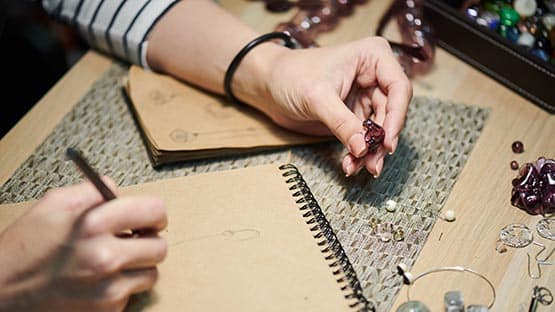
Jewelry is more than an accessory. It can tell a story, celebrate milestones, and showcase individuality in a way that no other wearable can. A custom piece lets you create something that feels uniquely yours rather than following whatever trend happens to be circulating at the moment.
Define the look and feel you want
Before sketching a single design or stepping into a studio, it helps to identify your personal aesthetic. Think about whether you gravitate toward classic silhouettes, clean modern lines, vintage-inspired details, minimalist restraint, or bold statement pieces. There is no wrong answer, but knowing where you land saves a lot of time during the design process.
A practical starting point is your existing wardrobe and the jewelry you already reach for most often. The pieces you wear on a Tuesday afternoon without thinking twice reveal more about your taste than any mood board. Your lifestyle matters too. Someone who works with their hands daily has different practical needs than someone who primarily wears jewelry to evening events. Both are valid, and both lead to different design choices.
Gathering inspiration from multiple sources, including fashion editorials, architecture, nature, and even furniture, gives a designer more to work with. It also helps you put words to preferences you might not have language for yet.
Choose materials that match your personality
Metal choice shapes the entire character of a piece. Gold carries warmth and a sense of heritage. Yellow gold reads as classic and bold, while white gold and rose gold offer softer, more contemporary tones. Platinum is denser, cooler, and exceptionally durable, making it a strong choice for pieces worn daily. Sterling silver is accessible and versatile, though it requires more upkeep over time. Mixed-metal designs have grown considerably in popularity, allowing for a layered, collected look that feels less prescribed.
The global personalized jewelry market was valued at $38.6 billion in 2025 and is projected to reach $81.4 billion by 2034, expanding at a CAGR of 8.7%, driven largely by consumers who want pieces that reflect personal identity rather than off-the-shelf designs. That shift in demand has pushed jewelers to offer a wider range of metal options and finishes than ever before.
Durability and maintenance should factor into the decision alongside aesthetics. A delicate yellow gold band with fine milgrain detailing is beautiful, but it demands more care than a heavier platinum setting. Consider how much attention you are realistically willing to give a piece over the years, and let that inform your metal choice.
Select gemstones with personal meaning
Gemstones carry layers of meaning that go well beyond color. Birthstones connect a piece to a specific person or moment in time. Anniversary stones mark years together. Favorite colors, family heirlooms, or stones tied to cultural traditions all bring depth to a design that a generic setting cannot replicate.
Symbolism matters alongside appearance. Sapphires have long been associated with loyalty and wisdom. Emeralds carry connotations of growth and renewal. Garnets, often overlooked, come in a range of colors far beyond the deep red most people picture. Choosing a stone because of what it means to you, rather than because it is currently fashionable, tends to produce pieces with much longer emotional staying power.
Long-term appeal is worth weighing carefully. Trends in gemstone cuts and settings shift, but a stone chosen for personal significance stays relevant regardless of what is popular in any given season.
Add custom details that tell your story
The details are where a piece moves from well-made to genuinely irreplaceable. Engravings, initials, meaningful dates, family symbols, and unique design elements are the difference between jewelry that could belong to anyone and jewelry that could only belong to you.
Small personalized touches carry more weight than they appear to on paper. A date engraved inside a band. A grandmother’s initial worked into a pendant bail. A motif drawn from a family crest or a place that holds significance. These elements do not need to be large or obvious to be meaningful. In many cases, the most personal details are ones only the wearer knows are there. That’s the whole point.
Some options to consider when adding custom details:
- Engravings: Names, dates, coordinates, short phrases, or handwritten signatures reproduced in metal
- Initials and monograms: Stacked or interlocking letterforms that work as both decoration and identification
- Symbolic motifs: Animals, botanicals, geometric patterns, or cultural symbols with personal resonance
- Hidden details: Interior engravings, small stones set inside a band, or design elements visible only at certain angles
- Family references: Incorporating stones or metal from inherited pieces into a new design
Work with experts to bring your vision to life
Having a clear sense of what you want is a strong starting point. But translating ideas into a wearable, structurally sound piece requires technical knowledge that most people do not have. A skilled designer understands how metals behave under stress, how stone settings affect durability, and how proportions that look right on paper translate to something worn on a hand or around a neck.
Working with experienced jewelry designers can help transform ideas into a wearable piece that balances beauty, functionality, and craftsmanship in ways that are difficult to achieve without professional guidance. The collaborative process also tends to surface possibilities a buyer would not have considered independently. A designer might suggest a setting style that better protects a chosen stone or a metal combination that achieves the tonal balance you were after but could not quite name.
The design consultation
The initial consultation is where the most important groundwork gets laid. Come prepared with reference images, a clear sense of your budget, and an honest description of how and where the piece will be worn. The more context a designer has, the more precisely they can tailor the work.
Reviewing renderings and models
Most studios now produce detailed renderings or 3D models before any metal is cast. This stage is your opportunity to adjust proportions, refine details, and confirm that the design reads the way you imagined. Changes at this point are straightforward. Changes after casting are not.
Create a design you’ll love for years to come
Longevity in jewelry design comes from balancing what feels current with what is genuinely timeless. Certain elements, such as clean lines, quality metal weight, and well-set stones, age gracefully across decades. Others, particularly highly specific trend references, can feel dated within a few years. The gap between those two outcomes is wider than most people expect.
According to the Theore Grace 2026 Jewelry Trends & Insights Report, 72.8% of consumers buy jewelry as a meaningful gift, which points to something worth sitting with: the pieces people value most are the ones tied to emotion and story, not trend cycles. Designing with that in mind from the start produces work that holds its significance over time.
Versatility and comfort are practical considerations that often get overlooked during the excitement of the design phase. A ring that cannot be resized, a necklace too delicate for daily wear, or a bracelet that catches on everything will eventually stop being worn regardless of how beautiful it is. The best custom pieces are ones you reach for without thinking, the ones that feel like a natural extension of who you are.
The takeaway
The most meaningful jewelry reflects both your style and your story. By choosing the right materials, details, and design approach, you can create a piece that remains special long after the occasion that inspired it has passed. Start with what is true to you, work with people who understand the craft, and the result will be something worth wearing every day.
This content is provided for informational purposes only and is not a substitute for professional advice. AFP editorial staff were not involved in the creation of this content.

 Share
Share